Digestive System (Cambridge International IGCSE Biology)
Identifying organs of the digestive system
Spec point —
7.1.2· nan
-
The digestive system is an example of an organ system
-
Some of the digestive system organs make up the alimentary canal; food passes directly through these organs as it moves through the body:
- mouth
- oesophagus
- stomach
- small intestine, including the duodenum and the ileum
- large intestine, including the colon, rectum and anus
-
Some of the organs of the digestive system do not form part of the route travelled by food, but are still involved with digestion; these are the associated organs, or accessory organs, and include the:
- salivary glands
- pancreas
- liver
- gall bladder
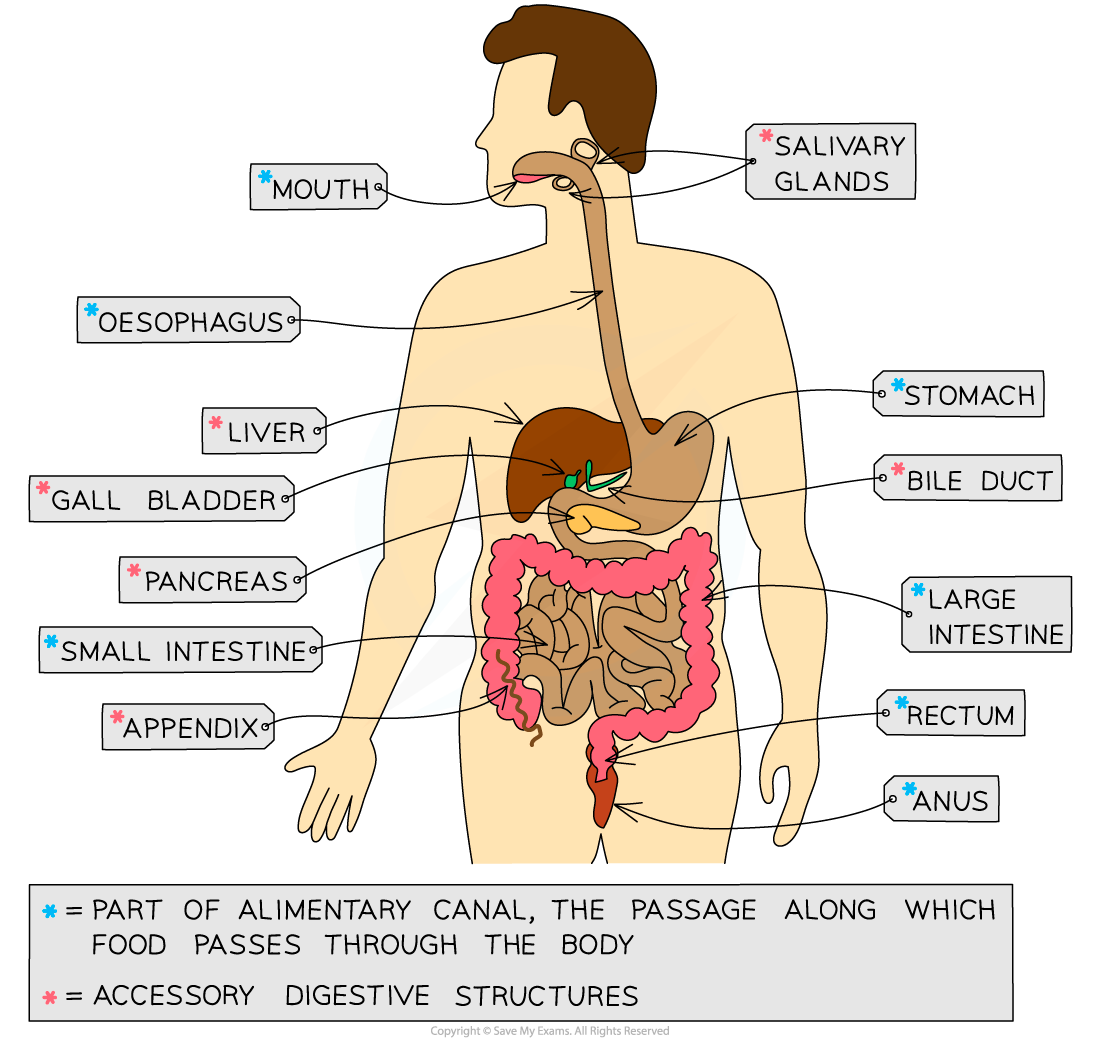
The organs of the human digestive system work together to digest food and absorb nutrients
Organs of the digestive system: function
Spec point —
7.1.2· nan
-
The function of the digestive system is to digest food and absorb nutrients
-
The digestive system carries out its function in several stages:
- ingestion: food and drink are taken into the body through the mouth
- mechanical digestion: food is broken down into smaller pieces without chemical change to the food molecules
- chemical digestion: large, insoluble molecules are broken down into small, soluble molecules
- absorption: small food molecules and ions move through the wall of the intestine into the blood
- egestion: food that has not been digested or absorbed passes out of the body as faeces
-
Once nutrients have been absorbed into the blood by the digestive system they can be assimilated into the body; this occurs when they are taken up by the cells of the body
| Structure | Function |
|---|---|
| Mouth | Food is ingested here and the teeth break it down into smaller pieces during mechanical digestion |
| Salivary glands | Saliva is secreted into the mouth The enzyme amylase in saliva begins to digest starch into maltose Saliva lubricates the food for easy swallowing |
| Oesophagus | This tube connects the mouth to the stomach Contractions of the walls of the oesophagus force the food downwards; this is peristalsis |
| Stomach | Churning of the muscular stomach walls continues the process of mechanical digestion Protease enzymes begin protein digestion Hydrochloric acid provides a suitable pH for the enzymes and also destroys any pathogens in food |
| Liver | Bile is produced here Bile aids the digestion of fats, as well as neutralising stomach acid as it exits the stomach |
| Gall bladder | Bile is stored here before being released into the duodenum via the bile duct |
| Pancreas | Amylase, protease and lipase enzymes are produced here before being released into the duodenum |
| Small intestine: duodenum | Food enters the small intestine from the stomach here The acidic stomach contents are neutralised by bile and become slightly alkaline Enzymes complete chemical digestion here |
| Small intestine: ileum | Food and water are absorbed into the blood via villi in the lining of the ileum |
| Large intestine: colon | Remaining water is absorbed from food into the blood, and the solid waste left behind in the colon forms faeces |
| Large intestine: rectum | Faeces are stored here prior to egestion |
| Large intestine: anus | Faeces leave the body via the anus; this is egestion |
Was this revision note helpful?
Build on this topic