13 markseasy
Solve the equation \left|3 x - 2\right| = 7.
15 questions · 81 marks · ≈ 1 hours
Solve the equation \left|3 x - 2\right| = 7.
Solve the following.
(i) \left|4 x + 3\right| < 9
(ii) \left|2 x\right| + 5 \geq 15
(iii) \left|x + 8\right| = \left|2 x + 10\right|
Solve the equation \left|6 - 2 x\right| = 4.
On the same diagram, sketch the graphs of y = \left|6 - 2 x\right| and . Label the coordinates of the points where the two graphs intersect each other and the coordinate axes.
Consider the graphs of y = \left|6 - 2 x\right| and , where is a constant. For which values of will the two graphs have
(i) no points of intersection,
(ii) one point of intersection,
(iii) two points of intersection?
The graph of y = \text{f} \left(x\right), where \text{f} \left(x\right) = 2 x - 3, is shown below.
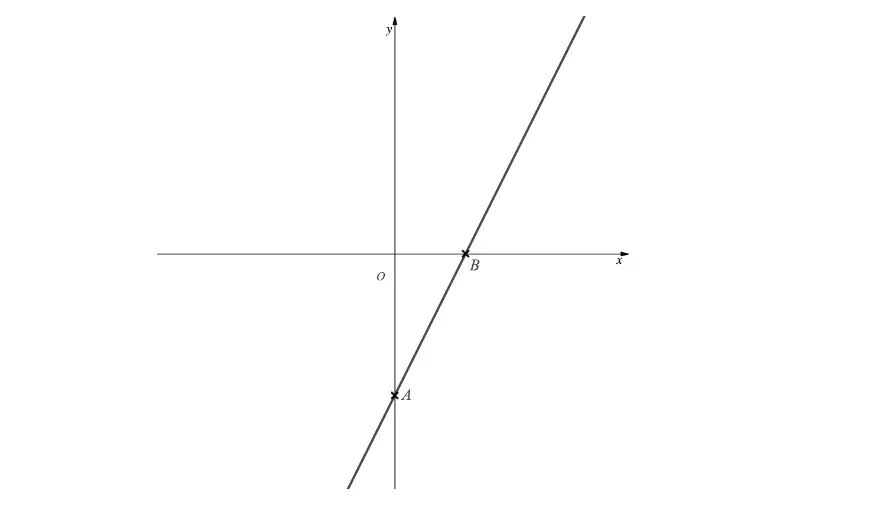
Determine the coordinates of the points marked and .
(i) On the diagram above, sketch the graph of y = \left|\text{f} \left(x - 1\right)\right|.
(ii) Determine the coordinates of the image of the points and under the transformation in part (i).
Solve the equation \left|4 x + 2\right| = 5.
The functions and are defined for all real by \text{f} \left(x\right) = \left( x + 2 \right)^{2} and \text{g} \left(x\right) = 2 x + 4.
On the same axes, sketch the graphs of y = \text{f} \left(x\right) and y = \left|\text{g} \left(x\right)\right|, labelling the points at which the graphs intersect the coordinate axes.
Solve the equation \text{f} \left(x\right) = \left|\text{g} \left(x\right)\right|.
Solve the equation \left|2 x - 3\right| = \left|x + 1\right|.
Solve the inequality \left|3 x + 2\right| \leq \left|x - 4\right|.
Solve the equation \left|x - 4\right| = 2 x - 5.
The graph of y = \text{f} \left(x\right), where \text{f} \left(x\right) = \left|3 x + 1\right|, is shown below.
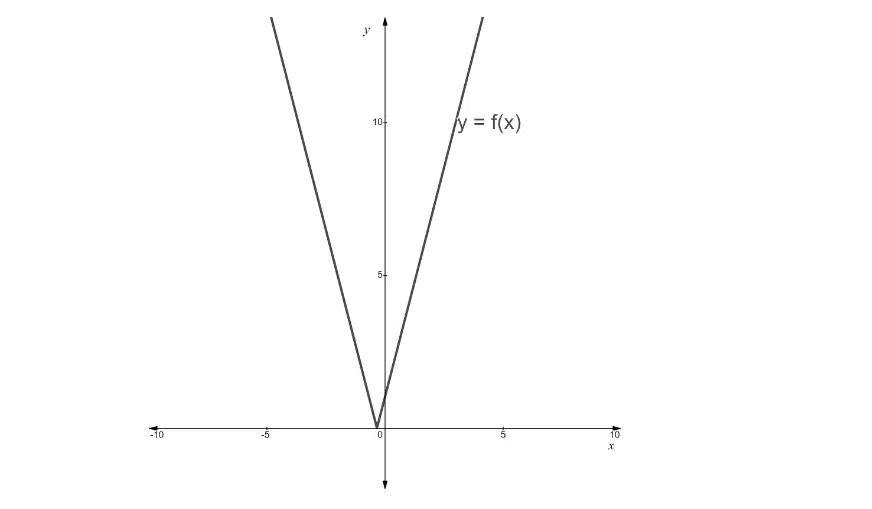
(i) On the diagram above, sketch the graph of y = \left|x - 5\right| and state the coordinates of any points of intersection with y = \text{f} \left(x\right).
(ii) Hence, or otherwise, solve the inequality \left|3 x + 1\right| < \left|x - 5\right|.
The functions and are defined for all real by \text{f} \left(x\right) = 3 x - 1 and \text{g} \left(x\right) = 2 x + 2.
On the same axes, sketch the graphs of y = \left|\text{f} \left(x\right)\right| and y = \left|\text{g} \left(x\right)\right|, labelling the points at which the graphs intersect the coordinate axes.
Solve the equation \left|\text{f} \left(x\right)\right| = \left|\text{g} \left(x\right)\right|.
Which of the solutions to \left|\text{f} \left(x\right)\right| = \left|\text{g} \left(x\right)\right| is also a solution to \text{f} \left(x\right) = \text{g} \left(x\right)?
The function is defined by \text{f} : x \mapsto \left|3 x - 2\right| for .
Explain why the inverse of \text{f} \left(x\right) does not exist.
Suggest an adaptation to the domain of \text{f} \left(x\right) so that its inverse exists, while also producing the maximum possible range for \text{f} \left(x\right).
Using your adaptation from part (b), find an expression for \text{f}^{- 1} \left(x\right) and state its domain and range.
The function is defined by \text{p} \left(x\right) = \left|2 x\right| for .
On the same axes, sketch the graphs of y = \text{p} \left(x\right) and y = \text{p}^{- 1} \left(x\right).
Find an expression for \text{p}^{- 1} \left(x\right) and state its domain.
Show that \text{p}^{- 1} \left(x\right) = - \frac{1}{2} \text{p} \left(- \frac{1}{2} x\right).
The constant is positive. Solve the inequality \left|2 x - a\right| > \left|x + a\right|, giving your answer in terms of .
The functions and are defined by \text{f} \left(x\right) = \sqrt{x} for and \text{g} \left(x\right) = 2 x - 3 for .
On the same axes, sketch the graphs of y = \text{f} \left(x\right) and y = \left|\text{g} \left(x\right)\right|, labelling the points at which the graphs intersect the coordinate axes.
Solve the equation \text{f} \left(x\right) = \left|\text{g} \left(x\right)\right|.
Which of the solutions to \text{f} \left(x\right) = \left|\text{g} \left(x\right)\right| is not a solution to \text{f} \left(x\right) = \text{g} \left(x\right)?