14 markseasy
2 marks
Given
and
find and .
2 marks
Hence, or otherwise, find in terms of .
22 questions · 162 marks · ≈ 3 hours
Given
and
find and .
Hence, or otherwise, find in terms of .
The parametric equations of a curve are
, ,
where .
Find and .
Find an expression for in terms of , and find the gradient of the curve at the point where .
Hence find the equation of the tangent to the curve at the point where .
The parametric equations of a curve are
, ,
where .
Find the coordinates of the point on the curve where .
(i) Find and .
(ii) Hence find in terms of .
Find the coordinates of the stationary point on the curve.
The diagram shows the curve with parametric equations
, ,
for .
The curve is symmetric about the -axis, passes through the origin, and has a cusp at the point .
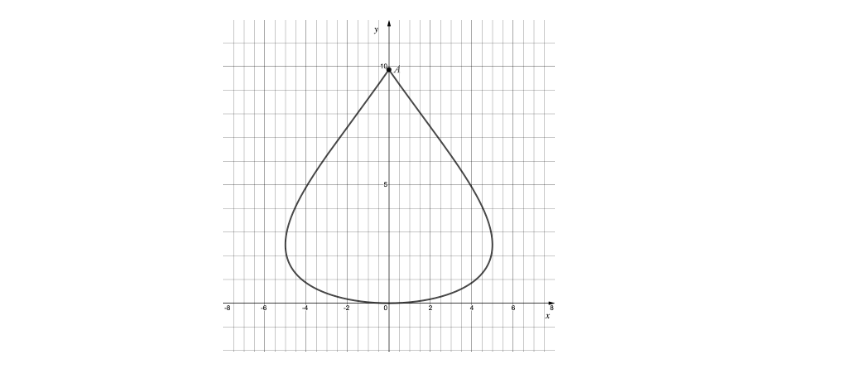
Find the exact coordinates of the point .
(i) Write down the value of at the origin.
(ii) Write down the value of at the points where and .
(i) Find and .
(ii) Hence find an expression for in terms of .
(iii) Find the gradient of the curve at the point where .
The curve has parametric equations
and ,
(i) Find and .
(ii) Hence find in terms of .
(i) Find the gradient of the tangent to at the point \left(4 , 3\right).
(ii) Hence find the equation of the tangent to at the point \left(4 , 3\right).
The curve has parametric equations
and ,
(i) Find and .
(ii) Hence find in terms of .
(i) Find the gradient of the tangent to at the point \left(16 , 7\right).
(ii) Hence find the gradient of the normal to at the point \left(16 , 7\right).
(iii) Find the equation of the normal to at the point \left(16 , 7\right).
The parametric equations of a curve are
, .
Find an expression for in terms of .
The curve passes through the point P \left(1 , 1\right).
(i) Find the value of at the point .
(ii) Find the gradient of the curve at the point .
(iii) State what the value of the gradient tells you about the point .
The parametric equations of a curve are
, ,
for .
Find the -coordinate of the point on the curve where .
Find the minimum value of on the curve.
Find the values of when , giving your answers correct to 1 decimal place.
The diagram shows the curve with parametric equations
, ,
for .
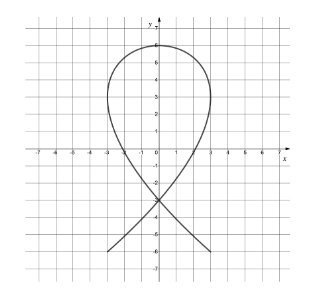
(i) Write down the value of at the point \left(0 , 6\right).
(ii) Write down the value of at the points \left(- 3 , 3\right) and \left(3 , 3\right).
Find an expression for in terms of .
(i) Find the values of , and at the point where .
(ii) Hence show that the equation of the tangent to at the point where is
2 \sqrt{2} x + 3 y - \left(9 \sqrt{3} + 6\right) = 0
The parametric equations of a curve are
, ,
where .
Find an expression, in terms of , for .
(i) Find the gradient of the tangent to at the point \left(8 , 1\right).
(ii) Hence write down the gradient of the normal to at the point \left(8 , 1\right).
(iii) Find the equation of the normal to at the point \left(8 , 1\right).
The parametric equations of a curve are
, .
Find an expression for in terms of .
Verify that the curve passes through the point \left(0 , 1\right), and find the gradient of the curve at that point.
The parametric equations of a curve are
, ,
for .
Find and , and hence find in terms of .
Find the difference between the greatest and least values of .
Find the value of when .
The diagram shows the curve with parametric equations
, ,
for .
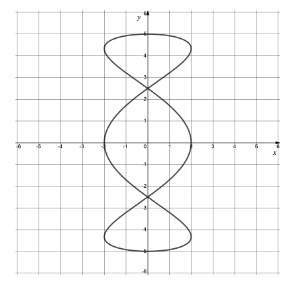
Find an expression for in terms of .
(i) Show that the gradient of the tangent to at the point where is .
(ii) Hence find the equation of the tangent to at the point where .
The parametric equations of a curve are
, ,
where .
Find an expression, in terms of , for .
(i) Find the gradient of the tangent to at the point where .
(ii) Hence find the equation of the normal to at the point where .
The parametric equations of a curve are
, ,
for .
(i) Write down the value of at the point where .
(ii) Find the minimum value of on the curve.
Find the value of at the point where and .
The diagram shows the ellipse with parametric equations
x = 2 \text{cos} \left(\theta + \frac{\pi}{3}\right), ,
for .
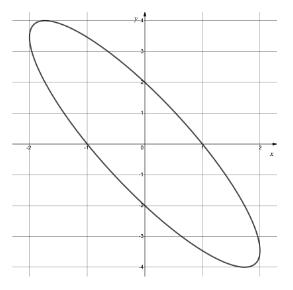
Find an expression for in terms of .
Find the equation of the tangent to at the point where , giving your answer in the form , where and are real numbers that should be given in exact form.
The parametric equations of a curve are
, .
Show that at the point \left(0 , 6\right), and find the value of at this point.
The tangent at the point \left(0 , 6\right) is parallel to the normal at the point .
Find the exact coordinates of the point .
The parametric equations of a curve are
, ,
where .
Show that, in terms of ,
Show that the distance between the maximum and minimum points on is units.
The diagram shows the curve with parametric equations
, .
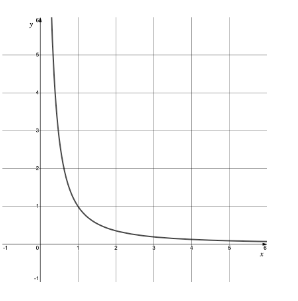
(i) Verify that the curve passes through the point \left(1 , 1\right).
(ii) Show that the line with equation is not the normal to the curve at the point \left(1 , 1\right).
The parametric equations of a curve are
, ,
where .
Find the equation of the normal to at the point where intersects the line .
The diagram shows the curve with parametric equations
, .
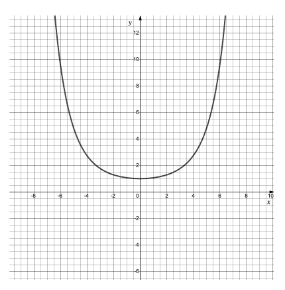
The tangents to the curve that pass through the origin meet the curve at the points and .
Show that the values of at and are and .
Hence, or otherwise, show that the area of the triangle is square units.
The parametric equations of a curve are
, .
The tangents to at the points and meet at the point , as shown in the diagram.
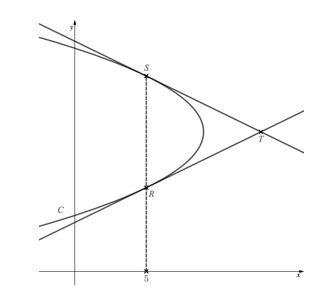
Given that the -coordinate of both and is 5, find the area of the triangle .