15 markseasy
(i) Write down the exact value of .
(ii) Write down the exact value of .
(iii) Use the compound angle formula for to find the exact value of .
(iv) Hence show that .
42 questions · 235 marks · ≈ 4 hours
(i) Write down the exact value of .
(ii) Write down the exact value of .
(iii) Use the compound angle formula for to find the exact value of .
(iv) Hence show that .
Express in terms of sines and cosines of and .
Hence show that
Starting with the identity
and using the substitution , show that .
Hence show that .
Use an appropriate identity to find in terms of sines and cosines of and .
Hence show that .
Solve the equation
for .
Solve the equation
for .
Show that
5 \; \text{cos}\left(\theta - \dfrac{\pi}{6}\right) \equiv \dfrac{5\sqrt{3}}{2} \; \text{cos} \; \theta + \dfrac{5}{2} \; \text{sin} \; \theta
Show that
Sketch the graph of for , showing the coordinates of the points of intersection with the axes.
Use the difference of two squares to show that
Hence solve the equation
for .
The alternating voltage, , in an electrical circuit, seconds after it is switched on, is modelled by the function
Use the identity to show that
can be written as
40 \; \text{cos}\left(\pi t - \dfrac{\pi}{3}\right)
(i) Write down the maximum voltage in the electrical circuit.
(ii) Find the voltage at time .
(iii) Find the voltage after two seconds.
After how many seconds does the voltage first equal volts?
Express in terms of and .
Hence show that .
Starting with the identity
and using the substitution , show that .
Hence, or otherwise, show that .
Using an appropriate trigonometric identity, show that
where and are constants.
Hence show that .
By using an appropriate double angle formula, solve the equation
for .
By using an appropriate double angle formula, solve the equation
for .
Show that
for .
(i) Show that , where and are constants.
(ii) Use your result from part (i) to show that \text{cos} \; x - \sqrt{3} \; \text{sin} \; x \equiv 2 \; \text{cos}\left(x + \dfrac{\pi}{3}\right).
Hence solve the equation for .
Using the identities
and
show that .
Hence, or otherwise, solve the equation
for .
Show that can be written in the form , where and .
Sketch the graph of for , showing the coordinates of the points of intersection with the axes.
Show that
The alternating voltage, , in an electrical circuit, seconds after it is switched on, is modelled by the function
Show that
can be written as
R \; \text{sin}\left(\dfrac{\pi t}{30} + \alpha\right)
where and .
(i) Find the voltage at time .
(ii) Find the voltage after one minute.
After how many seconds does the voltage first equal volts?
(i) Show that , where and are constants with and .
(ii) Use your result from part (i) to show that \sqrt{3} \; \text{sin} \; \theta + \text{cos} \; \theta \equiv 2 \; \text{sin}\left(\theta + \dfrac{\pi}{6}\right).
Write down the maximum value of .
If , then
By using a suitable counter-example with , show that does not hold for all values of and .
Express in terms of cosines and sines of and .
Hence show that .
Show that
You may use the identity .
Show that can be written in the form , where and are constants with and .
Give in the form , where is an integer, and give correct to three decimal places.
Show that can be written as , where correct to three decimal places.
Hence solve the equation
for , giving your answers correct to 3 significant figures.
The alternating voltage, , in an electrical circuit, seconds after it is switched on, is modelled by the function
V = 55\sqrt{2}\left(\text{sin} \; \dfrac{\pi t}{60} + \text{cos} \; \dfrac{\pi t}{60}\right)
Express
55\sqrt{2}\left(\text{sin} \; \dfrac{\pi t}{60} + \text{cos} \; \dfrac{\pi t}{60}\right)
in the form
R \; \text{sin}\left(\dfrac{\pi t}{60} + \alpha\right)
where and are constants to be found, with and acute.
Find the voltage when the circuit is switched on.
(i) Write down the maximum voltage and the time at which this first occurs.
(ii) Find the time it takes the voltage to complete one period.
Solve the equation
for .
Solve the equation
for .
Show that
for A, \; B \neq \left(k + \dfrac{1}{2}\right)\pi.
By letting , use the identity for to derive an expression for in terms of .
Hence, or otherwise, solve the equation
for .
Sketch the graph of y = 2\left(\text{sin} \; x - \text{cos} \; x\right) for .
Label any points where the graph intercepts the coordinate axes, and state the coordinates of any maximum and minimum points.
Show that
for .
(i) Show that does not hold for all values of and .
(ii) Find values for and , with and , for which the statement does hold.
Use the identities
to show that
Hence show that .
Show that
State clearly any trigonometric identities you use to show this result.
Given that , where and are positive constants, is to be written in the form , find expressions for:
(i) in terms of and
(ii) in terms of and
Solve the equation
for .
Solve the equation
for .
Show that
The diagram below shows two right-angled triangles. Angles and have been labelled.
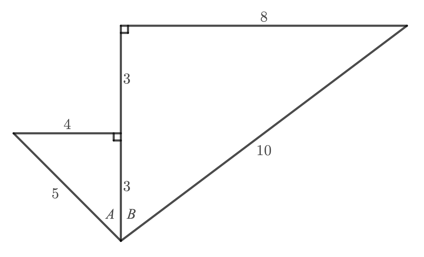
Given that , find the exact values of , and .
The alternating voltage, , in a domestic electrical circuit, seconds after it is switched on, is modelled by the function
Express
in the form
where and are constants to be found, with and acute.
In the UK, domestic electricity runs at a frequency, , of 50 Hertz (Hz). The constant is given by .
(i) Find the initial voltage when a domestic appliance, such as a kettle or a television, is switched on.
(ii) Find the time at which the voltage first turns negative.
(i) Find the period of one cycle of voltage in the UK.
(ii) In the US, the period of one cycle is seconds. Write down the frequency of US domestic electricity.
Show that can be written in the form , where and radians correct to three decimal places.
Use your result from part (a), and the properties of the sine and cosine functions, to solve the equation
for , giving your answers correct to 3 significant figures.
Use an identity for to derive an identity for , in terms of .
Hence, or otherwise, solve the equation
for , giving your answers correct to 3 significant figures.