Quadratic symmetry
Excerpt: Are all quadratic graphs symmetrical? Students are asked to come up with a convincing argument to answer this question.
Problem
Are all quadratic graphs symmetrical?
Take a look at the graph below.
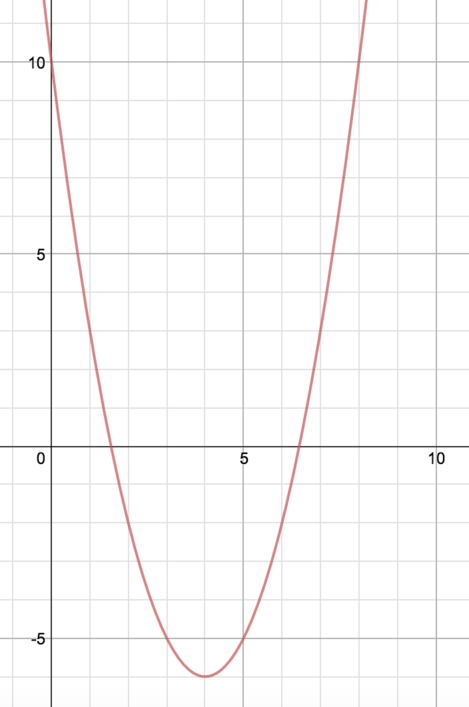
The equation of this graph is
Is this graph symmetrical? Are you convinced? How can you convince someone else?
Suggestion
How would you define symmetrical in this context?
If the graph has a line of symmetry, what is it? How can we use this idea?
Does the graph look similar to any other graph you know? How can we use this idea?
Solution
Approach 1
It looks like the graph has a line of symmetry with equation .
If we can show that each point on the curve has a mirror image about the line , then we will be correct.
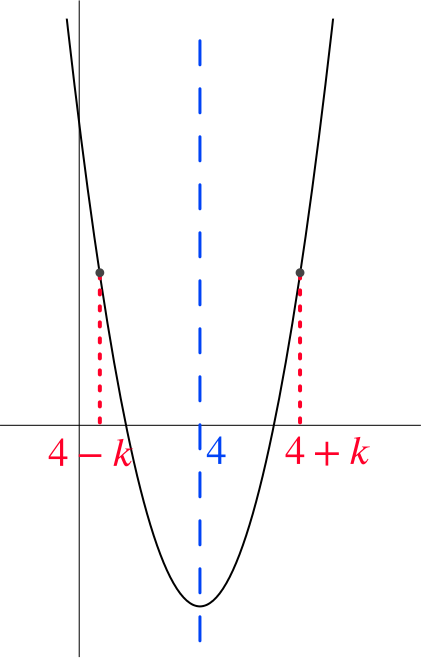
Let’s choose coordinates such that they are equidistant from the line , e.g. and .
When , .
When , .
The coordinates are equal. This shows we are correct and the graph is symmetrical about the line .
Alternatively, we can perform the same calculation with the completed square form. What do you notice?
By completing the square, we have . From this, we can see the coordinates of two points equidistant from must be the same and the quadratic graph is symmetrical about the line .
Completed square form approach
What did we do in this approach? We made a conjecture (an educated guess) and then went on to prove that this was correct. This is a fundamental process in doing mathematics.
Approach 2
It looks like the graph of has the same shape as but is in a different position.
If we can show that is symmetrical and we can translate the graph to , then we have shown that is symmetrical. We do this in two steps.
Step 1: Show that the graph is symmetrical about the axis.
When , .
When , .
By a similar argument to Approach 1 above, the graph of is symmetrical about the axis.
Note: A function where for all is called an even function and is symmetrical about the axis. There is more on this topic in Odd or even or ….
Step 2: Rewrite as a translation of .
By completing the square, we have which is a translation of the graph by . The line of symmetry is therefore translated to and the vertex is translated to ().
Therefore the graph is symmetrical.
How do these approaches compare?
Which is the more easily generalised?
How would these approaches help us to consider whether all quadratics are symmmetrical?