Discriminating - teacher support
Excerpt: Detailed notes for Discriminating, produced as part of an ongoing research project in collaboration with teachers.
Outline
These notes are intended to be read in conjunction with the resource files for the main task, Discriminating, including the teacher notes and solution.
These notes have been produced as part of a research project in collaboration with colleagues at the University of Cambridge, Faculty of Education. We are researching how teacher notes and video clips can support teachers to use Underground Mathematics resources.
In these notes you will find
- Suggestions of how the main task, Discriminating, could be used, indications of mathematical behaviour to look out for and reflection questions to draw together ideas.
- Details of opportunities for learning in the main task, including identifying big ideas, connections, common issues and misconceptions. We also suggest questions and prompts that you could use to raise awareness of these while students work on the main task.
- Suggestions of preliminary and follow-up tasks for the main task.
- Sample student work
For more information on this project please e-mail us.
About these notes
Resource outline
Discriminating consists of several statements about the number of solutions of a quadratic equation. Students are asked to decide whether MUST, MAY or CAN’T is the correct choice of word within the statement. The statements are available as cards to be cut up and sorted according to which word should be used. Some cards may be simpler when tackled with an algebraic approach, whereas others may be more suited to a graphical approach.
Discriminating can be used to consolidate understanding of the discriminant and make connections between graphs and algebra. Students are required to justify their arguments by giving proofs or examples as appropriate. There’s the potential for some quite subtle thinking here.
Introducing the task and suggested ways of working
If possible, provide mini-whiteboards to help encourage graph sketching.
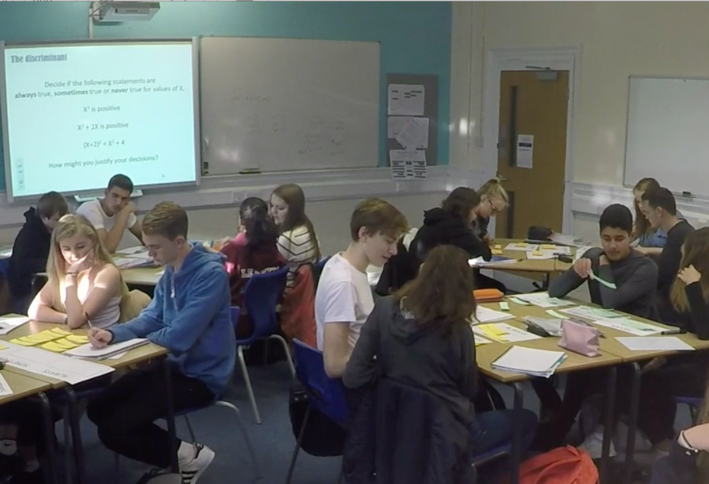
Allow individual thinking time at the start of the activity for students to think about one or two cards. To help process the statements on the cards, students could think of examples that satisfy the first part of the statement (not cards 6, 8, or 11) and then think about which is the correct word for the special case of their examples. Note that students will need to recognize the distinction between these examples and the general results.
In pairs, students should sort the cards into ‘MUST’, ‘MAY’, ‘CAN’T’ and ‘Unsure’ piles, and record their reasoning. Pairs could then compare and contrast solutions and approaches.
After several cards have been sorted, ask students to write down their argument for at least one card in each of the MUST, MAY and CAN’T piles, or present their arguments to each other. How can they use sketches to support their arguments? They should think about what makes a convincing argument – a general proof or specific example. The interactive graph in the resource could be used to support discussion.
As an alternative the statements could be used as a sequence of problems over a series of lessons.
- Using the discriminant to justify the choice of MUST, MAY or CAN’T.
- Distinguishing between a proof, an example and a counter-example.
- Generalising from sketches and concrete examples to general cases, e.g. “This would be also true for any positive .”
- Exploring through variation and finding limiting cases, e.g. “This MUST be true as gets bigger, but not if goes below …”
Mathematical behaviour to look out for
- What strategies have you used?
- If you used algebra, could you have used a graph? If you used a graph, could you have used algebra?
- Were any cards surprising?
- What features of quadratics have you not used to solve this problem?
- Could you make up a further card for each of ‘MUST’, ‘MAY’ and ‘CAN’T’?
- What can you do well in this topic? What do you need to think about?
Reflection questions
Prerequisites
The discriminant, manipulating inequalities, sketching quadratics.
Skills involved in this task
Calculating the discriminant, relating roots of a quadratic to the coefficients in the equation, completing the square, manipulating inequalities, sketching curves, graph transformations, reasoning and deduction, proving results, generating examples.
Opportunites for learning
Here are some prompts and suggestions for questions you could use to raise awareness of the overarching ideas, connections, common issues and misconceptions in this resource.
| Overarching ideas in this resource | Questions teacher could ask |
|---|---|
| Generalising [and specialising] | Can you try some values or find particular examples? (If students sketch graphs.) Can you think of specific examples with similar sketch graphs? |
| Conjecturing, logic, proof | What have you assumed? How can you decide between MUST/MAY/CAN’T? How can you demonstrate truth/otherwise in general? When is it enough to give an example? |
| Talking about mathematics | Have you convinced someone else? Have you asked someone to convince you of their ideas? |
| Visualising | What does the graph look like? How are the discriminant and the roots connected? What happens to the graph if you change the sign of ? What is the effect of increasing or decreasing ? |
Overarching ideas
| Making connections | Questions teacher could ask |
|---|---|
| Quadratics and the discriminant | How can we tell if a quadratic has a solution? |
| Algebraic and graphical representations | How could we show this on a graph? What is another quadratic that has a similar graph to this? |
| Links between , , and the graphs | What are the key features of the graph of a quadratic? What do the coefficients tell us about the curve? |
| Quadratic inequalities | How could we show this on a graph? What happens if you complete the square? |
| Link to complex numbers | What happens if the discriminant is negative? |
| Graph transformations | Card 3: Why does the new equation have two roots? Why does move the graph up/down? |
| Symmetry | What if you replace by in the equation or discriminant? What happens if you swap and ? |
Opportunities for making connections
| Common issues or misconceptions | How might these be revealed? | Teacher input |
|---|---|---|
| No idea where to start. | Not being able to process the statements on the cards. Asking “What are , , and ?” | Ask students to work with specific examples which satisfy the first part of a statement. Can you tell how many roots a quadratic has without solving it? |
| What is a proof? How do you prove something? | Examples given as proofs. | Can you generalise your example? What would happen if…? Can you vary the example to make it fail? |
| What and mean and how to solve inequalities. | Try positive and negative values for , , and | |
| What roots are and the link with -intercepts. | “What is a root?” | Use of graphing software. “What do you notice about this graph?” |
| Thinking a change in only translates horizontally. | Compare graphs, e.g. and | |
| Assuming is always negative. | Card 8: Unable to work with | Look at the graphs of or . What do you notice if you change the sign of ? |
| Thinking only has one root. | Card 5 | What is |
| Square rooting negative values, calculator mistakes. | Getting error message | Talk through the steps. Look at the graph. |
| Thinking has real solutions. | What happens if you substitute your solutions in? | |
| Limited examples used. | Examples all U-shaped/have or all crossing -axis | What does look like? What about or ? Try to sketch graphs of your algebraic examples. |
Common issues and misconceptions
Preliminary and Follow-up tasks
Preliminary task
These alternative options for a preliminary task could be used in a lesson a few days before the main task, or set as homework. The purpose of the preliminary task is to
- remind students of certain ideas or skills related to the main task so that they do not become an artificial barrier in the main task, and
- help to inform the way you use the main task by assessing students’ familiarity or confidence with these ideas or skills.
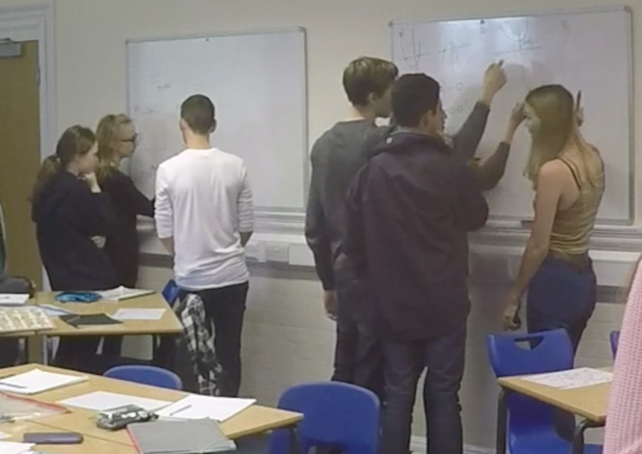
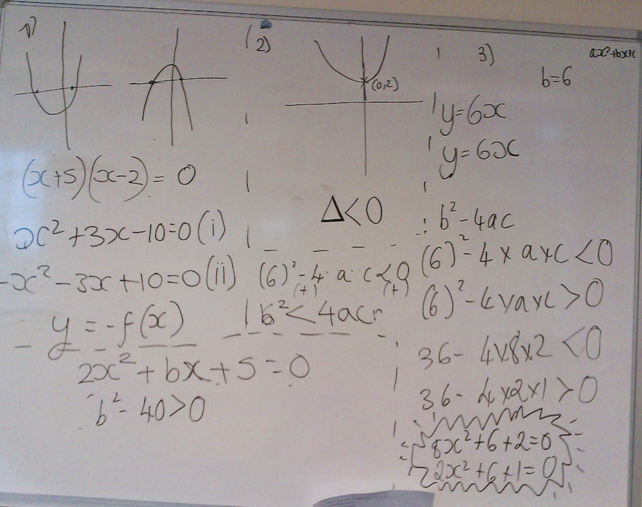
Students could use mini-whiteboards in this task. The option to sketch is suggested to encourage all students to participate even if they struggle to suggest equations. Students can add equations to their sketches as ideas emerge through discussion.
- Sketch or give equations of two quadratics that have and as roots. What can you say about the coefficients in each case?
- Sketch or give an equation of a quadratic with no real roots. What is the value of the discriminant? Can you change one coefficient to give an equation with real roots?
- Give two quadratics where the coefficient of is but the equations have different numbers of solutions.
- If and , what can you say about if has two distinct real solutions? What if instead?
An interactive graph has been provided to support discussion of these ideas and connections between algebraic and graphical representations. As well as these questions, students could test their intuition by thinking about what happens to the roots if you vary , , or ?
Option 1 - Give me an example of…
Use Desmos or GeoGebra to investigate the effects on the graph and discriminant of a quadratic by changing coefficients using sliders. See the interactive in the resource.
Option 2 - Investigation: roots and coefficients
Follow-up task
These could be used a few days after the main task to provide an opportunity to revisit key ideas from the main task.
Students add extra cards to Discriminating to try to challenge each other. They should include a written solution for each card they produce.
Option 1 - Extending Discriminating
The resource Proving the quadratic formula asks students to order the steps in a derivation of the quadratic formula. To help build on ideas from the main task, students should focus on the following points
- Why does the discriminant determine the nature of the roots?
- Compare the steps in the proof with the statements on the discriminating cards. Does this help to explain the choice of MUST/MAY/CAN’T?
Option 2 - Proving the quadratic formula
Can we find the tangents to a circle from a point?
Prove that the line will touch the circle if . Hence or otherwise find equations of the two tangents to this circle from the point
Option 3 - Review question
We have suggested these preliminary and follow-up tasks as part of a sequence of teaching, but they are intended to be used flexibly. For example, you may prefer to use one of our suggested preliminary tasks as a follow-up task, or vice versa.
Sample work
This sample work is provided to help prompt discussion and encourage students to reflect on alternative approaches.
Please note that to give you more flexibility in how you use the sample work, there is an extra printable copy without questions.
Card 1
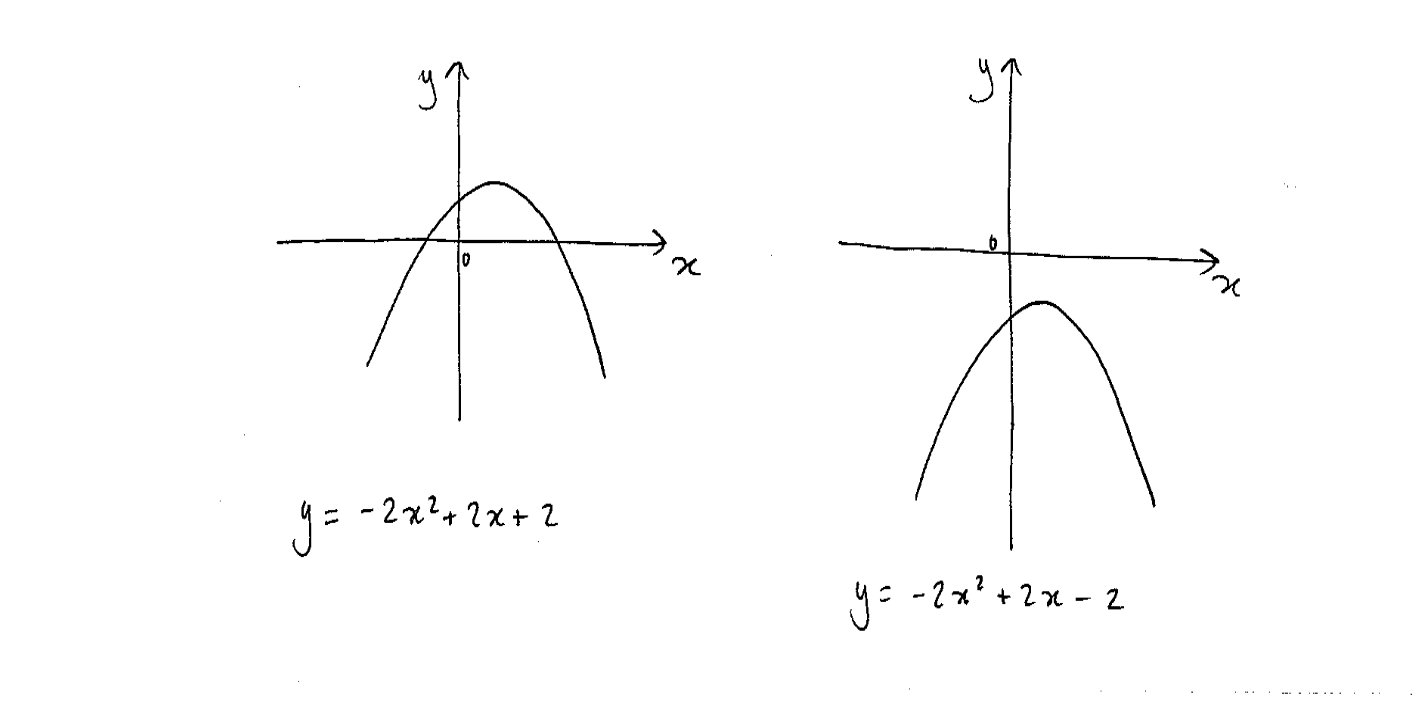
- What do these graphs tell you about the statement on card 1?
- What do these examples tell you about the statement on card 3?
Questions
Card 3
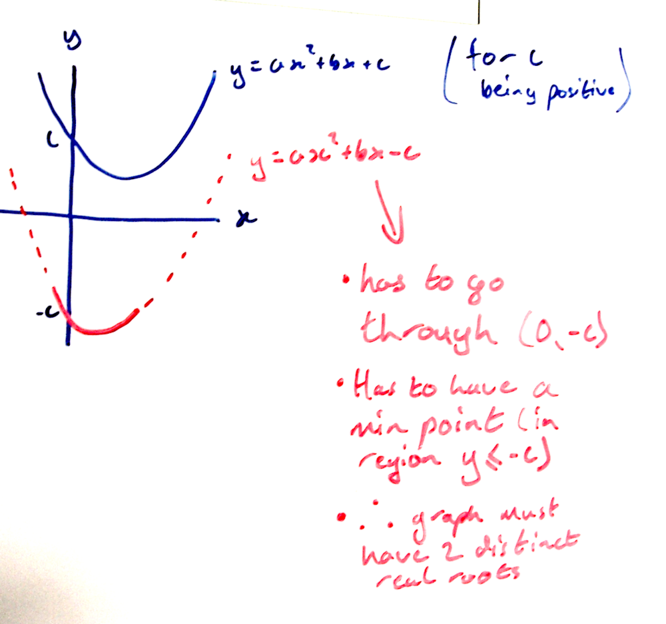
- Are there any other cases to be considered?
- Can you use the discriminant to explain what you see in these graphs?
Questions
Card 4
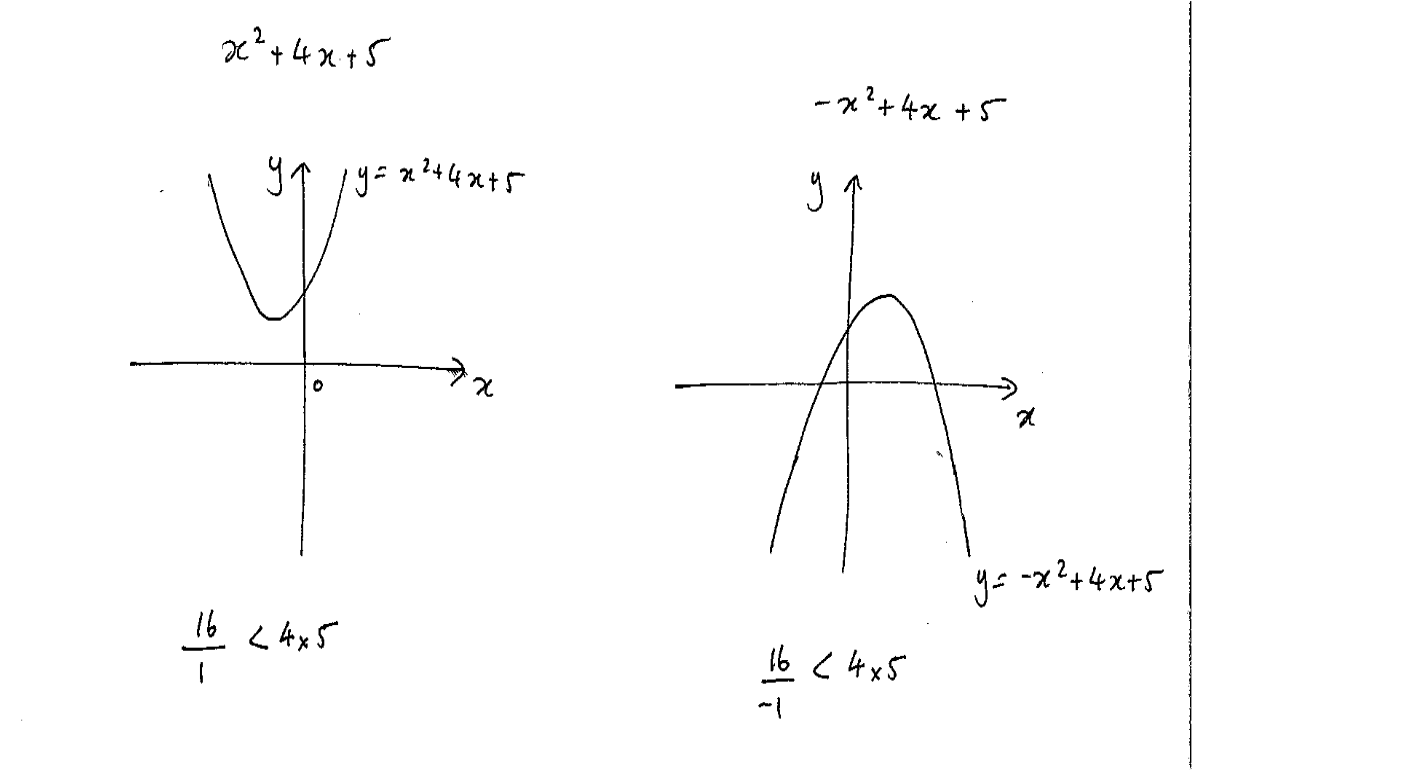
- Based on these examples, would you choose MUST, MAY or CAN’T for this statement?
- Can you relate this to the discriminant?
- Why has this student chosen two examples?
Questions
Card 5
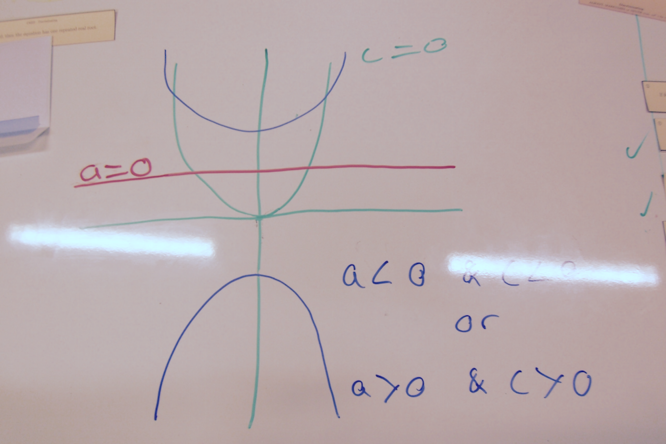
- What do these graphs tell you about the statement on card 5?
Questions
Card 7
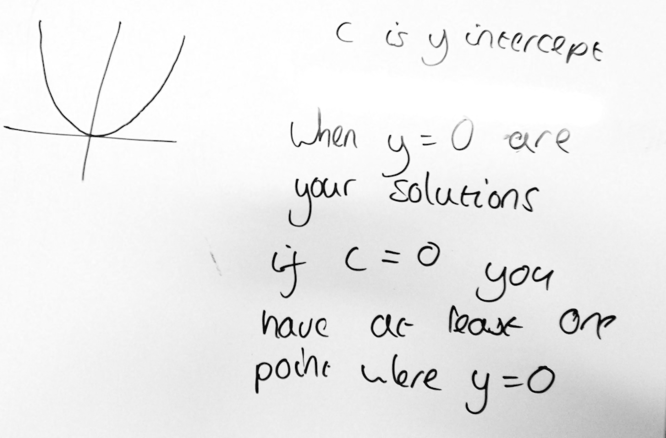
- Try to explain the connection between graph and the written argument. How could you suggest the student makes this clearer?
- What are the solutions of if ?
Questions
Card 8
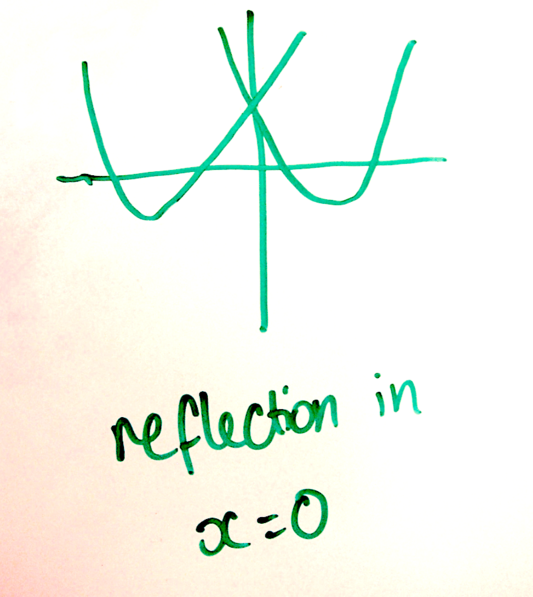
- Has this student considered a general example or a special case?
- How could you use this idea to give a convincing argument for this card?
Questions
Card 9
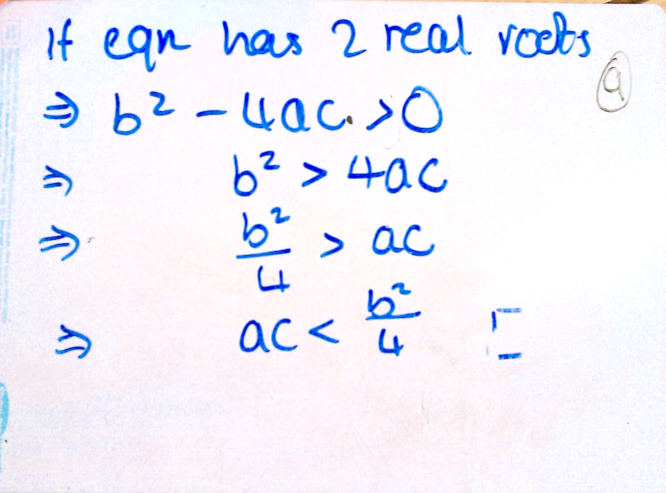
- What other inequalities can you obtain from ?
Questions
Card 11
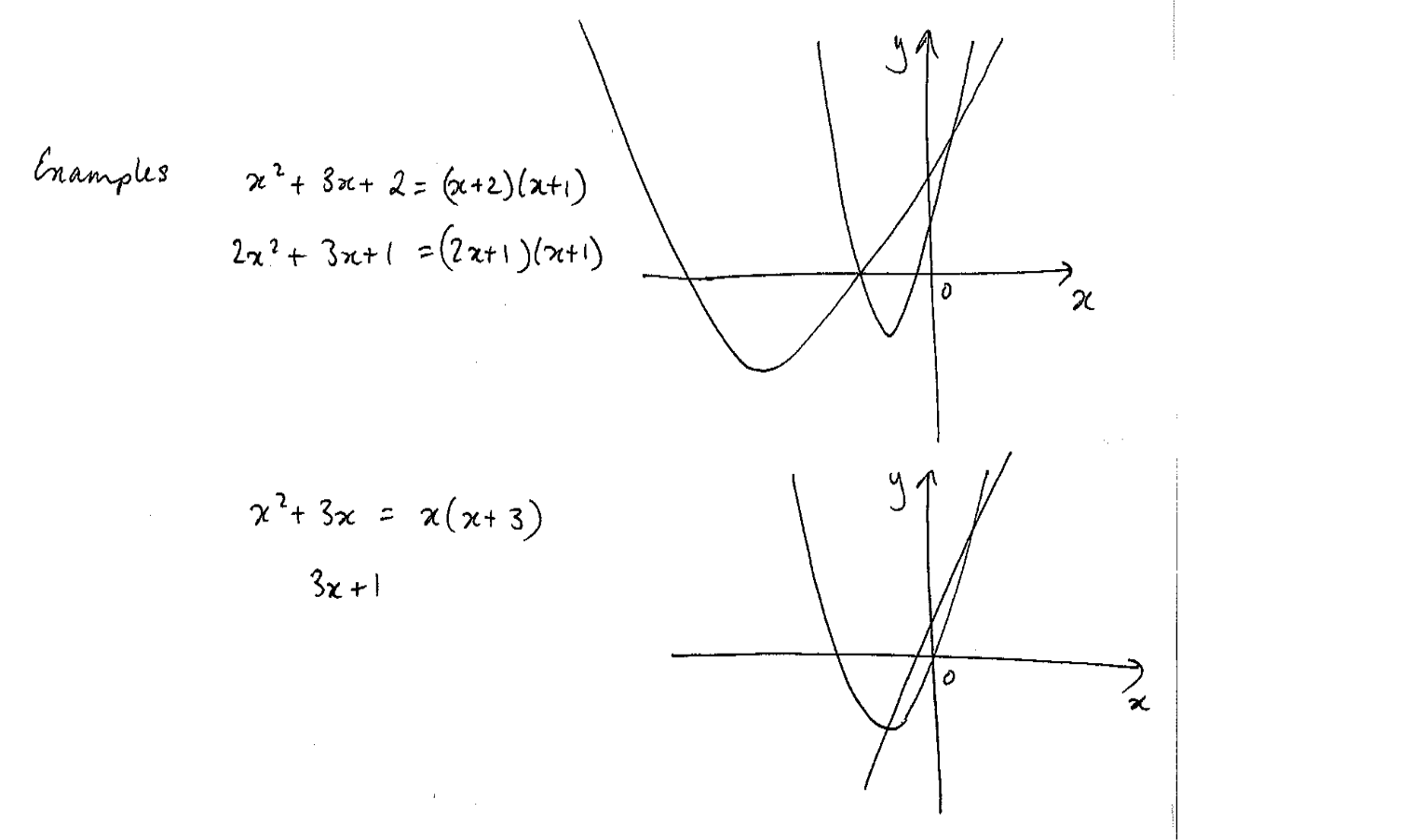
- What do these examples show?
- How could you modify the statement on card 11 so the two equations must have the same number of solutions?
Questions
Card 12
“Because they’ve all been turned to negatives, the will still be a positive, but you times the and together to make a positive and times that by and then it’s a positive, minus negative times negative which makes negative.” Explanation by Student 1
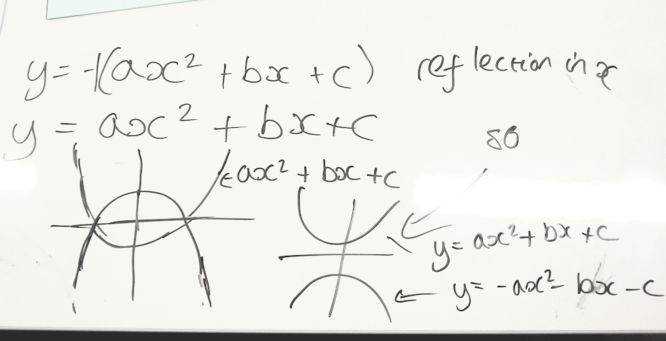
Work by Student 2
- What do you think student 1 and student 2 are trying to communicate?
- What advice would you give them to help improve their solutions?
Questions