13 markseasy
Expand and simplify
(i)
(ii)
(iii)
45 questions · 193 marks · ≈ 3 hours
Expand and simplify
(i)
(ii)
(iii)
Factorise
(i)
(ii)
(iii)
Complete the square for
(i)
(ii)
(iii)
Sketch the graph of , labelling any points where the graph intercepts the coordinate axes.
(i) Write down the -axis intercept on the graph of .
(ii) Find the roots of .
Sketch the graph of , labelling all points where the graph crosses the coordinate axes.
The function has two distinct real roots.
Show that .
Solve
(i)
(ii)
(iii)
The function has no real roots.
Show that .
Write down the value of the discriminant of
(i)
(ii)
(iii)
Write in the form , where and are constants to be found.
Hence write down the minimum point on the graph of .
Without showing it algebraically, explain how you know that the function has a discriminant of zero.
Find the minimum value of the function f \left( x \right) = x^{2} + 4x + 5.
Hence, or otherwise, show that the function f \left( x \right) = x^{2} + 4x + 5 has no real roots.
The function has two distinct real roots.
Show that .
Find the set of values of for which the equation has real roots.
The equation has no real roots. Show that .
The diagram below shows the graph of y = f \left( x \right), where f \left( x \right) is a quadratic function. The intercepts with the x-axis and the turning point have been labelled.
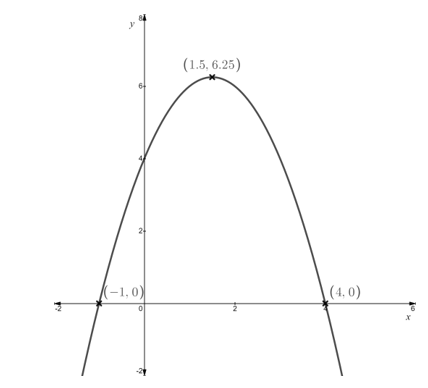
Sketch the graph of y = f \left( x + 2 \right), stating the coordinates of any points that intersect the x-axis and the coordinates of the turning point.
(i) Find the roots of the function .
(ii) Write down the -axis intercept on the graph of .
(i) Write in the form , where and are constants to be found.
(ii) Hence write down the coordinates of the turning point on the graph of .
Sketch the graph of , labelling all points where the graph intercepts the coordinate axes and the turning point.
The curve C has equation .
Find the coordinates of any points where C intersects the coordinate axes.
Sketch the graph of C, showing clearly all points of intersection with the coordinate axes.
Solve the equation .
Write the quadratic function in the form where a, b and c are integers to be found.
Write down the minimum point on the graph of .
Sketch the graph of , clearly labelling the minimum point and any point where the graph intersects the coordinate axes.
Solve .
Solve the equation .
Find the coordinates of the turning point on the graph of .
Sketch the graph of , labelling the turning point and any points where the graph crosses the coordinate axes.
Write the quadratic function in the form where a, b and c are integers to be found.
Write down the minimum point on the graph of .
Sketch the graph of , clearly labelling the minimum point and any point where the graph intersects the coordinate axes.
The curve C has equation . The line l has equation .
Find any points of intersection between C and l.
Sketch the graphs of C and l, showing clearly any points of intersection with the coordinate axes for both graphs, the minimum point of C and any points of intersection found between C and l.
The equation of a curve is , where and are constants.
Given that the equation has no real roots, show that .
Given that the curve passes through and , find the values of and .
The equation has two distinct real roots, where k is a negative constant.
Find the set of values of k.
In the case sketch the graph of , labelling all points where the graph crosses the coordinate axes.
The function f is defined by f \left( x \right) = x^{2} + 4x + c.
Find the minimum value of f \left( x \right), giving your answer in terms of c.
Given that , hence, or otherwise, show that the equation f \left( x \right) = 0 has no real roots.
Sketch the graph of , labelling any points where the graph crosses the coordinate axes. (You do not need to label the turning point.)
The functions f and g are defined by f \left( x \right) = kx^{2} + 2kx - 3 and g \left( x \right) = kx^{2} + 4kx - 16, where k is a constant.
The equation f \left( x \right) = 0 has two distinct real roots and the equation g \left( x \right) = 0 has no real roots.
Find the set of values of k.
The graph below shows the curve y = f \left( x \right) where f \left( x \right) = 5 - \dfrac{x^{2}}{6}.
The curve is used as the model for the arch on a bridge, where the water level under the bridge is represented by the x-axis. All measurements are in metres.
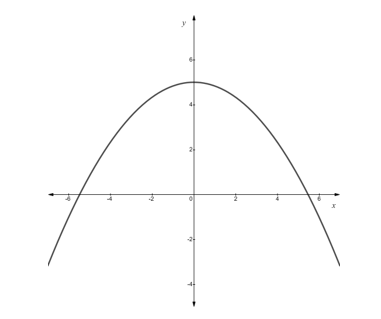
Write down the maximum height of the bridge above the water.
Determine whether the bridge is wide enough to span a river of width 11 m, justifying your answer.
A second bridge is modelled by the curve y = f \left( x \right) where f \left( x \right) = 4 - \dfrac{x^{2}}{8}. To support the bridge the arch will continue 2 m under the water (ground) level.
Find the distance between the base of the arch on either side of the river.
The diagram below shows the graph of y = f \left( x \right), where f \left( x \right) is a quadratic function. The intercepts with the coordinate axes and the turning point have been labelled.
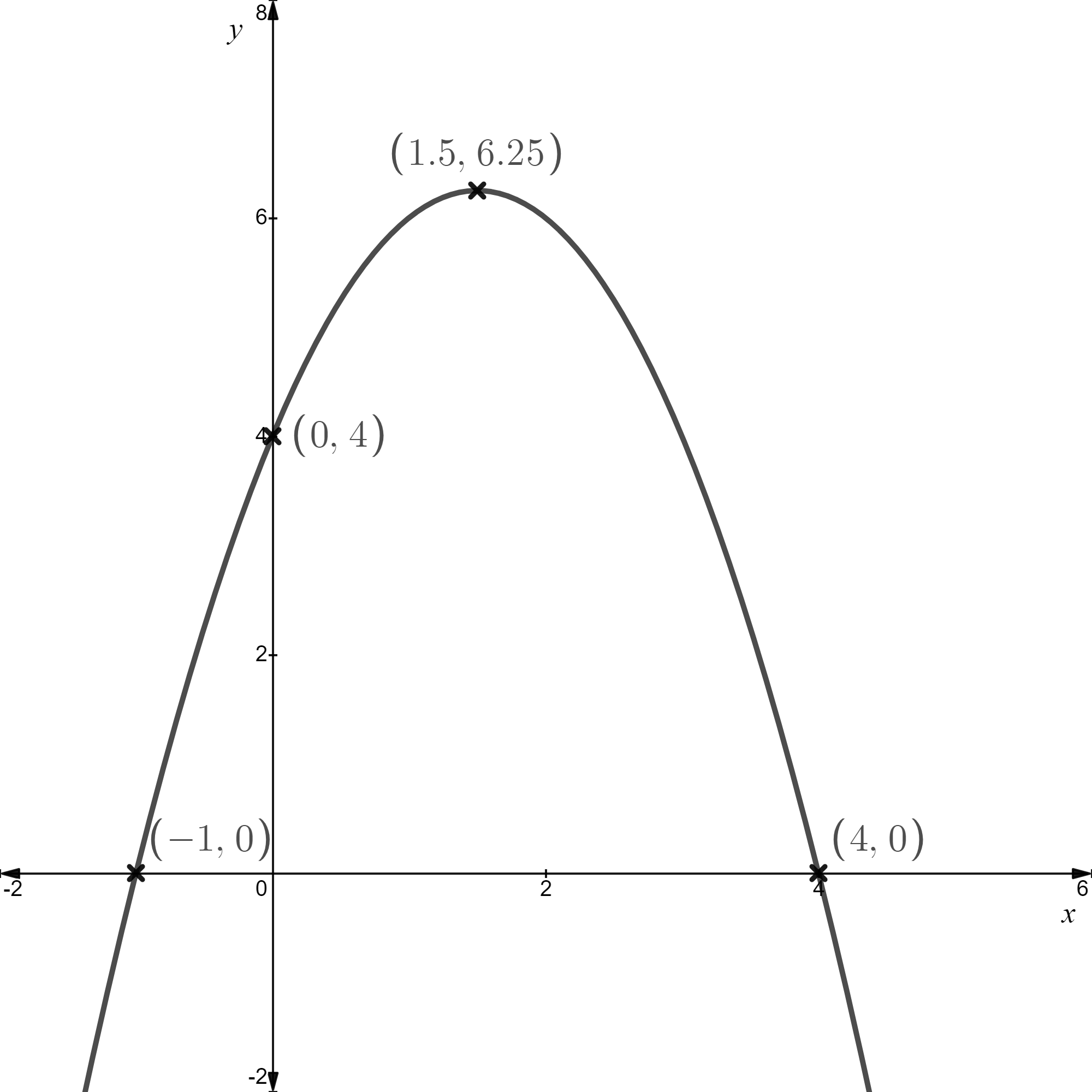
Sketch the graph of y = f \left( x + 3 \right), stating the coordinates of any points that intersect the coordinate axes and the turning point.
A stone is thrown vertically upwards from the top of a cliff. The height, h metres, of the stone above the sea, t seconds after it is thrown, is modelled by h \left( t \right) = 24 + 2t - 0.5t^{2}, for .
Write down the height of the cliff from which the stone was thrown.
Find the maximum height the stone reaches above the sea.
Find the time it takes for the stone to hit the sea.
Find the minimum value of the function f \left( x \right) = x^{2} + 8x + c, giving your answer in terms of c.
Find the values of c for which the function f \left( x \right) = x^{2} + 8x + c has no real roots.
Solve the equation .
Solve the equation 2^{4x} + 64 = 20 \left( 2^{2x} \right).
The diagram below shows the graph of y = f \left( x \right). The intercepts with the coordinate axes and the turning point have been labelled.
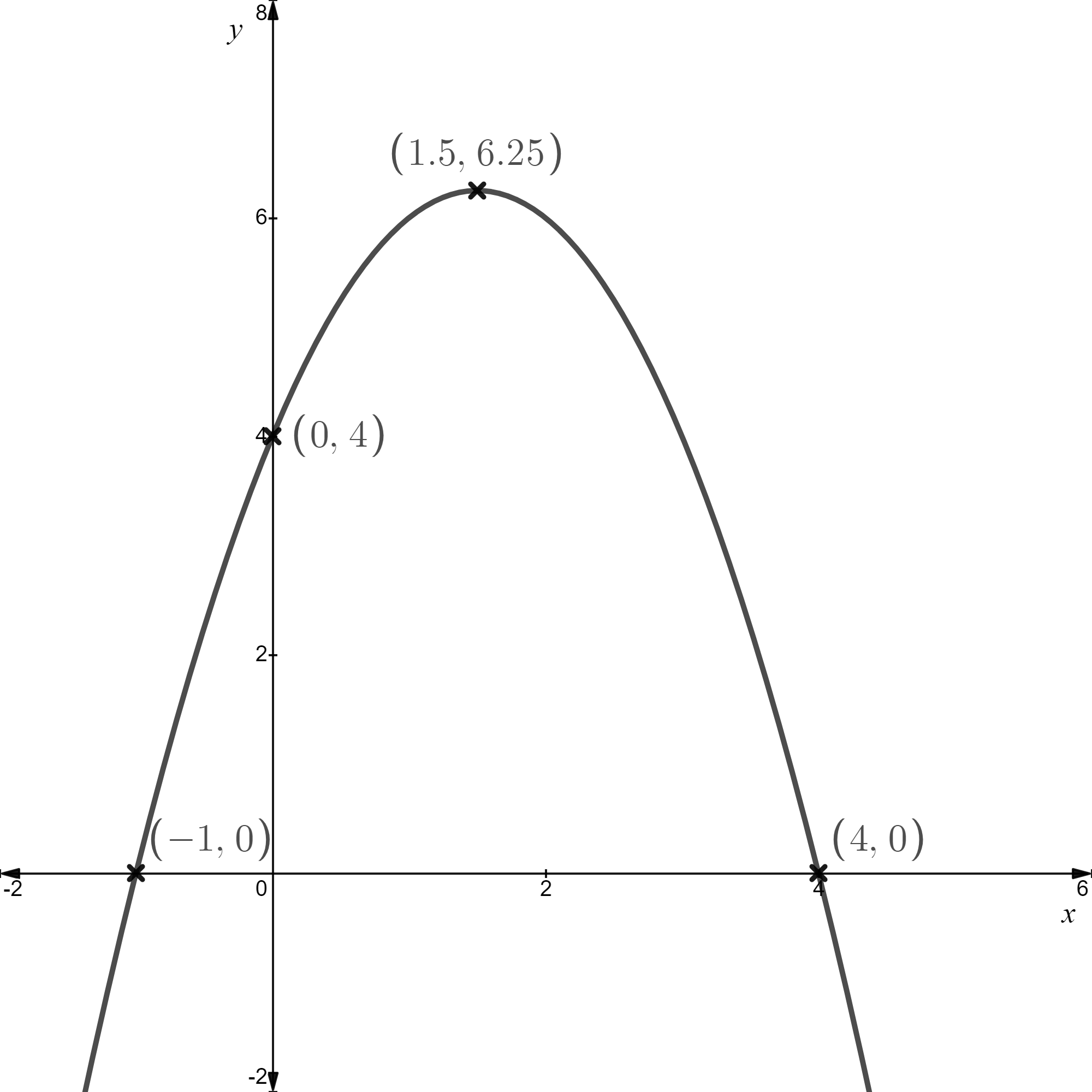
The graph is transformed by the function y = f \left( x \right) + 6. One of the new x-axis intercepts is (-2, 0).
Sketch the graph of y = f \left( x \right) + 6, stating the coordinates of any points that intersect the coordinate axes and the turning point.
Factorise
Factorise
Find a relationship between x and y such that .
Solve the equation .
Solve .
Solve the equation 2^{2x} + 64 = 20 \left( 2^{x} \right).
Write the quadratic function in the form where a, b and c are constants to be found.
Write down the maximum point on the graph of .
Sketch the graph of , clearly labelling the maximum point and any point where the graph intersects the coordinate axes.
The equation has no real roots. Show that and explain why q must be a positive value.
Given that the minimum point on the graph of is (3, 1) find the values of p and q.
The equation has two distinct real roots.
Find the set of values of k.
The equation has two distinct real roots, and . k is a negative constant and .
Sketch the graph of , labelling the points where the graph crosses the coordinate axes.
Find the possible values of k.
The graph below shows the curve y = f \left( x \right) where f \left( x \right) = 4 - \dfrac{x^{2}}{8}.
The curve is used as the model for the arch on a bridge, where the water level under the bridge is represented by the x-axis. All measurements are in metres.
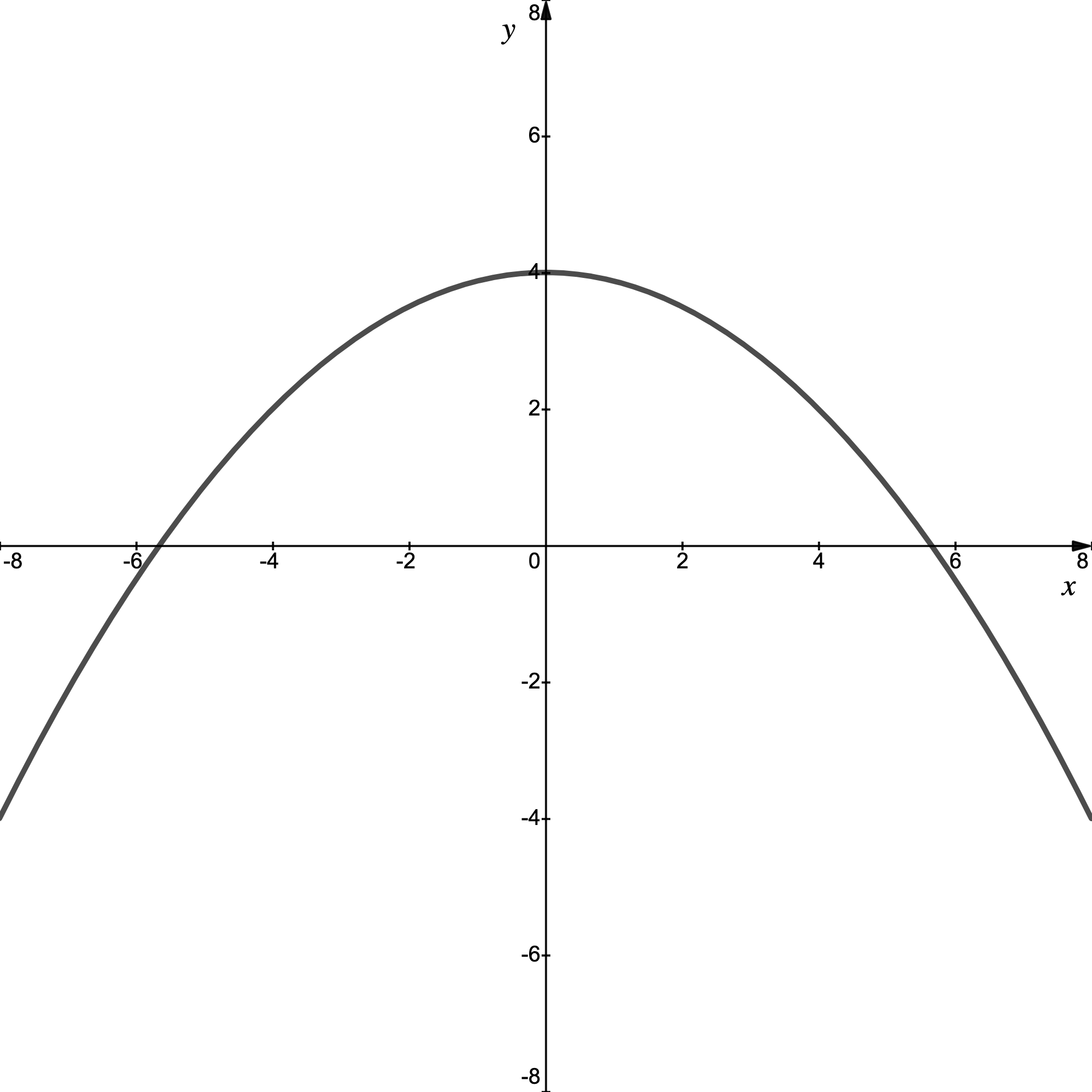
The water level can rise by up to 0.5 m. Determine whether the bridge is still wide enough to span a river of width 11 m when the water is at its peak height, justifying your answer.
A barge in the shape of a cuboid (above water level) has a cross-section measuring 6 m wide by 2.5 m tall. The barge regularly travels along the river where the bridge is to be built. Justifying your answer, determine whether the barge will fit underneath the bridge.
To support the bridge the arch will continue 2.5 m under the water (ground) level.
Find the exact distance between the base of the arch on either side of the river.
Show that the equation can be written in the form
a\left(x + \dfrac{b}{2a}\right)^{2} - \dfrac{b^{2} - 4ac}{4a} = 0
Hence show that .
The function f \left( x \right) is defined by f \left( x \right) = \left( k - 1 \right) x^{2} - \left( k - 2 \right) x - 2k, .
The function g \left( x \right) is defined by g \left( x \right) = \left( k - 1 \right) x^{2} - 3kx + k + 1, .
k is a non-zero constant and .
The graphs of y = f \left( x \right) and y = g \left( x \right) intersect at a single point. Find the x-coordinate of the intersection, giving your answer in terms of k.
In the case when , find the coordinates of the point of intersection of the two graphs.
A stone is thrown vertically upwards from the top of a cliff. The height, h metres, of the stone above the sea, t seconds after it is thrown, is modelled by h \left( t \right) = 52 + 3t - 0.5t^{2}, for .
Write down the height of the cliff from which the stone was thrown.
Find the maximum height the stone reaches above the sea.
Find the time it takes for the stone to hit the sea.
Find the length of time for which the stone is above its starting height.