Compression techniques (Cambridge International AS Computer Science)
File compression
MP3 (MPEG-1 Audio Layer 3) - Audio compression
-
MP3 uses audio compression to reduce file size
-
A typical music file can be reduced by up to 90% (e.g. 80 MB to 8 MB)
-
MP3 files are used on:
- MP3 players
- Computers
- Smart phones
-
Music can be:
- Downloaded or streamed from the internet
- Converted from a CD to MP3 format
-
MP3 quality isn’t as high as the original CD, but it’s good enough for most people
-
MP3 uses perceptual music shaping to remove sounds we don’t notice:
- Frequencies outside human hearing range
- Quieter sounds that are masked by louder ones
-
This makes the file smaller without a big drop in quality
-
MP3 is a lossy format:
- Some original data is permanently lost
- You can’t get the original file back
MPEG-4 (MP4) - Multimedia file format
-
MP4 is similar to MP3, but stores more than just audio
-
It can store:
- Music
- Videos
- Photos
- Animations
-
Commonly used for streaming videos over the internet
-
MP4 uses compression to keep file size small
-
Maintains high quality without noticeable loss to the viewer
Images
- Bitmap images can be compressed, the file size and quality are reduced
- JPEG is the most common file format for bitmap images
- The JPEG compression algorithm creates a new file, so the original file can no longer be used
- Vector graphics can also be compressed but with limited success
- Scalable vector graphics(.svg) use an XML text file which means that allows them to be compressed.
Run-length encoding (RLE)
What is run-length encoding?
- Run-length encoding (RLE) is a form of data compression that condenses identical elements into a single value with a count
Text data
-
For text data containing the string "AAAABBBCCDAA", the plain RLE encoding would be "4A3B2C1D2A"
-
The string has:
- four 'A's (4A)
- three 'B's (3B)
- two 'C's (2C)
- one 'D' (1D)
- two 'A's (2A)
-
To represent this in binary, the count is stored in a fixed size binary format (e.g. 7 or 8 bits)
-
The character is stored using its ASCII value (7 bits)
-
The binary RLE representation of 4A would be 0000100 1000001
- 0000100 *- binary for the count (4)
- 1000001 *- binary for 'A' (65)
Images
- Run-length encoding (RLE) uses frequency/data pairs to compress bitmap **image **data
- For example, the following bitmap image with a** bit depth of 1 bit** would have the following binary bit pattern
| Bitmap | Bit pattern |
|---|---|
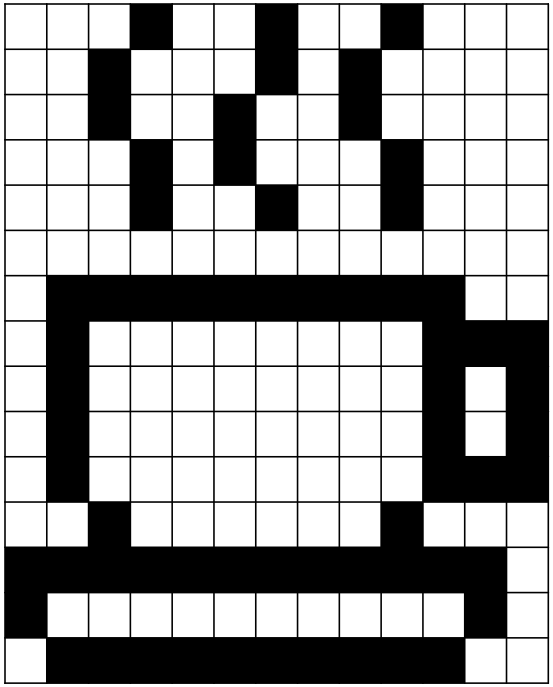 | 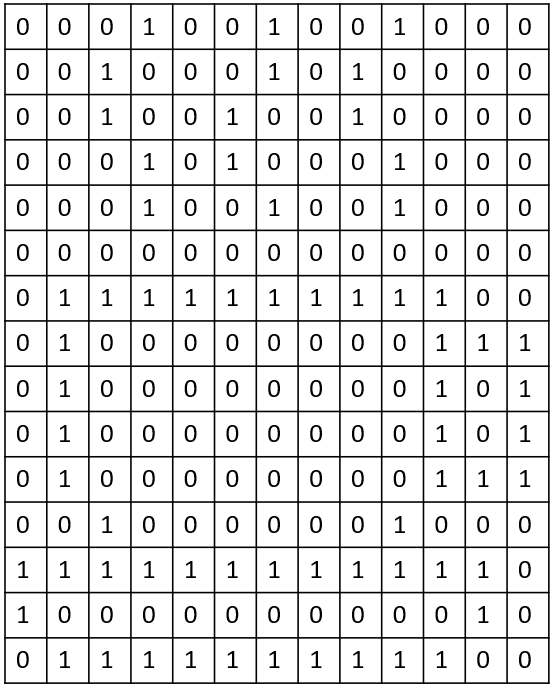 |
-
Using RLE we group pixel colours and can create frequency/data pairs as follows
- 30, 11, 20, 11, 20, 11, 50, 11, 30, 11, 10, 11, 60, 11......
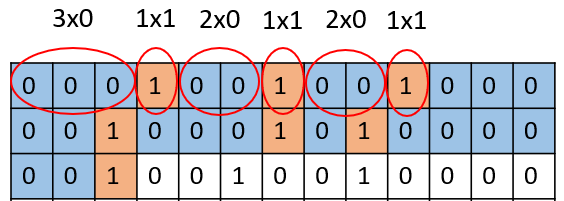
- 3 x 0 = 3 x white, 1 x 1 = 1 x black
- Data pairs can carry over on to the next line, e.g. end of first line and start of second line is 5 x 0 (5 x white)
- The original file would need to use 195 bits of storage space
- The RLE compressed file would need use 38 bits of storage space, a saving of 157 bits (80%)
- For images using more than two colours, the RGB value for each colour is stored along with the count
- For example, an image using the following four colours:
| Colour | Red | Green | Blue |
|---|---|---|---|
| Black | 0 | 0 | 0 |
| White | 255 | 255 | 255 |
| Red | 255 | 0 | 0 |
| Green | 0 | 255 | 0 |
-
The data stored could look like:
- 10 0 0 0 5 255 0 0 3 0 255 0
-
Ten black pixels ((10) 0 0 0) - count + RGB
-
Five red pixels ((5) 255 0 0) - count + RGB
-
Three green pixels ((3) 0 255 0) - count + RGB
Was this revision note helpful?
Build on this topic