Markets (Cambridge International AS Business)
Consumer and industrial markets
-
An industrial market is where businesses sell their products or services to other businesses
-
Goods are not usually for final consumption, but are used to help make other products or to support business operations
-
It is also known as B2B (business-to-business) selling
- E.g. a company that produces steel may sell it to a car manufacturer
-
-
A consumer market is where businesses sell products or services directly to individuals for their own personal use
- It is often called B2C (business-to-consumer) selling
- These include markets for goods and services such as clothing, smartphones, fast food or video streaming platforms
Key differences between consumer and industrial markets
| Feature | Industrial market | Consumer market |
|---|---|---|
| Target customer | - Other businesses (B2B – Business to Business) | - Individual consumers (B2C – Business to Consumer) |
| Purchase purpose | - For use in production or business activities | - For personal or household use |
| Purchase volume | - Usually large (bulk buying) | - Usually small (single or few items) |
| Product type | - Often technical or specialised | - General, used in daily life |
| Sales process | - Involves negotiation and longer decision-making | - Usually quick with less negotiation |
| Promotion | - Personal selling, trade shows, direct contact | - Advertising, promotions, social media |
Local, national and international markets
-
A local market is where goods and services are bought and sold within a small geographical area, such as a town or city
-
They serve nearby consumers and are often run by small businesses
- E.g. a local bakery selling fresh bread to people in the same neighbourhood or a hairdresser serving clients in their local town
-
-
A national market is where a business operates and sells its products or services across the entire country
-
Customers can come from anywhere within that country, and businesses use websites, advertising and delivery services to reach a wider audience
- E.g. Ale Hop sells gifts, stationery and homewares through stores and online across the whole of Spain
-
-
An international market is where businesses sell their products or services in more than one country
-
Businesses operating in these markets have to deal with different languages, cultures, laws and currencies
- E.g. Coca-Cola sells drinks globally and Samsung sells electronics in many different countries
-
Product orientation and customer orientation
Product orientation
-
A business with a product orientation focuses primarily on manufacturing a product rather than the needs of the consumer
-
The emphasis is on creating a product first and then finding a market
-
Over time, being too product orientated means the business may move further and further away from what the market is looking for, thus increasing the risk of business failure
- E.g. Gillette's razors can be classified as a product-orientated business as the business focuses on the quality of its products and regular innovations aimed at increasing sales
-
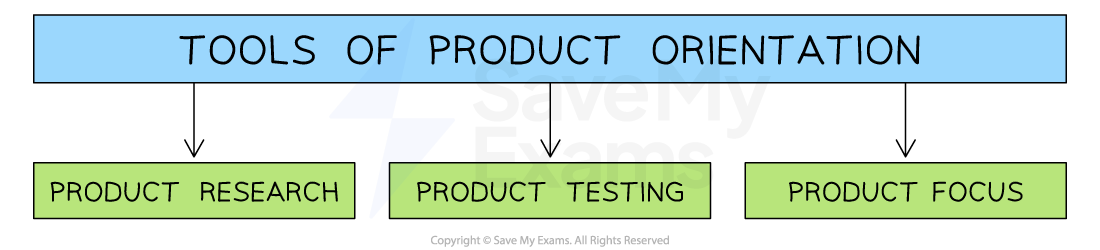
*Product orientation is an approach often used by inventors who research, test and produce a product well before market research has taken place *
Benefits of product orientation
-
Focus on quality and innovation
- Businesses can develop high-quality or unique products by concentrating on design and production
-
Strong brand image
- Offering something distinctive or well-made can build a strong reputation and brand loyalty
-
Less need for constant market research
- Product-oriented firms rely more on internal expertise than customer feedback
-
Efficient production
- Standardised products allow for* economies of scale* and streamlined processes
Customer (market) orientation
-
Customer (market) orientation is a business approach that focuses on the consumer demand and designs products that meet customer needs
-
Consumers are at the centre of marketing decisions
-
Products are designed to meet consumers' needs
- E.g. Universities often develop new courses based on the feedback they receive from students and employers
-
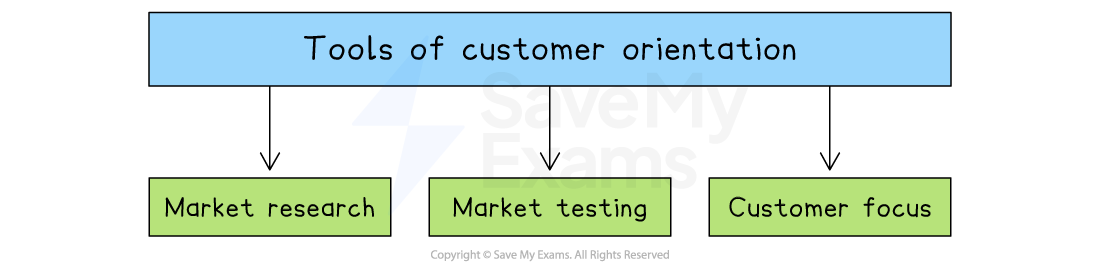
Tools of customer orientation include market research, market testing and customer focus
Benefits of customer orientation
-
Better customer satisfaction
- Products are developed based on what customers actually want and need
-
Stronger customer loyalty
- Meeting customer expectations can lead to repeat purchases and positive word-of-mouth
-
Faster response to market changes
- Businesses can adapt quickly to changes in tastes, trends, or demand
-
Higher sales potential
- Products are more likely to succeed when they’re tailored to the target market
Market share and market growth
-
Market share is the proportion of the total sales of a product or service compared to the market as a whole
- e.g. Tesco has 26% of the UK grocery market
-
Market share can be calculated using the formula
Worked Example In 2024, the UK coffee shop market was worth £4.8bn. Sales of Starbucks Coffee were £526m in 2024. Using the data, calculate, to 2 decimal places, the market share of Starbucks Coffee in the coffee shop/café market. You are advised to show your workings.
(3)
Step 1: Identify annual sales of Starbucks Coffee
£526m
Step 2: Identify total market sales in the coffee shop market
£4.8bn
Step 3: Substitute figures into the formula
****$= \frac{\pounds 526 \mathrm{m} }{\pounds 4.8 bn} \times 100
= 10.96 %$**** [3]
-
Market growth is the increase in the overall size, value or volume of a market over a period of time, usually expressed as a percentage
- This metric considers the size of the whole market/industry as opposed to a single firm's share of the market
-
Some common ways to measure market growth include sales revenue, sales volume or the number of customers
-
Market growth is calculated using the formula
- If the growth rate is positive, the market is getting bigger (expanding)
- If the growth rate is negative, the market is getting smaller (contracting)
Worked Example In 2023, worldwide sales of plug-in hybrid vehicles was 4.27 million units. By 2024 sales had increased to 6.51 million units.
Calculate the rate of market growth in the plug-in hybrid vehicles market.
(2)
Step 1 - Deduct 2023's sales from 2024's sales
Step 2 - Divide the outcome by 2023's sales
[1 mark]
Step 3 - Multiply the outcome by 100 to find the percentage growth rate
$= 0.5246 \times 100
= 52.46 %$ [1 mark]
- Market growth provides an incentive for businesses looking to expand, increase sales and generate higher revenue
- Businesses are often attracted to the potential of growing markets, and they can become increasingly competitive quite rapidly
Factors affecting the rate of market growth
| Factor | Explanation |
|---|---|
| Economic conditions | - Growth is usually faster when the economy is strong and people have more money to spend |
| Consumer trends | - Changes in lifestyle, fashion or technology can increase demand for certain products |
| Population growth | - More people often means more potential customers, leading to a larger market |
| Level of competition | - In markets with few rivals, businesses may grow quickly; too much competition can slow growth |
| Technological innovation | - New technology can create demand for new products or services, speeding up market growth |
| Government policies | - Supportive laws or *subsidies *can help markets grow, while strict regulations may slow growth |
| Availability of substitutes | - If there are many alternatives, market growth may be limited as customers have more choice |
Implications of changes in market share and market growth
The implications of changes in market share and market growth
Increasing market share
-
Strong brand recognition and customer trust
- As a business gains a larger share of the market, more people become aware of the brand, making it easier to attract and keep loyal customers
-
Greater power over prices, especially in less competitive markets
- A business with high market share may be seen as a market leader, giving it the ability to charge higher prices without losing many customers
-
Can benefit from economies of scale
- Producing and selling more units often reduces the cost per unit, allowing the business to be more efficient and more profitable
-
Attracts more investment and partnerships
- Investors and other companies are more likely to work with businesses that dominate the market, as they appear more stable and successful
-
More influence over suppliers and retailers
- A larger market share gives the business stronger negotiating power, which can lead to better deals from suppliers and more shelf space in stores
Falling market share
-
Harder to compete with larger rivals
- When a business loses market share, it may struggle to keep up with competitors who have more resources and customer loyalty
-
May need to lower prices to attract customers
- To win back customers, the business might have to cut prices, which can reduce profit margins
-
Lower profits due to fewer sales and higher costs per unit
- Selling fewer products often means each one costs more to make, while total revenue drops, leading to lower profits overall
-
Less visibility in the market
- A declining market presence can make the brand less familiar to consumers, reducing interest and trust in the product
-
Might struggle to access good suppliers or distribution channels
- Suppliers and retailers may prioritise businesses with higher sales, meaning those with falling market share may get worse terms or less exposure
Implications of changes in market growth
| Market condition | Implication | Explanation |
|---|---|---|
| Growing market | - Increased sales opportunities | - More demand means businesses can sell more products or services |
| - Easier to enter or expand | - New or smaller firms may find it easier to grow as customer demand is rising | |
| - Potential for higher profits | - With more sales, businesses can increase revenue and reduce costs per unit | |
| - Attracts investment | - Investors are more willing to support businesses in markets with strong growth | |
| - Encourages innovation | - Firms compete by creating new or improved products to win market share | |
| Contracting market | - Falling sales | - Overall demand is shrinking, making it harder to maintain sales levels |
| - Increased competition | - Businesses may fight harder over fewer customers, leading to price wars | |
| - Cost-cutting pressure | - Firms might need to reduce *expenses *to stay profitable | |
| - Risk of redundancy and closures | - Lower demand could force businesses to *downsize *or shut down operations | |
| - Less investment interest | - Investors may be cautious or reduce investment in declining markets |
Was this revision note helpful?
Build on this topic