Vmax & the Michaelis-Menten Constant (Cambridge International AS Biology)
Spec point — explain that the maximum rate of reaction (Vmax) is used to derive the Michaelis–Menten constant (Km), which is used to compare the affinity of different enzymes for their substrates
Vmax & the Michaelis-Menten constant
-
Substrate concentration affects the rate of catalysis in an enzyme-substrate reaction
- When the substrate concentration is fixed (and enzyme concentration is kept constant) the initial rate of reaction is fastest
- As substrate is used up (converted to product), the substrate concentration falls, so there are fewer enzyme-substrate collisions and the reaction rate falls
-
The Michaelis-Menten model describes the kinetics of such enzyme catalysed reactions
-
In this model, two values are used to describe an enzyme catalysed reaction:
- The maximal rate or maximal velocity (Vmax)
- The Michaelis-Menten constant(Km)
-
These values are derived from the reaction rate at different substrate concentrations
-
The maximum rate of reaction (Vmax) is used to derive the Michaelis–Menten constant (Km)
- This is then used to compare the affinity of different enzymes for their substrates
Michaelis-Menten enzyme kinetics
-
The Michaelis-Menten model is used to investigate the kinetics of enzyme catalysed reactions (enzyme kinetics is an area in biochemistry that studies how different variables affect reaction rates)
-
The rate of reaction is measured at different substrate concentrations, producing a graph like the one below
-
The two important values deduced are:
-
The Vmax (maximum rate of reaction at saturating substrate concentrations)
-
The Km, which is the substrate concentration at ½Vmax(this is also known as the Michaelis-Menten constant)
- The Michaelis-Menten constant is the substrate concentration at which the enzyme works at half its maximum rate
- At this point, half of the active sites of the enzyme are occupied by substrate molecules
- The higher the affinity of the enzyme for the substrate, the lower the substrate concentration needed for this to occur
- This is why the Michaelis-Menten constant is a measure of the affinity of an enzyme for its substrate
-
-
There is an inverse relationship between the Km****and the affinity of an enzyme for its substrate
-
An enzyme with a high Km** has a low affinity for its substrate and an enzyme with a low Km** has a high affinity for its substrate
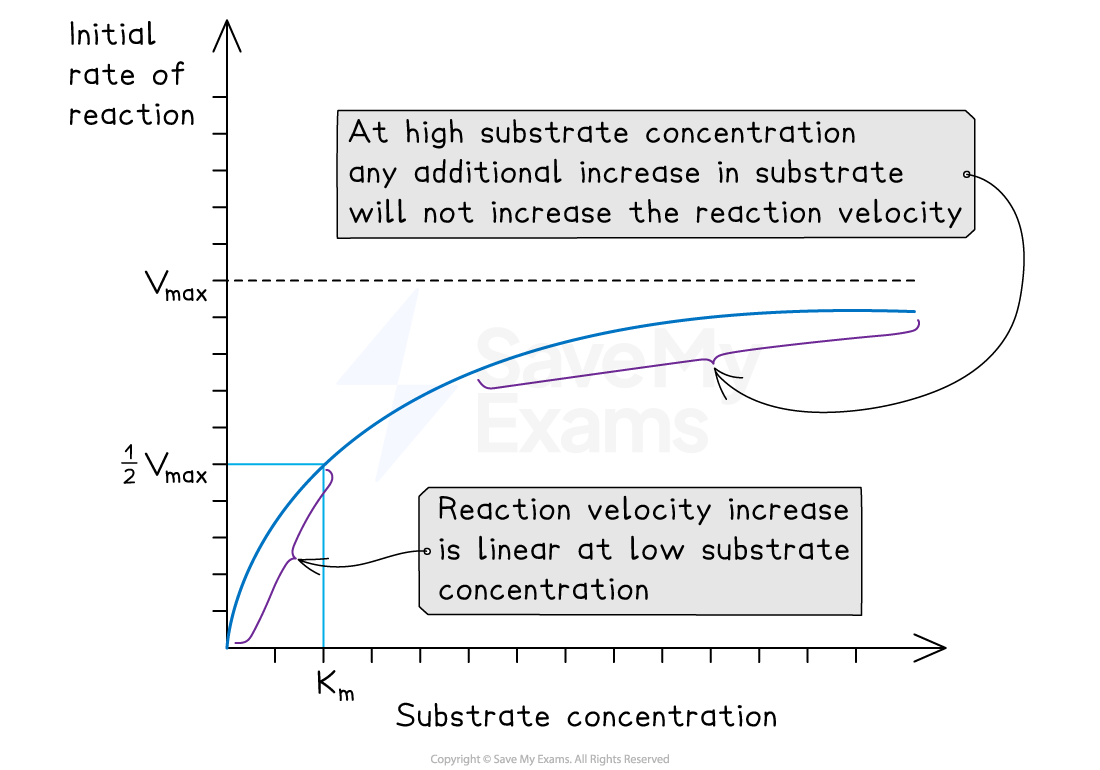
A graph showing the effect of substrate concentration on initial reaction rate, with Vmax, ½Vmax and Km values shown
Exam Hint Make sure you can identify the Vmax and the Km on a graph like the one above.
Was this revision note helpful?
Build on this topic