Prokaryotic v Eukaryotic Cells (Cambridge International AS Biology)
Structural Features of Typical Prokaryotic Cells
Spec point — "outline key structural features of a prokaryotic cell as found in a typical bacterium, including: • unicellular • generally – μm diameter • peptidoglycan cell walls • circular DNA • S ribosomes • absence of organelles surrounded by double membranes"
Structural features of typical prokaryotic cells
-
Animal and plant cells are eukaryotic cells, whereas bacterial cells are prokaryotic
-
Prokaryotes have a cellular structure that is distinct from eukaryotes:
-
Their genetic material is free in the cytoplasm and is circular
- Eukaryotic genetic material is packaged as linear chromosomes in the nucleus
-
Prokaryotes lack membrane-bound organelles
- This means that they do not have any internal structures surrounded by membrane, e.g. a nucleus or mitochondria
-
They are many times smaller than eukaryotic cells
- Prokaryotic cells are usually 1-5 μm in diameter, while eukaryotic plant cells can be 10-100 μm across
-
Their ribosomes are structurally smaller (70 S) in comparison to those found in eukaryotic cells (80 S)
-
Their cell walls are made of peptidoglycan rather than cellulose or chitin
-
-
Prokaryotes are always unicellular, while eukaryotic animal and plant cells can function together in multicellular organisms
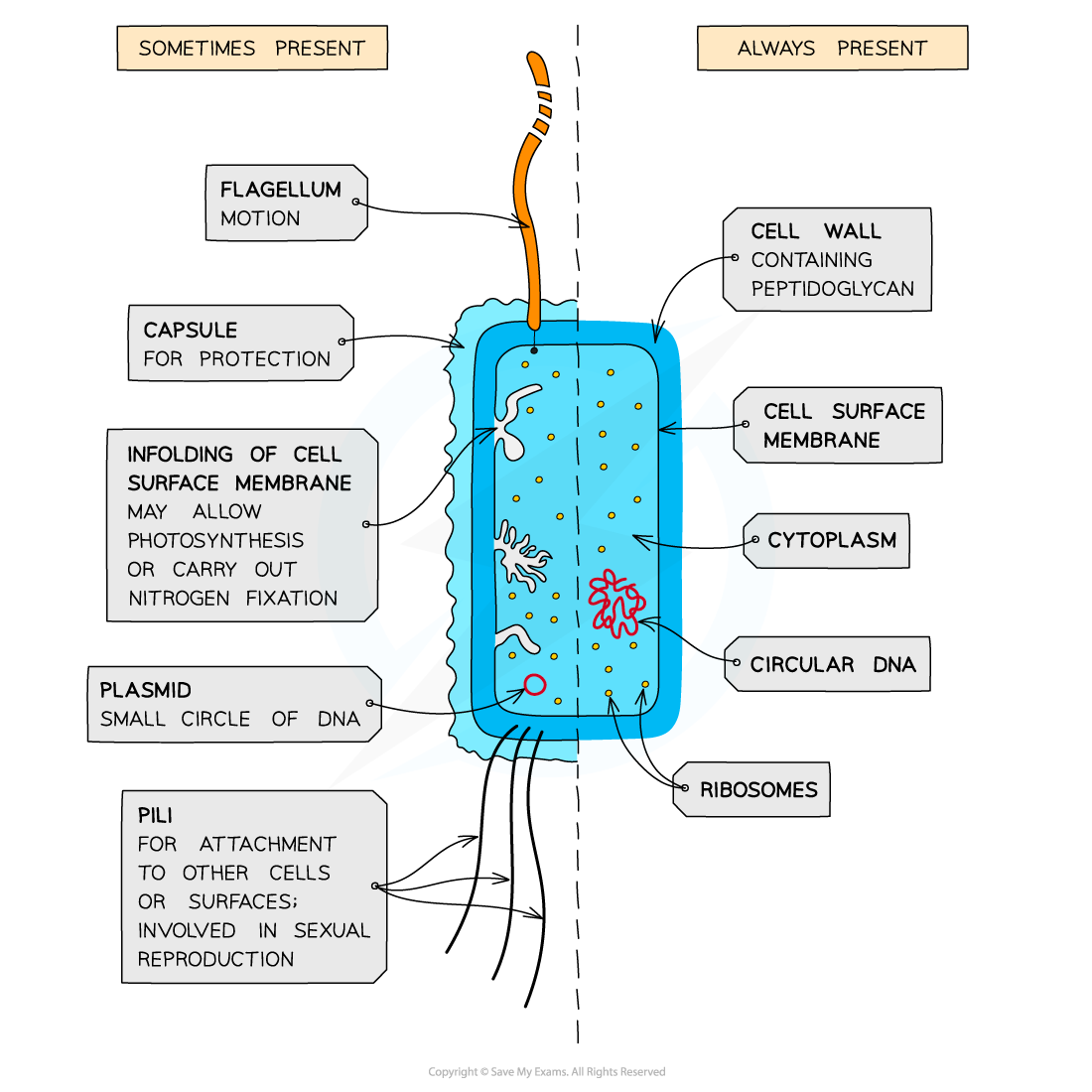
Prokaryotic cells have no internal membrane-bound structures, and are smaller than eukaryotic cells
Prokaryotic v Eukaryotic Cell Structures
Spec point —
1.2.6· compare the structure of a prokaryotic cell as found in a typical bacterium with the structures of typical eukaryotic cells in plants and animals
| Feature | Prokaryotes | Eukaryotes |
|---|---|---|
| Size | 1–5 μm | Up to 100 μm |
| Genetic material | Circular chromosome in the cytoplasm Not associated with proteins | Linear chromosomes in the nucleus Associated with histone proteins |
| Cell division | Binary fission No spindle fibres involved | Mitosis or meiosis Chromosomes are separated by spindle fibres |
| Ribosomes | 70S | 80S |
| Organelles | No membrane-bound organelles | Multiple membrane-bound organelles, e.g. a nucleus, mitochondria, chloroplasts |
| Cell wall | Made of peptidoglycan | Made of cellulose in plants, or chitin in fungi |
Was this revision note helpful?