Antibiotic Resistance (Cambridge International AS Biology)
Resistance to Antibiotics: An Outline
Spec point —
10.2.2· discuss the consequences of antibiotic resistance and the steps that can be taken to reduce its impact
Resistance to antibiotics
-
Genetic variation exists between individuals in a bacterial population
- This is the result of random mutation
-
A chance mutation might give rise to a new allele that provides resistance to an antibiotic
- E.g. some pathogenic bacteria have become resistant to penicillin
- They have acquired ****an allele that codes for the production of an enzyme which breaks down penicillin
-
When the bacterial population is treated with this antibiotic** any bacteria with the resistance allele do not die**
- The antibiotic acts as a selection pressure
-
The resistant bacteria can continue to reproduce with less competition from the non-resistant bacteria, which are now dead
-
The allele for antibiotic resistance is passed on with much greater frequency to the next generation
-
This can occur especially quickly in bacterial populations, due to:
- short generation times
- all offspring being clones of their parents
- horizontal gene transfer
-
-
The antibiotic resistance allele increases in frequency
- A higher proportion of the bacterial population is now resistant to the antibiotic
-
This is an example of evolution by natural selection
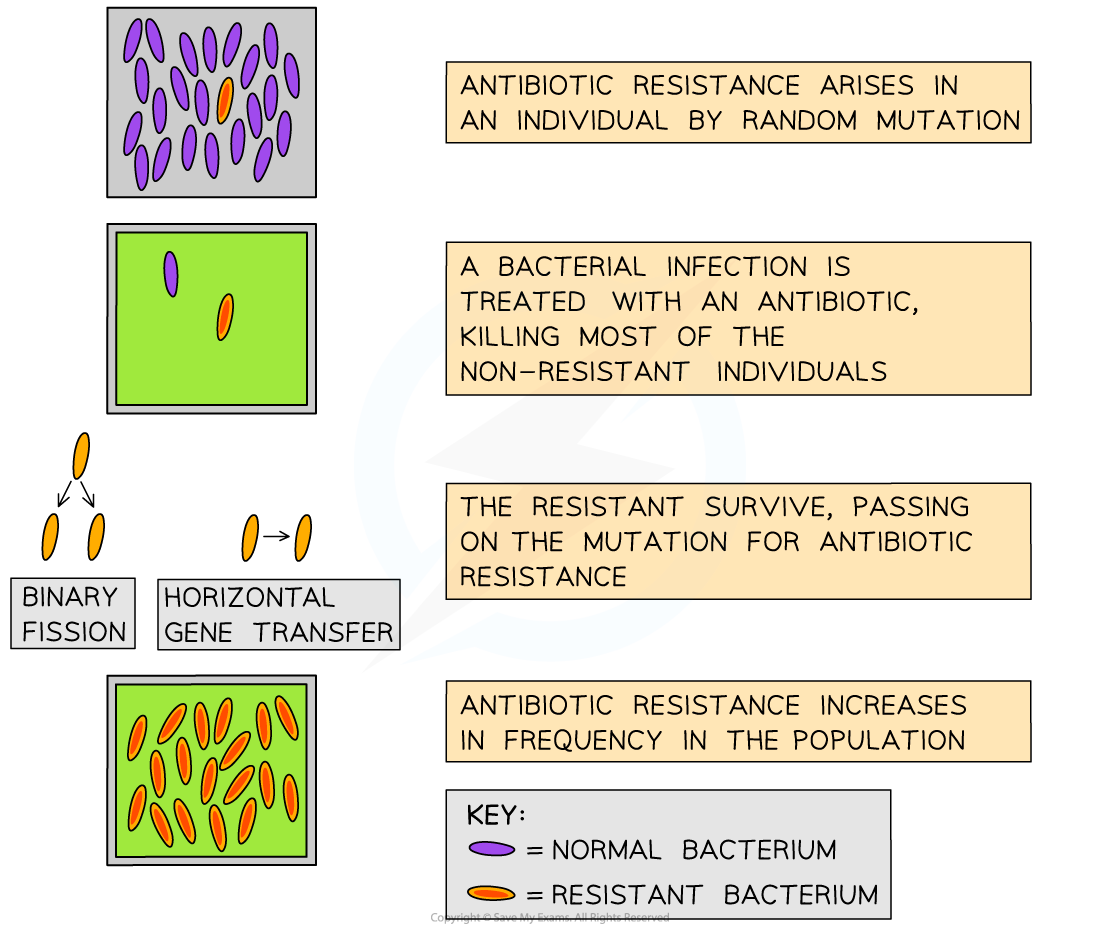
Bacteria evolve rapidly due to their high mutation rate and short generation times; this means that antibiotic resistance can arise quickly when a population is exposed to a new antibiotic
-
Humans have caused an increase in the occurrence of antibiotic resistance
- This is because treating infections with antibiotics provides a selection pressure which drives natural selection
-
This problem is made worse when antibiotics are used improperly, e.g.
- For treatment of non-serious infections
- For treatment of viral infections
- Routine treatment to animals in agriculture
- A course of antibiotics is not fully completed
Exam Hint Be careful when describing the development of antibiotic resistance; there are two major pitfalls to look out for:
- Antibiotic resistance mutations occur by chance, and not as the result of exposure to antibiotics; you should never say that antibiotics* cause *mutation
- Mutation gives rise to a new resistance allele, and not a new gene
Was this revision note helpful?
Build on this topic