Starch & Glycogen (Cambridge International AS Biology)
Starch & Glycogen: Structures & Functions
Spec point —
2.2.7· describe the molecular structure of the polysaccharides starch (amylose and amylopectin) and glycogen and relate their structures to their functions in living organisms
-
Starch and glycogen are polysaccharides
-
Polysaccharides are polymers formed from many monosaccharides joined by glycosidic bonds to form chains; these chains may be:
- Branched or unbranched
- Folded
- Straight or coiled
-
Starch and glycogen are storage polysaccharides because they are:
-
Compact
- Many molecules fit into a small space, so large volumes can be stored inside cells
-
Insoluble
- They do not dissolve in the cell cytoplasm, so have no osmotic effect on cells; soluble molecules like glucose would lower the water potential of cell cytoplasm, drawing water into cells by osmosis
-
Starch
-
Starch is the storage polysaccharide of plants. It is stored as granules in plastids (e.g. chloroplasts)
-
Due to the many monomers in a starch molecule, it takes longer to digest than glucose
-
Starch is constructed from two different polysaccharides:
-
Amylose (10 - 30% of starch)
- Unbranched helix-shaped chain with 1,4 glycosidic bonds between α-glucose molecules
- The helix shape enables it to be more compact and thus it is more resistant to digestion
-
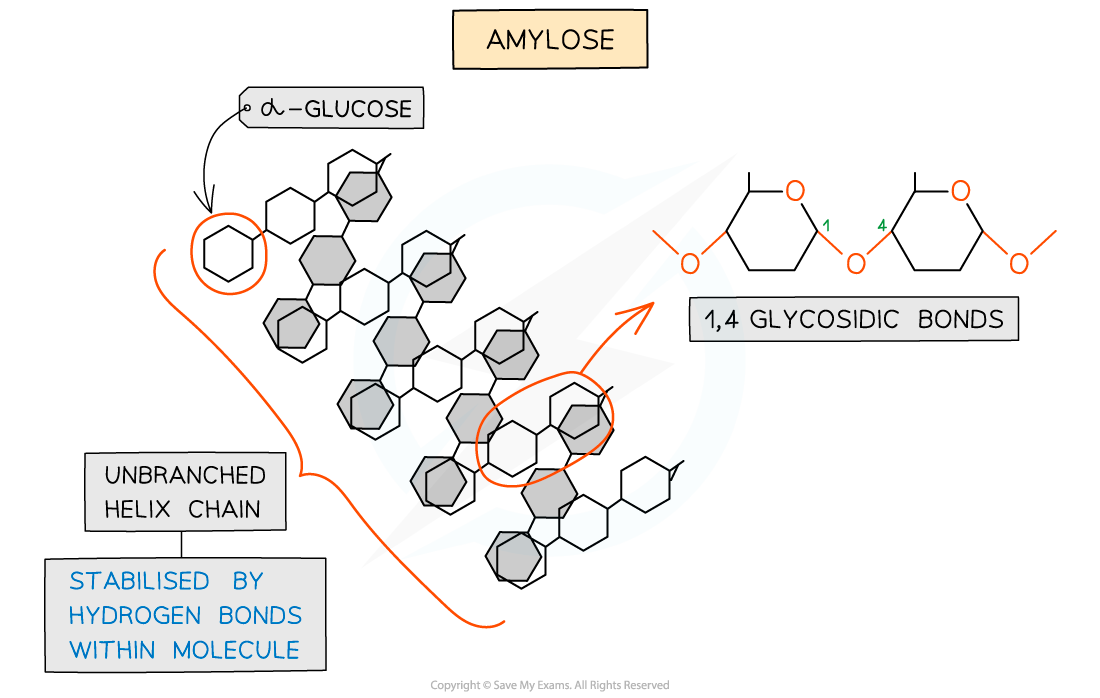
Amylose is one of the two polysaccharides that forms starch, the storage polysaccharide in plants
-
Amylopectin (70 - 90% of starch)
- 1,4 glycosidic bonds between α-glucose molecules but also 1,6 glycosidic bonds form between glucose molecules creating a branched molecule
- The branches result in many terminal glucose molecules that can be easily hydrolysed for use during cellular respiration or added to for storage
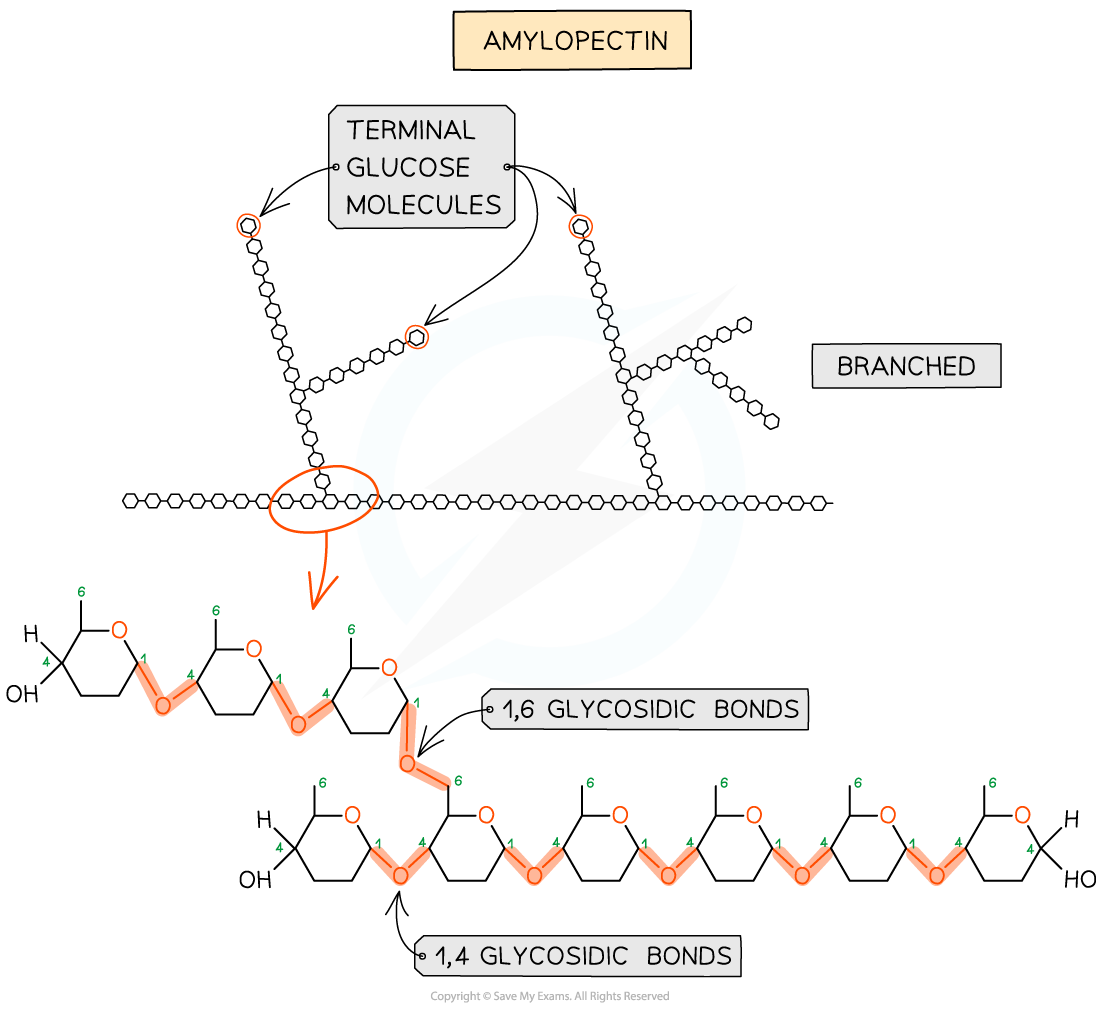
Amylopectin is the other of the two polysaccharides that forms starch
Glycogen
- Glycogen is the storage polysaccharide of animals and fungi, it is highly branched and not coiled
- Liver and muscles cells have a high concentration of glycogen, present as visible granules, as the cellular respiration rate is high in these cells (due to animals being mobile)
- Glycogen is more branched than amylopectin making it more compact which helps animals store more
- The branching enables more free ends where glucose molecules can either be added or removed allowing for condensation and hydrolysis reactions to occur more rapidly – thus the storage or release of glucose can suit the demands of the cell
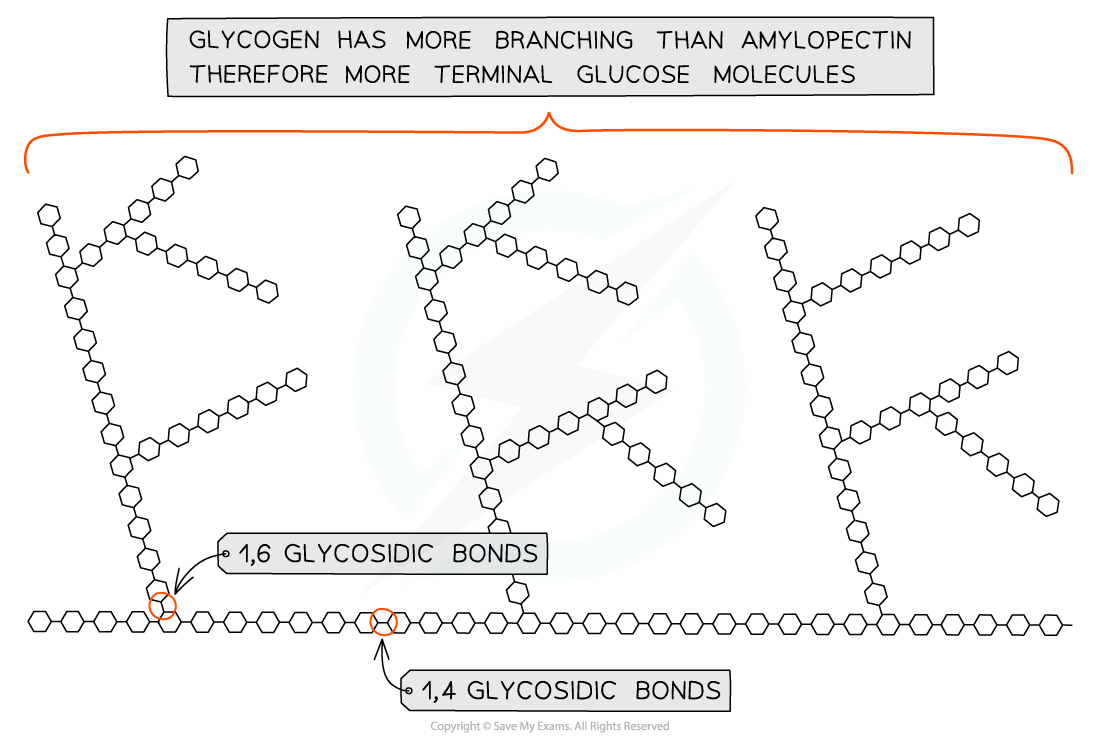
Glycogen is a highly branched molecule used as a storage polysaccharide in animals and fungi
| Feature | Starch | Glycogen | |
|---|---|---|---|
| Amylose | Amylopectin | ||
| Monomer | α-glucose | α-glucose | α-glucose |
| Branched | No | Yes | Yes |
| Helix shape | Yes | No | No |
| Glycosidic Bond Present | 1,4 | 1,4 and 1,6 | 1,4 and 1,6 |
| Source | Plants | Plants | Animals |
Exam Hint Be clear about the differences between starch (amylose and amylopectin) and glycogen.
Was this revision note helpful?
Build on this topic