The Random Nature of Radioactive Decay (Cambridge International A-Level Physics)
Spec point —
23.2.1
The random nature of radioactive decay
- Radioactive decay is defined as:
The spontaneous disintegration of a nucleus to form a more stable nucleus, resulting in the emission of an alpha, beta or gamma particle
-
The random nature of radioactive decay can be demonstrated by observing the count rate of a Geiger-Muller (GM) tube
- When a GM tube is placed near a radioactive source, the counts are found to be irregular and cannot be predicted
- Each count represents the decay of an unstable nucleus
- These fluctuations in count rate on the GM tube provide evidence for the randomness of radioactive decay
Graph of radioactive decay
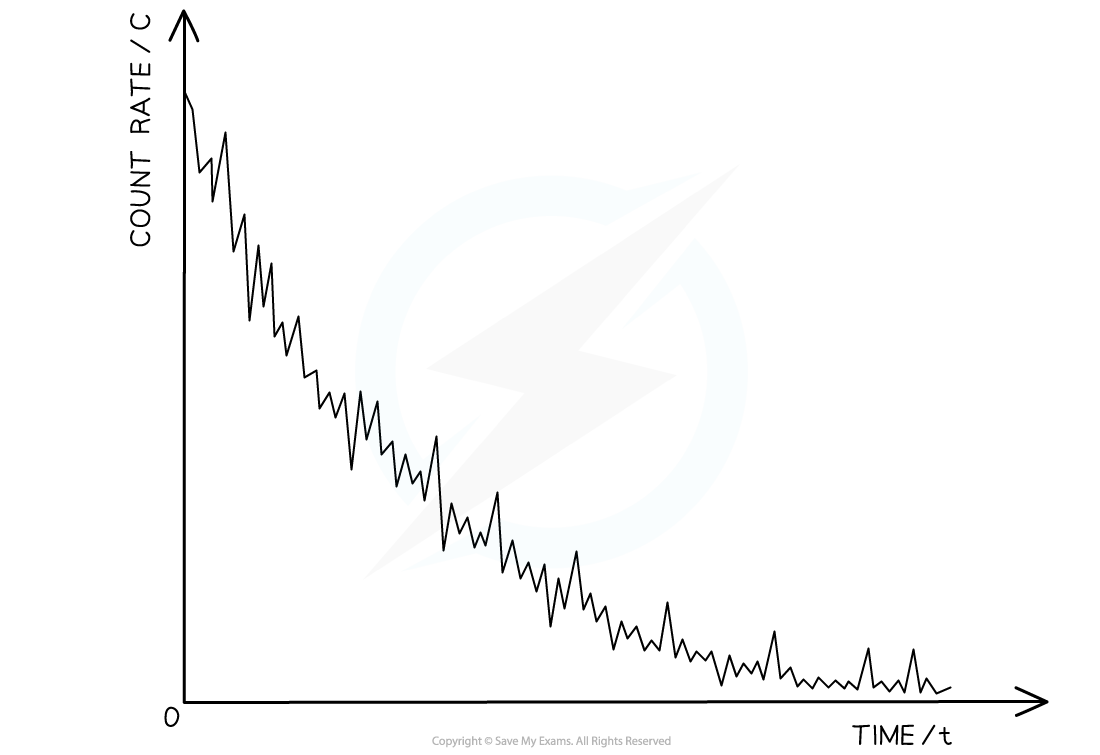
The variation of count rate over time of a sample radioactive gas. The fluctuations show the randomness of radioactive decay
Characteristics of Radioactive Decay
- Radioactive decay is both spontaneous and random
- A spontaneous process is defined as:
A process which cannot be influenced by environmental factors
-
This means radioactive decay cannot be affected by environmental factors such as:
- temperature
- pressure
- chemical conditions
-
A random process is defined as:
A process in which the exact time of decay of a nucleus cannot be predicted
- Instead, the nucleus has a constant probability, i.e. the same chance, of decaying in a given time
- Therefore, with large numbers of nuclei, it is possible to statistically predict the behaviour of the entire group
Exam Hint Make sure you can define what constitutes a radioactive decay, a random process and a spontaneous decay - these are all very common exam questions!
Was this revision note helpful?
Build on this topic