Circular Orbits in Gravitational Fields (Cambridge International A-Level Physics)
Spec point —
13.2.1
Circular orbits in gravitational fields
- The orbits of most planets and satellites in the Solar System are nearly circular
- The gravitational force between two bodies provides the centripetal force required to maintain a circular orbit
- Consider a satellite with mass m orbiting Earth with mass M at a distance r from the centre, travelling with linear speed v
- Equating the gravitational force to the centripetal force for a planet or satellite in orbit gives:
- The mass of the satellite m will cancel out on both sides to give:
-
Where:
- = orbital speed of the smaller mass (m s−1)
- G = Newton's Gravitational Constant
- M = mass of the larger mass being orbited (kg)
- r = orbital radius (m)
-
This equation shows that all satellites moving in a circular orbit of fixed radius will travel at a constant speed
-
The direction of a satellite orbiting in circular motion is constantly changing, which means that the satellite has
- a **velocity **which is constantly changing
- a** centripetal acceleration** that acts towards the satellite
- a centripetal force, provided by the gravitational force, which causes the satellite to accelerate
Gravitational force and instantaneous velocity
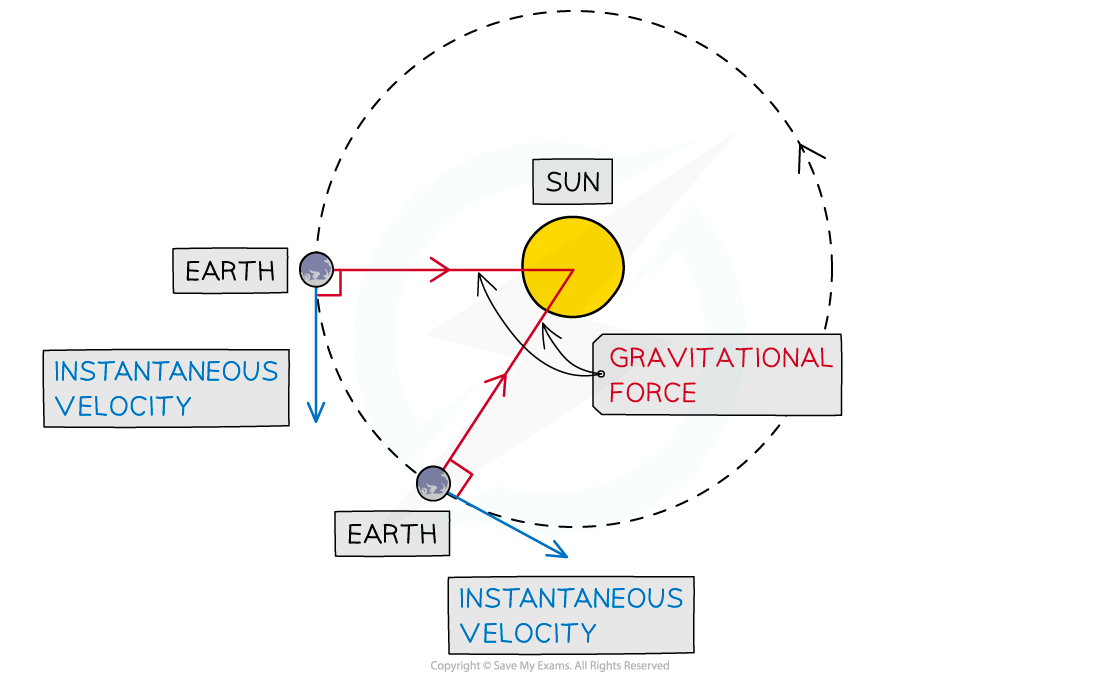
The direction of the instantaneous velocity and the gravitational force at different points of the Earth’s orbit around the sun
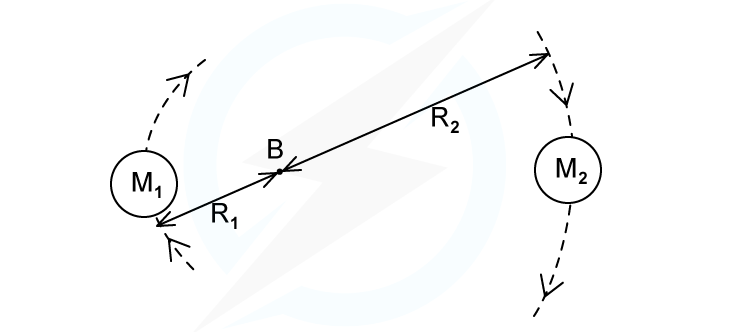
Worked Example A binary star system consists of two stars orbiting about a fixed point B. The star of mass M1 has a circular orbit of radius R1 and mass M2 has a radius of R2. Both have an angular speed ω about B.
State the following formula, in terms of G, M2, R1 and R2
(a) The angular speed ω of M1
(b) The time period T for each star in terms of angular speed ω
Answer:
**(a) **
Step 1: Equating the centripetal force of mass M1** to the gravitational force between M**1and M2
Step 2: M1cancels on both sides
Step 3: Rearrange for angular velocity ω
Step 4: Square root both sides
(b)
Step 1: Angular speed equation with time period T
Step 2: Rearrange for T
Step 3: Substitute in ω
Exam Hint Many of the calculations in the Gravitation questions depend on the equations for Circular motion. Be sure to revisit these and understand how to use them!
Was this revision note helpful?