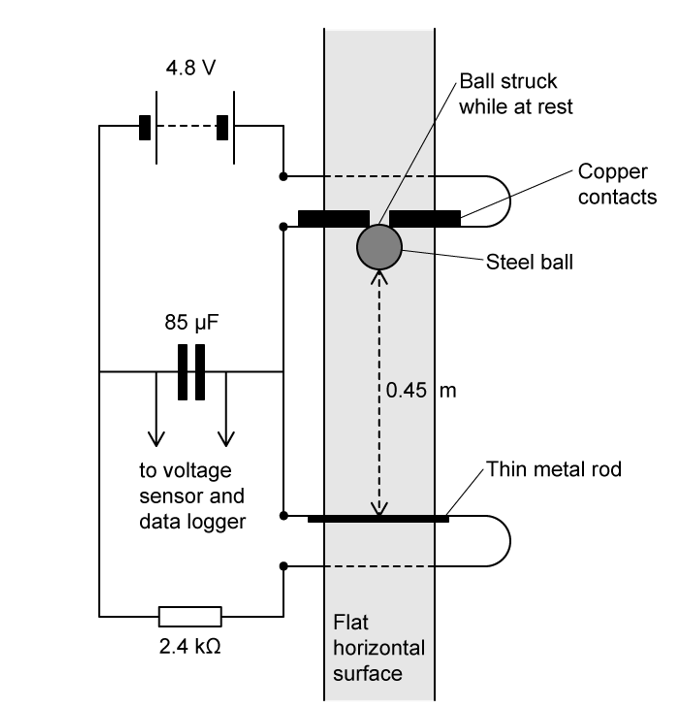
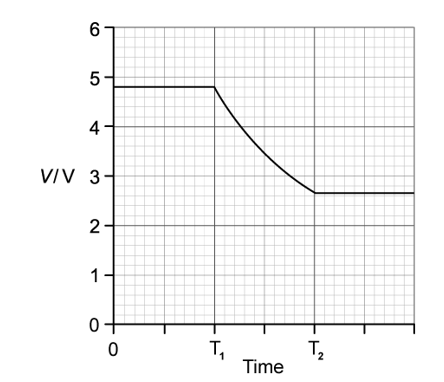
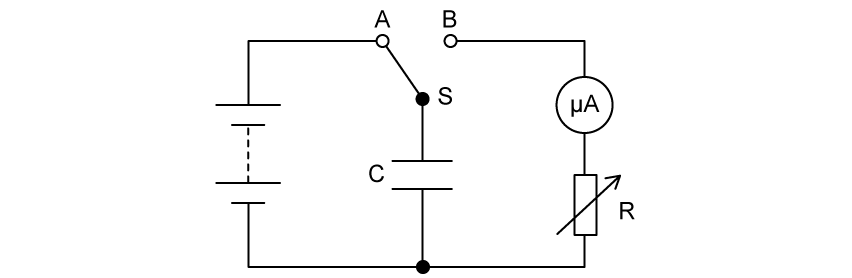
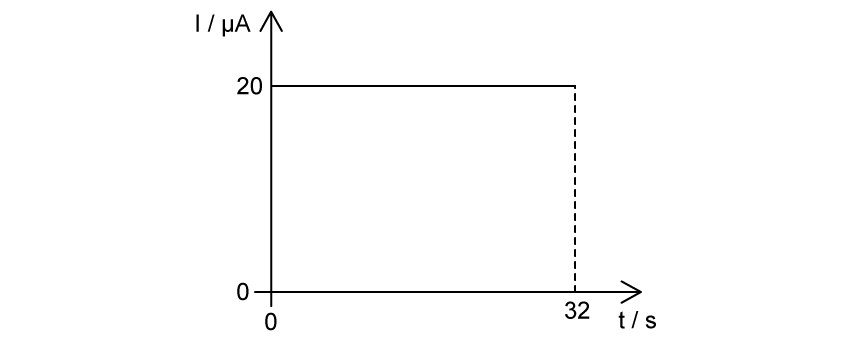
A capacitor stores electric charge and electric potential energy.
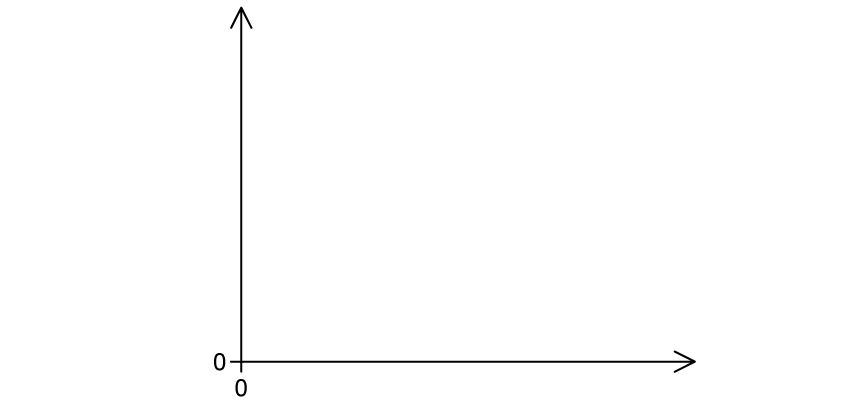
Fig. 1.1
Sketch a graph labelling both axes on Fig. 1.1, to show how the charge stored, Q by a capacitor varies with the potential difference, V.
Extract:
A capacitor stores electric charge and electric potential energy. Sketch a graph labelling both axes on Fig. 1.1, to show how the charge stored, Q by a capacitor varies with the potential difference, V. The graph is a straight line with a positive gradient through the origin, with charge Q on the vertical axis and potential difference V on the horizontal axis.
State the feature of the graph in Fig. 1.1 from part (a) that represents the electric potential energy stored by the capacitor.
Calculate the energy stored by a capacitor of capacitance 1200 μF that is charged to a potential difference of 4.5 V.
A healthy debate between two physics students concerns the equations for the energy stored by a capacitor.
A transcript of the debate is given below:
Student A: “The energy stored *E *by a capacitor is proportional to the potential difference V, because E = QV.”
Student B: “Actually, the energy stored *E *by a capacitor is proportional to the square of the potential difference, V2, because *E *=CV2.”
State and explain whether Student A or Student B is correct regarding the energy stored by a capacitor.
The equation for capacitance is: C =