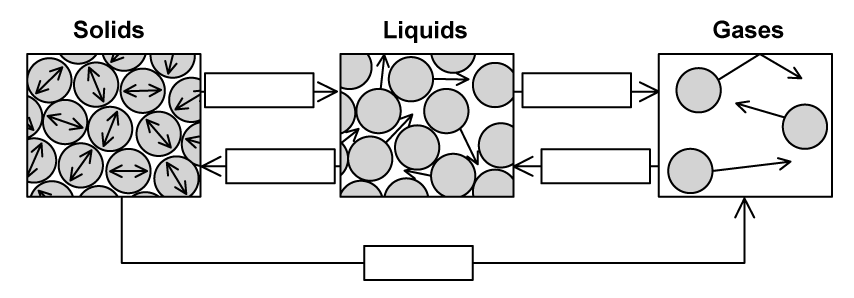
Specific heat capacity and latent heat capacity are described in Table 1.1.
Determine the correct definitions and equations by placing them in the correct boxes in Fig 1.1.
Table 1.1
| The thermal energy required to change the state of 1 kg of mass of a substance without any change of temperature. | |
|---|---|
| The amount of thermal energy required to raise the temperature of 1 kg of a substance by 1 °C. |
Fig 1.1
| Equation | Definition | |
|---|---|---|
Specific Latent Heat Capacity | ||
Specific Heat Capacity |
A student is trying to explain specific heat capacity to a friend.
Identify, by placing a tick (✓) next to the correct statements about specific heat capacity.
| Statement | (✓) here if the statement is correct |
|---|---|
| All substances have the same specific heat capacity. | |
| The heavier the material, the more thermal energy is required to raise its temperature. | |
| The larger the change in temperature, the higher the thermal energy will be required to achieve this change. | |
| Specific heat capacity is mainly used in gases. |
The student is confused about how to explain specific latent heat capacity.
Identify, by circling the best option, the explanations that correctly describe specific latent heat capacity.
(i) When a substance changes state there is a temperature change / no temperature change
(1 mark)
(ii) There are two / three types of specific latent heat
(1 mark)
(iii) The specific latent heat of fusion is present during the melting / condensing of a substance
(1 mark)
(iv) The specific latent heat of vapourisation is present during the freezing / boiling of a substance.
(1 mark)
The student has three substances of equal mass, aluminium, copper and water set up for an experiment in his laboratory where the room temperature is initially 20°C. 5000 J of thermal energy is transferred to each substance.
The temperature of aluminium increases to 75°C, the temperature of the copper to 150°C and the water to 30°C.
Write the numbers 1, 2 and 3 next to the correct substances, with 1 being the lowest and 3 being the highest specific heat capacity.
- Aluminium ........
- Copper ........
- Water ........