11 markeasy
What is a particle that is not made of any smaller particles?
Choose your answer
elementary particle
minimum particle
original particle
atomic particle
22 questions · 22 marks · ≈ 22 min
What is a particle that is not made of any smaller particles?
Choose your answer
elementary particle
minimum particle
original particle
atomic particle
Light is made up of which type of elementary particle?
Choose your answer
quarks
leptons
photons
bosons
What type of elementary particles are electrons ?
Choose your answer
quarks
leptons
photons
bosons
What elementary particles are the building blocks for protons and neutrons ?
Choose your answer
quarks
leptons
photons
bosons
How many quarks make up a proton ?
Choose your answer
0
1
2
3
Which particle is made up of two 'down' quarks and one 'up' quark?
Choose your answer
atom
electron
neutron
proton
How many types of quark are there ?
Choose your answer
2
4
6
8
Which elementary particle is a lepton ?
Choose your answer
neutron
electron
quark
proton
What are the fundamental particles of an atom ?
Choose your answer
quarks, gluons and electrons
protons, neutrons and electrons
quarks, photons and electrons
quarks, gluons and neutrino
What are mesons ?
Choose your answer
a type of composite particle produced by high energy
a type of gluon
an antimatter version of the electron
a type of neutrino
Which of the following sentences about antimatter is incorrect?
Choose your answer
antimatter is normal matter with an opposite charge
antimatter is only produced in particle accelerators
antimatter destroys matter
equal amounts of antimatter and matter were created during the Big Bang
Fundamental or elementary particles are particles that aren't made up of smaller particles.
What is the most common type of fundamental particle in the universe ?
Choose your answer
atom
meson
neutrino
quark
In a nucleus of Tritium, , how many ‘down’ quarks are there?
Choose your answer
5
4
3
2
Which row in the table gives the correct quark combination for the particle?
| Particle | Category | Quark combination | |
|---|---|---|---|
| A | neutron | baryon | |
| B | neutron | meson | |
| C | proton | baryon | |
| D | positive pion | meson |
Choose your answer
What are the numbers of hadrons, baryons and mesons in an atom of ?
| Hadrons | Baryons | Mesons | |
|---|---|---|---|
| A | 7 | 3 | 3 |
| B | 7 | 4 | 4 |
| C | 7 | 7 | 0 |
| D | 10 | 7 | 0 |
Choose your answer
Quarks are thought to make up protons and neutrons.
The 'up' quark has a charge of ; a 'down' quark has a charge of , where e is the elementary charge (+ 1.6 × 10⁻¹⁹ C)
How many up quarks and down quarks must a proton contain ?
| Up quarks | Down quarks | |
|---|---|---|
| A | 0 | 3 |
| B | 2 | 1 |
| C | 1 | 2 |
| D | 1 | 1 |
Choose your answer
A CERN detector shows a signal only in the hadronic calorimeter. No signal is observed in the tracker, electromagnetic calorimeter or muon chambers.
Which particle must be responsible for this signal?
Choose your answer
pion
neutrino
photon
neutron
Some particles are made up of a combination of three quarks.
Which particle would not give a particle a charge of either +1.6 × 10⁻¹⁹ C or zero?
Choose your answer
up, up, up
up, up, down
up, strange, strange
up, down, down
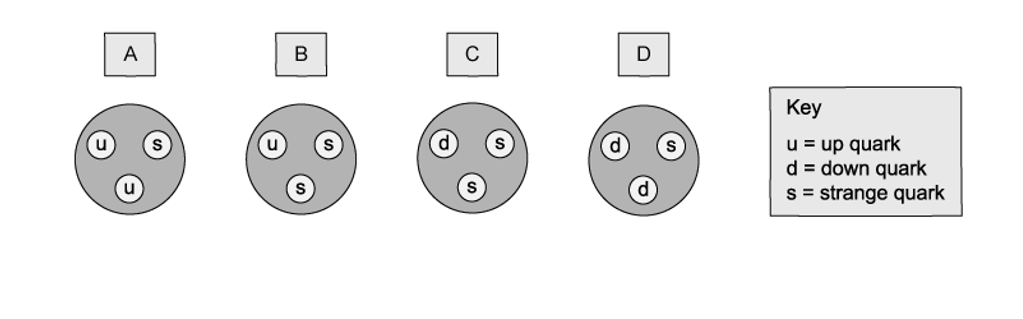
The composition of four different hadrons are shown in the diagram below. One of the hadrons is a Σ + particle. It has a charge of +e, where is *e *is the elementary charge.
Which hadron could be the Σ + particle ?
Choose your answer
When high-speed hadrons collide in particle accelerators, a positive pion (π+) is an unstable particle produced. The π+ particle has a charge of +e.
What is the quark combination of the π+ particle?
Choose your answer
A graph of nucleon number A against proton number Z is shown in the diagram below.
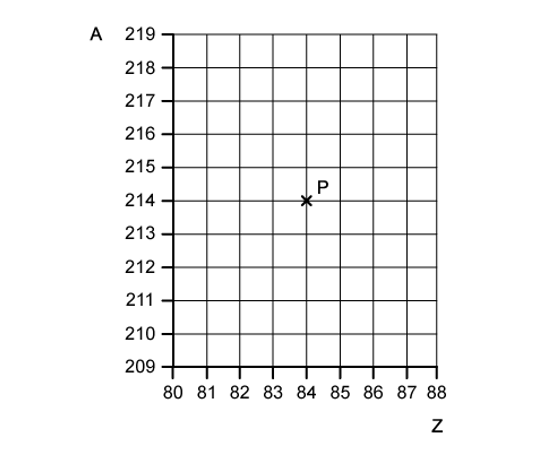
The graph shows a cross that represents a nucleus P.
Nucleus P decays by emitting an α-particle to form a nucleus Q.
Nucleus Q then decays by emitting a β– particle to form a nucleus R.
The quark composition of one nucleon in Q is changed during the emission of the β– particle.
What is the corresponding change in quark composition from nucleus Q to nucleus R ?
Choose your answer
no change
u-quark to d-quark
d-quark to u-quark
d-quark to s-quark
The equation for β– decay is
Using your knowledge of antiparticles and the weak interaction, what is the equation for β+ decay?
Choose your answer