11 markeasy
Which pair contains one vector and one scalar quantity?
| A | Displacement | Acceleration |
|---|---|---|
| B | Force | Kinetic energy |
| C | Momentum | Velocity |
| D | Power | Speed |
Choose your answer
16 questions · 16 marks · ≈ 16 min
Which pair contains one vector and one scalar quantity?
| A | Displacement | Acceleration |
|---|---|---|
| B | Force | Kinetic energy |
| C | Momentum | Velocity |
| D | Power | Speed |
Choose your answer
Two physical quantities P and Q are added together. The sum of P and Q is R, as shown in the diagram.
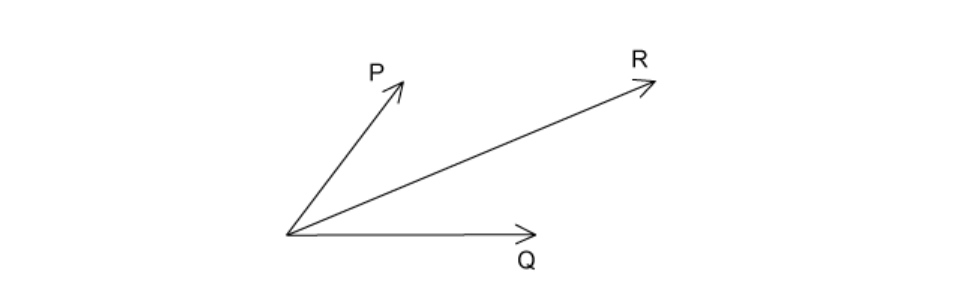
Which quantity could be represented by P and by Q?
Choose your answer
Kinetic energy
Power
Speed
Velocity
The arrow represents the vector R.

Which diagram does not represent R as two perpendicular components?
Choose your answer
The diagram shows a resultant force F at an angle of θ to the horizontal. The horizontal component * *and vertical component are labelled on the diagram.

What is the horizontal component of F?
Choose your answer
Which one of the following statements is true?
Choose your answer
A scalar quantity has both magnitude and direction
A scalar quantity has only direction
A vector quantity has only magnitude
A vector quantity has both magnitude and direction
The speed of an aeroplane in still air is 200 km h-1. The wind blows from the west at a speed of 85.0 km h-1.
In which direction must the pilot steer the aeroplane in order to fly due north?
Choose your answer
23.0° east of north
23.0° west of north
25.2° east of north
25.2° west of north
Vectors P and Q are drawn to scale.

Which diagram represents the vector (P – Q)?
Choose your answer
A vector has magnitude R and perpendicular components P and Q, as shown in the diagram.
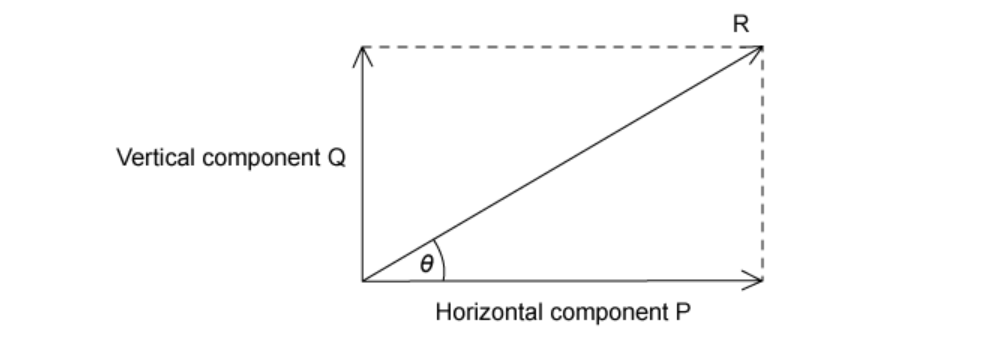
Which row correctly describes the perpendicular components?
| Vertical component | Horizontal component | |
|---|---|---|
| A B C D | Q *R *cos θ *R *cos θ *R *sin θ | sin θ P *R *sin θ *R *cos θ |
Choose your answer
A resultant force of 20 N is 30° to the horizontal.
What is the horizontal and vertical component of the resultant force?
| Horizontal Component / N | Vertical Component / N | |
|---|---|---|
| A | 17 | 10 |
| B | 10 | 17 |
| C | 11.5 | 10 |
| D | 17 | 11.5 |
Choose your answer
Fig 1.1 shows three coplanar forces which are in equilibrium.
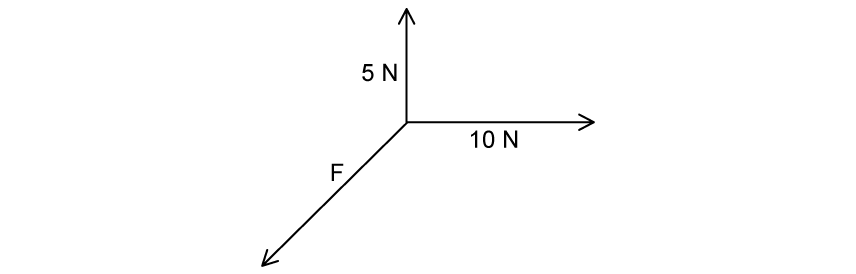
What is the value of force F?
Choose your answer
5 N
8.7 N
11 N
15 N
A ship’s speed in still water is 20 km h−1. A current coming from the east pushes the ship at a constant speed of 5 km h−1. At what bearing should the captain direct the ship so that it travels perfectly due north?
Choose your answer
014.5°
075.5°
284.5°
345.5°
Two forces, each of 10 N, act at a point P as shown in the diagram. The angle between the force vectors is 120°
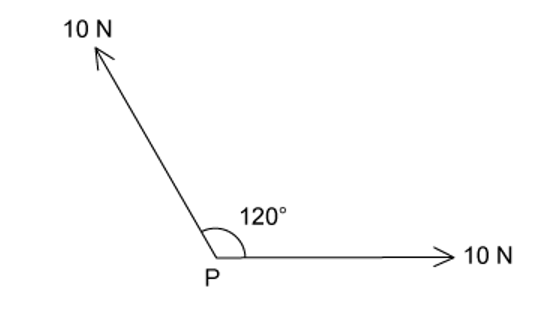
What is the magnitude of the resultant force?
Choose your answer
5 N
10 N
17 N
20 N
The diagrams represent systems of coplanar forces acting at a point. The lengths of the force vectors represent the magnitudes of the forces.
Which system of forces is in equilibrium?
Choose your answer
A glider is descending at a constant speed at an angle of 15° to the horizontal. The diagram shows the directions of the lift L, air resistance R and weight W acting on the glider.
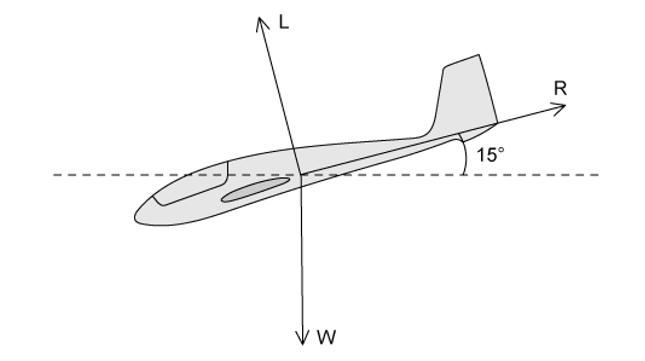
Which vector triangle could represent the forces acting on the glider?
Choose your answer
Figure 1.1 shows two coplanar forces, R and N, which act at point P. The angle between the forces is , where .

What is the magnitude of the resultant force F equal to?
Choose your answer
A boat is being pulled along by two equal forces of 700 kN, both at angle* * to the direction of motion. The boat experiences a resistive force of 40 kN. The net force on the boat is 1270 kN.
What is the value of ?
Choose your answer
21°
25°
57°
61°