13 markseasy
With respect to the origin , the points and have position vectors given by
Find the exact length of .
19 questions · 94 marks · ≈ 2 hours
With respect to the origin , the points and have position vectors given by
Find the exact length of .
In the triangle , the vectors and are given by
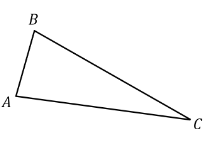
(i) Find the vector .
(ii) Hence, or otherwise, find the length of .
With respect to the origin , the points and have position vectors given by
(i) Find the vector .
(ii) Find the length of .
Find a unit vector parallel to .
With respect to the origin , the point has position vector .
The vectors and are given by
Find the position vector of .
State whether or not the vectors and are parallel, giving a reason for your answer.
With respect to the origin , the points , and have position vectors given by
Find the lengths , and . Hence determine whether the triangle is scalene, isosceles or equilateral.
The vectors and are defined by
\mathbf{p} = 14 \mathbf{i} + \left(a + b\right) \mathbf{j} + \left(c - b + 1\right) \mathbf{k}
Given that , find the values of , and .
The diagram below shows a cube whose vertices are , , , , , , and .
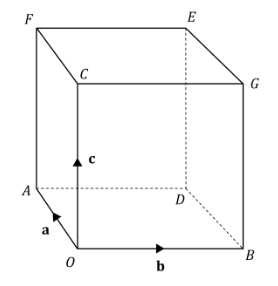
The vectors , and are , and respectively.
Find and in terms of , and .
(i) Explain why .
(ii) Show that . Hence state in terms of , and .
It is now given that .
Find the exact length of .
With respect to the origin , the points and have position vectors given by
\overrightarrow{OA} = \begin{pmatrix} - 2 \\ 5 \\ - 7 \end{pmatrix}
\overrightarrow{OB} = \begin{pmatrix} - 7 \\ k \\ 3 \end{pmatrix}
Given that , find the possible values of .
With respect to the origin , the points , and have position vectors given by
\overrightarrow{OP} = \begin{pmatrix} 12 \\ 3 \\ - 3 \end{pmatrix} , \quad \overrightarrow{OQ} = \begin{pmatrix} 7 \\ - 8 \\ k \end{pmatrix} , \quad \overrightarrow{OR} = \begin{pmatrix} 3 \\ 3 \\ - 12 \end{pmatrix}
Given that the triangle is equilateral, find the value of .
The vectors and are defined by
\mathbf{b} = 4 p \mathbf{i} + \left(p q r + 2 q r - p\right) \mathbf{j} - p q \mathbf{k}
Given that , find the values of , and .
The diagram below shows a cube whose vertices are , , , , , , and .
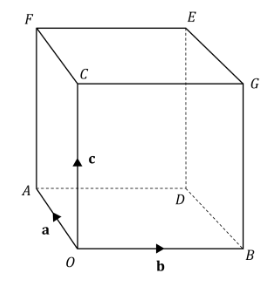
The vectors , and are , and respectively.
Find and in terms of , and .
Let be a point on , and let be a point on .
Explain why the vectors and can be expressed in the forms
where and are constants with and .
By solving the equation , using your results from parts (a) and (b), show that the diagonals and intersect each other, and determine the ratios into which they are cut by the point of intersection.
With respect to the origin , the points and have position vectors given by
\overrightarrow{OA} = \begin{pmatrix} - 1 \\ 3 \\ 14 \end{pmatrix}
\overrightarrow{OB} = \begin{pmatrix} 2 k \\ 3 k \\ 13 \end{pmatrix}
Given that and that is an integer, find the value of .
The vectors and are defined by
\mathbf{a} = \left(p + 1\right) \mathbf{i} - 7 \mathbf{j} + \left(q - 3 p\right) \mathbf{k}
\mathbf{b} = 5 \mathbf{i} + \left(14 q + r\right) \mathbf{j} + \left(1 - 2 r\right) \mathbf{k}
Given that , find the values of , and .
With respect to the origin , the points , and have position vectors given by
\overrightarrow{OP} = \begin{pmatrix} 2 \\ - 3 \\ 1 \end{pmatrix} , \quad \overrightarrow{OQ} = \begin{pmatrix} - 1 \\ - 4 \\ 3 \end{pmatrix} , \quad \overrightarrow{OR} = \begin{pmatrix} k \\ 0 \\ 3 \end{pmatrix}
Given that the triangle is isosceles and that , find the value of .
The diagram below shows a cube whose vertices are , , , , , , and .
The vectors , and are , and respectively.
Using vector methods, show that the diagonals and bisect each other.
With respect to the origin , the points and have position vectors given by
\overrightarrow{OA} = \begin{pmatrix} 5 \\ 0 \\ - 1 \end{pmatrix}
\overrightarrow{OB} = \begin{pmatrix} k \\ - 2 \\ 3 k \end{pmatrix}
Given that and that , find the value of .
The vectors and are defined by
\mathbf{b} = 6 \mathbf{i} + \left(p - r\right) \mathbf{j} + \left(p - 3 q\right) \mathbf{k}
Given that and that , find the values of , and .
, , and are the vertices of a regular tetrahedron.
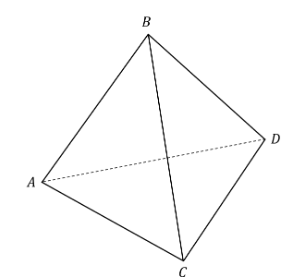
With respect to the origin , the points , , and have position vectors given by
\overrightarrow{OA} = \begin{pmatrix} 1 \\ 1 \\ 1 \end{pmatrix} , \quad \overrightarrow{OB} = \begin{pmatrix} - 8 \\ 10 \\ 1 \end{pmatrix} , \quad \overrightarrow{OC} = \begin{pmatrix} - 3 \\ 6 \\ - 10 \end{pmatrix} , \quad \overrightarrow{OD} = \begin{pmatrix} - 2 k \\ 13 \\ k \end{pmatrix}
Find the position vector of .
The diagram below shows a cuboid whose vertices are , , , , , , and .
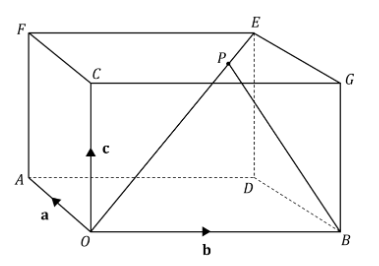
is a point on the diagonal that divides in the ratio , where .
Show that if line segment is extended it will intersect , and show that is divided in the ratio \left(a - b\right) : b by the point of intersection.