18 markseasy
2 marks
and
Work out the values of and .
3 marks
On a sketch of an Argand diagram, show the points representing , , and .
3 marks
On a separate sketch of an Argand diagram, show , , and as position vectors.
34 questions · 219 marks · ≈ 4 hours
and
Work out the values of and .
On a sketch of an Argand diagram, show the points representing , , and .
On a separate sketch of an Argand diagram, show , , and as position vectors.
Find the modulus of each of the following, giving your answers as exact values.
(i)
(ii)
(iii)
(iv)
(v)
(vi)
(vii)
(viii)
The diagram shows how the principal argument of a complex number , the argument lying in the interval , is obtained from the acute angle in each quadrant.
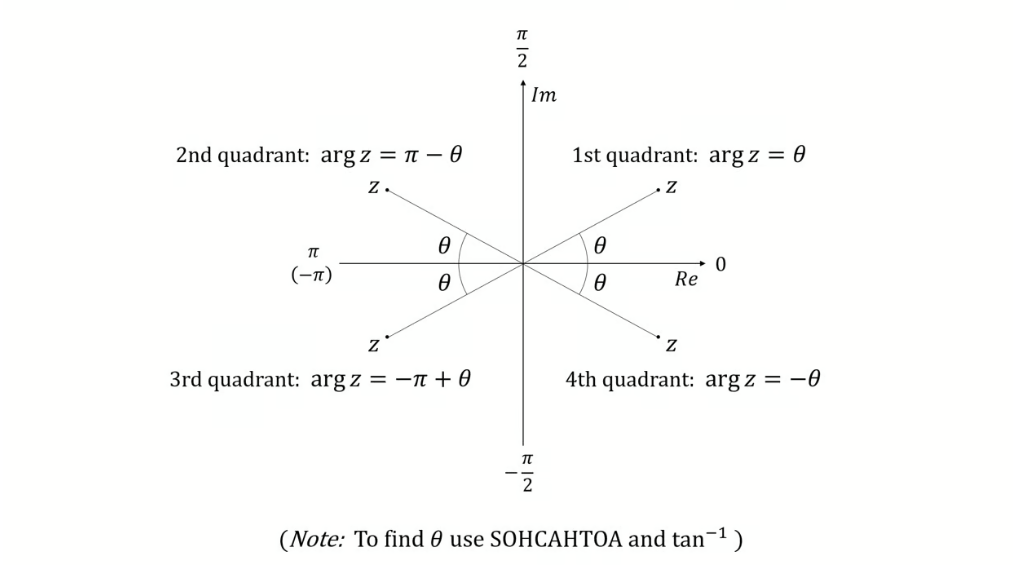
Write down the principal arguments of
(i)
(ii)
(iii)
(iv)
Find the principal arguments of the following complex numbers, giving your answers as exact values.
(i)
(ii)
(iii)
(iv)
Find the principal arguments of the following complex numbers, giving your answers correct to 3 significant figures.
(i)
(ii)
(iii)
(iv)
The complex number is such that , where is a real constant.
Show that |z| = \sqrt{50 + 50p^{2}}.
Given that |z| = 10, find the two possible values of .
For each of the values of found in part (b), find the argument of the corresponding complex number , giving your answers correct to 3 significant figures.
Given also that the point representing lies in the fourth quadrant of the Argand diagram, write down the value of .
A complex number may be written in modulus-argument form as
where r = |z| and .
Express the complex number in modulus-argument form. Give in radians correct to 3 significant figures, in the interval .
A complex number has modulus 14 and argument .
Express in the form , where and are real numbers given as exact values.
Explain why each of the following is not in modulus-argument form.
(i) z_{1} = -4\left(\cos\frac{\pi}{4} + i\sin\frac{\pi}{4}\right)
(ii) z_{2} = 5\left(\cos\frac{\pi}{3} - i\sin\frac{\pi}{3}\right)
(iii) z_{3} = 7\left(\cos\frac{\pi}{6} + i\sin\left(-\frac{\pi}{6}\right)\right)
For two complex numbers and ,
|z_{1}z_{2}| = |z_{1}||z_{2}|
\left|\frac{z_{1}}{z_{2}}\right| = \frac{|z_{1}|}{|z_{2}|}
\arg\left(\frac{z_{1}}{z_{2}}\right) = \arg(z_{1}) - \arg(z_{2})
Use these results to work out the following, giving your answers in modulus-argument form.
(i) 5\left(\cos\frac{\pi}{3} + i\sin\frac{\pi}{3}\right) \times 4\left(\cos\frac{\pi}{2} + i\sin\frac{\pi}{2}\right)
(ii) 12\left(\cos\frac{\pi}{2} + i\sin\frac{\pi}{2}\right) \div 3\left(\cos\frac{3\pi}{4} + i\sin\frac{3\pi}{4}\right)
(iii) \sqrt{3}\left(\cos\frac{\pi}{6} + i\sin\frac{\pi}{6}\right) \times \sqrt{6}\left(\cos\left(-\frac{3\pi}{4}\right) + i\sin\left(-\frac{3\pi}{4}\right)\right)
(iv)
On an Argand diagram, sketch the locus of points for which
|z - (1 - 3i)| = 4
Use your sketch from part (a) to write down a complex number satisfying each of the following.
(i) |z - (1 - 3i)| < 4
(ii) |z - (1 - 3i)| > 4
On an Argand diagram, sketch the locus of points for which
|z - (3 + 5i)| = |z - (-3 - i)|
Use your sketch from part (a) to write down a complex number satisfying each of the following.
(i) |z - (3 + 5i)| < |z - (-3 - i)|
(ii) |z - (3 + 5i)| > |z - (-3 - i)|
On an Argand diagram, sketch the locus of points for which
Use your sketch from part (a) to write down a complex number satisfying each of the following.
(i)
(ii)
The solutions of the quadratic equation are and .
Work out the values of and , giving your answers in the form , where and are integers.
On an Argand diagram, show the points representing , , and as position vectors.
The complex number is given by .
Show that .
Find, showing your working,
(i) |z^{2}|
(ii) , giving your answer in radians correct to 2 decimal places.
Show the points representing and on an Argand diagram.
The complex numbers and are such that and , where is a real constant.
Show that .
Given that |z_{1}| = \sqrt{130}, find the two possible values of .
Given also that \arg(z_{1}) = \tan^{-1}\left(\frac{9}{7}\right), find the value of .
Express the complex number in the form , where is a positive real number and is given in radians correct to 2 decimal places, in the interval .
A complex number has modulus 8 and argument .
Express the number in the form , where and are real numbers.
(i) Find , giving your answer in the form , where and are real numbers.
(ii) Find the modulus and argument of each of , and , and show that these satisfy the standard results
|z_{1}z_{2}| = |z_{1}||z_{2}|
(i) Using your answers to part (a) and the standard results
\left|\frac{z_{1}}{z_{2}}\right| = \frac{|z_{1}|}{|z_{2}|}
\arg\left(\frac{z_{1}}{z_{2}}\right) = \arg(z_{1}) - \arg(z_{2})
calculate the values of \left|\frac{z}{w}\right| and \arg\left(\frac{z}{w}\right).
(ii) Hence express in the form , where is a positive real number and is given in radians correct to 2 decimal places.
z_{1} = 12\left(\cos\frac{\pi}{6} + i\sin\frac{\pi}{6}\right)
z_{2} = 3\left(\cos\frac{5\pi}{12} + i\sin\frac{5\pi}{12}\right)
Work out
(i)
(ii)
giving your answers in modulus-argument form.
Given that |z - 3| = |z - 4i|,
(i) on an Argand diagram, sketch the locus for which the equation is true,
(ii) shade the region of your diagram that satisfies the inequality |z - 3| \geq |z - 4i|.
Given that ,
(i) on an Argand diagram, sketch the locus for which the equation is true,
(ii) shade the region of your diagram that satisfies the inequality .
Show that 7 and are roots of the equation , and write down the third root of the equation.
Verify that there is a constant such that all three roots of the equation satisfy
|z - 2| = c
(i) Draw an Argand diagram showing the locus of points representing all complex numbers for which |z - 2| = c, and mark the points corresponding to the three roots of the equation .
(ii) Shade the region of your diagram that satisfies the inequality |z - 2| \leq c.
Find, showing your working,
(i)
(ii) \left|z^{2}\right|
(iii) \arg\left(z^{2}\right), giving your answer in radians correct to 2 decimal places.
Express the complex number in the form , where is a positive real number and is given in radians correct to 2 decimal places, in the interval .
A complex number has modulus and argument .
Express the number in the form , where and are real numbers.
z_{1} = 9\left(\cos\frac{\pi}{6} + i\sin\frac{\pi}{6}\right)
z_{2} = 4\left(\cos\frac{4\pi}{3} + i\sin\frac{4\pi}{3}\right)
Work out
(i)
(ii)
giving your answers in modulus-argument form with in the interval .
The solutions of the cubic equation are , and , where is real.
Given that , work out the other two solutions of the equation.
(i) On an Argand diagram, show the complex numbers , , and as position vectors.
(ii) Describe the geometric transformation that maps to .
The complex numbers and are such that and , where is a real constant.
Find in the form , giving the real numbers and in terms of .
Given that |z_{2}| = \sqrt{73}, find the possible values of .
Given also that in radians correct to 2 decimal places, determine the exact value of .
Given that |z + 1 - 2i| = |z - 7 + 4i|,
(i) on an Argand diagram, sketch the locus for which the equation is true,
(ii) shade the region of your diagram that satisfies the inequality |z + 1 - 2i| > |z - 7 + 4i|.
On an Argand diagram, sketch the loci for which each of the following equations is true.
(i)
(ii) |z - 3 - 2i| = 5
Shade the region of your diagram that satisfies both of the following inequalities.
|z - 3 - 2i| \leq 5
You are given that satisfies the cubic equation
Find the other two roots of the cubic equation.
Verify that there is a constant such that all three roots of the cubic equation satisfy
|z + 3| = c
Draw an Argand diagram showing the locus of points representing all complex numbers for which |z + 3| = c, and mark the points corresponding to the three roots of the cubic equation.
Given that is a root of the equation , use algebra to solve completely.
Show all three solutions on an Argand diagram.
The complex numbers and are such that and , where is a real constant.
Given that |z_{2}| = \sqrt{58}, find the possible values of , showing clear algebraic working.
Given also that in radians correct to 2 decimal places, find the exact value of \text{Im}\left(z_{2}^{\star}\right).
z_{1} = -4\left(\cos\frac{\pi}{3} - i\sin\frac{\pi}{3}\right)
z_{2} = 2\left(\cos\frac{2\pi}{3} - i\sin\frac{2\pi}{3}\right)
Re-express and in correct modulus-argument form with in the interval .
Work out
(i)
(ii)
giving your answers in modulus-argument form with in the interval .
(i) On an Argand diagram, show the complex numbers , and as position vectors.
(ii) Use your diagram to explain briefly why we speak of a "parallelogram rule" for complex number addition.
On an Argand diagram, shade the region which satisfies both of the following inequalities.
|z - 4i| > |z|
|z - 4i| < |z + 2|
For a general complex number , where and are real and ,
(i) show that \frac{1}{z^{\star}} = \frac{z}{|z|^{2}},
(ii) show that \arg\left(\frac{1}{z^{\star}}\right) = -\arg(z^{\star}),
(iii) given that , write down in radians the principal argument of z + z^{\star}.
Express in the form , where is a positive real number and is given as an exact value in radians in the interval .
A complex number is such that |w| = \sqrt{2}|z| and .
Express in the form , where and are real numbers.
On an Argand diagram, shade the region which satisfies all three of the following inequalities.
|z + 4 - 3i| \leq 3
|z + 8| > |z + 4|
Given that
find all three roots of the equation , showing clear algebraic working.
Verify that there is a constant such that all three roots of the equation satisfy
|z - i| = c
Draw an Argand diagram showing the locus of points representing all complex numbers for which |z - i| = c, and mark the points corresponding to the three roots of the equation .