Which parabola?
Excerpt: This problem is good for thinking about how the equation of a parabola relates to its appearance on the graph, and for starting to think about transformations of graphs.
Question
This would also like sourceUrl http://nrich.maths.org/791
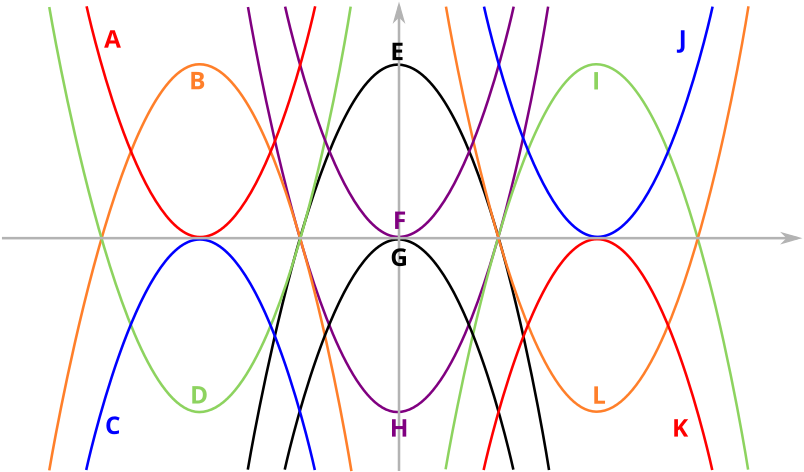
Given that two of the parabolas have the equations and can you find the equations of the other parabolas?
You might like to design your own pattern of parabolas, perhaps using Desmos. You could start from our design, if you like.
Problem
This would also like sourceUrl http://nrich.maths.org/791
Given that two of the parabolas have the equations and can you find the equations of the other parabolas?
You might like to design your own pattern of parabolas, perhaps using Desmos. You could start from our design, if you like.
Suggestion
Can you factorise these equations? What does this tell you about the graphs of these two functions?
What is the difference between the graphs of and y=? Can you spot any graphs in the picture that might satisfy such a relation?
If you know that a graph has equation , what is the equation of its reflection in the -axis?
Solution
Given that two of the parabolas have the equations and can you find the equations of the other parabolas?
Here is a summary of the equations that you should have found.
| Parabola | Equation |
|---|---|
| A | |
| B | |
| C | |
| D | |
| E | |
| F | |
| G | |
| H | |
| I | |
| J | |
| K | |
| L |
Here is a way to find the equations of the parabolas.
We will first look at the equation
The graph of this equation will intersect the -axis at and . The are only two parabolas in the picture that intersect the positive -axis twice: parabolas I and L, which are symmetrical about the -axis, which corresponds to the map . Since the coefficient of is positive, we know the parabola must look like rather than , so the equation must correspond to parabola L. But we now also know what the equation of parabola I is: .
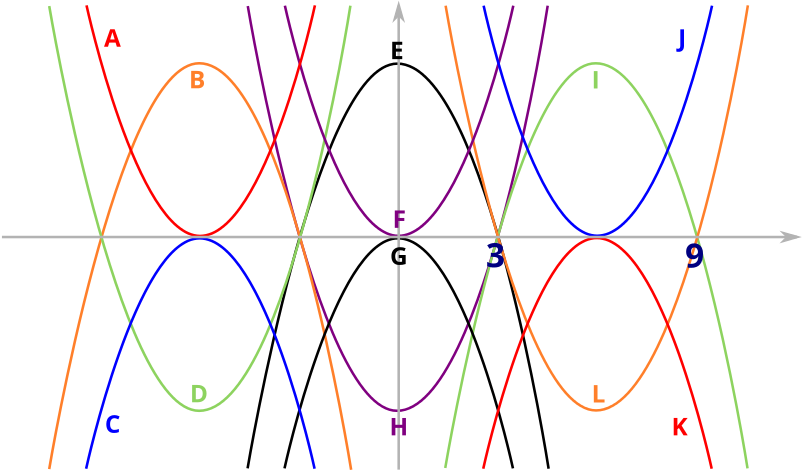
We can now mark some points on the -axis
We can also see from the picture that parabola B corresponds to parabola I reflected in they -axis. This reflection corresponds to the map , so we can see that the equation of parabola B is . Similarly, parabola D is parabola L reflected in the -axis, so parabola D has the equation .
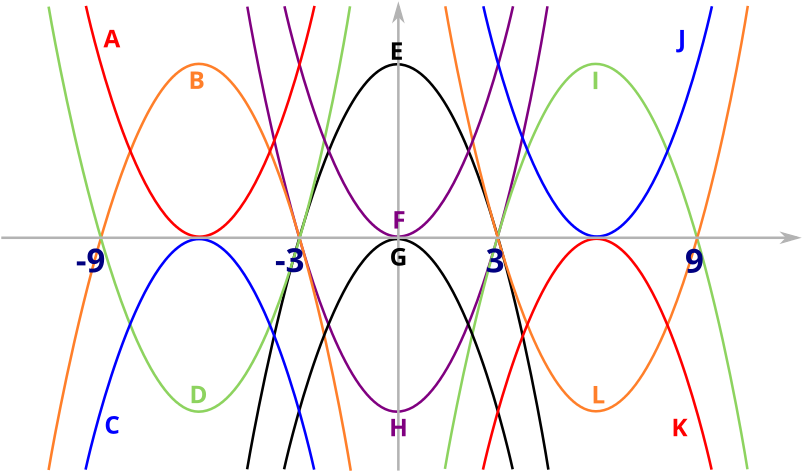
We can now mark more points on the -axis
Now let’s think about the equation
The parabola corresponding to has a double root at , so the top of the parabola must just touch the -axis (the coefficient of is so it looks like rather than ). We know where and are on the picture because we know that parabola B and D intersect the -axis at these points. Parabola A and C both have a double root at , so from their shapes we see that equation must be the equation of parabola C, and that the equation of parabola A, its reflection in the -axis, must have the equation .
We can see from the picture that parabolas J and K are parabolas A and C reflected in the -axis respectively. So parabola J must have the equation corresponding to parabola A under the transformation , which is . Similarly, parabola K has the equation .
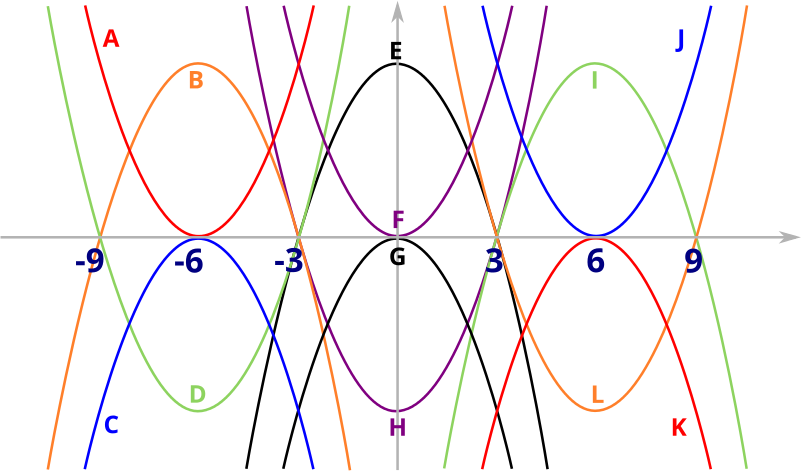
We can now mark all of the important points on the -axis
We still need to find the equations of parabolas E, F, G and H. From the picture, we see that E and H both intersect the -axis at the points and , so they look like , for some . From their shapes, we see that parabola E has equation and parabola H has equation . To find the value of , we compare to parabola I, which has the same height. The peak of parabola I is in the middle of its two roots, since a parabola is symmetrical. So the height of parabola I, and therefore of E, is . Since the peak of parabola E is at , we require that , and so .
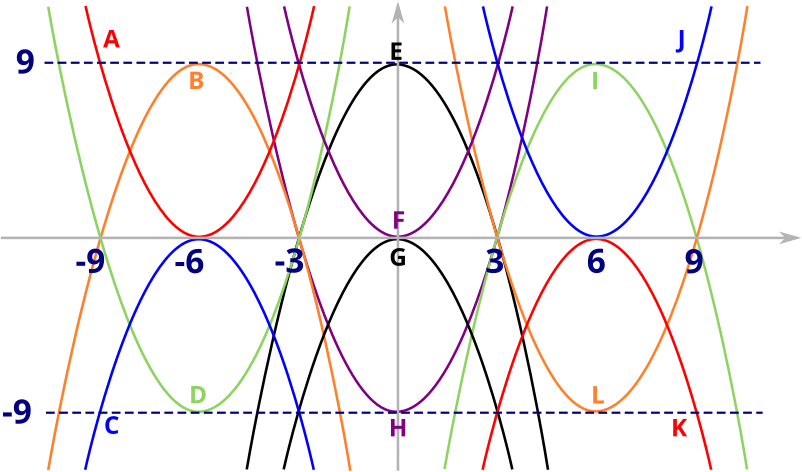
We now know the heights of the parabolas
Finally, parabolas F and G both have a double root at , which means they have the form , for some . Again looking at their shapes, we see that parabola F has equation and parabola G has equation . To find the value of , notice that parabola F is a translation of parabola J along the -axis by in the negative direction. So the equation of parabola F must be that of parabola J evaluated at instead of , and so is . So .