Stretch the function
Excerpt: Students evaluate definite integrals in order to find a scale factor that makes each function satisfy a pair of conditions. A connection is made between the definite integral and the area between the graph and the axis.
Warm-up
Evaluate the definite integral
Find the value of the constant so that
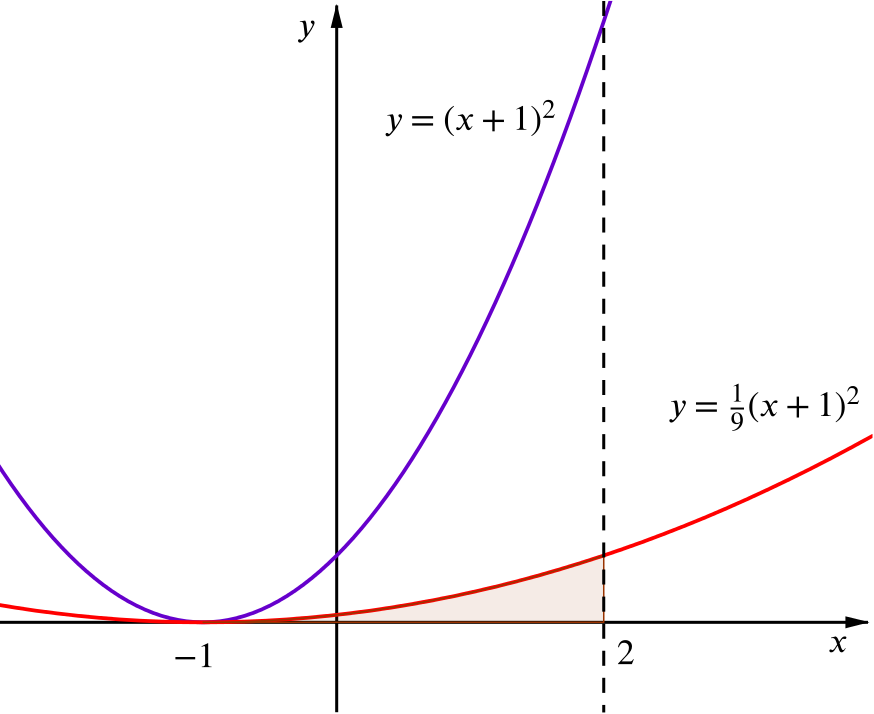
Sketch graphs to illustrate how these definite integrals are related.
Solution
Probably the easiest way to evaluate this integral is to expand the bracket (later you will learn about other ways to do it).
If we want then we need our integral to be times smaller. We can do this by scaling (i.e. vertically stretching) our function by a factor of . So .
We have used the fact that for a function , Is this always true?
Problem
In the Warm-up we scaled (or stretched) a function so that
-
Which of the following functions could we scale to satisfy this condition and what is the value of in each case?
-
Which ones lead to problems and why?
-
How would your answers be different if we changed the condition to
The functions
Can you think of some other functions which cannot be scaled to satisfy one or both of our conditions?
Solution
If we evaluate the integral, we find So we could scale this function to satisfy the integral condition, and we have .
To find the area between the curve and the -axis, we could either evaluate the integral in two parts or work out the areas of two triangles.
So to satisfy the area condition we need .
The answers for the two conditions are different because the curve is below the axis for part of the interval .
Note that the definite integral does tell us about the area, but that it subtracts the areas below the axis from those above.
The definite integral tells us something about the average value of the function over the given interval.
We need to evaluate
and we find that
satisfies the integral condition.
Why does need to be negative? What does that mean geometrically?
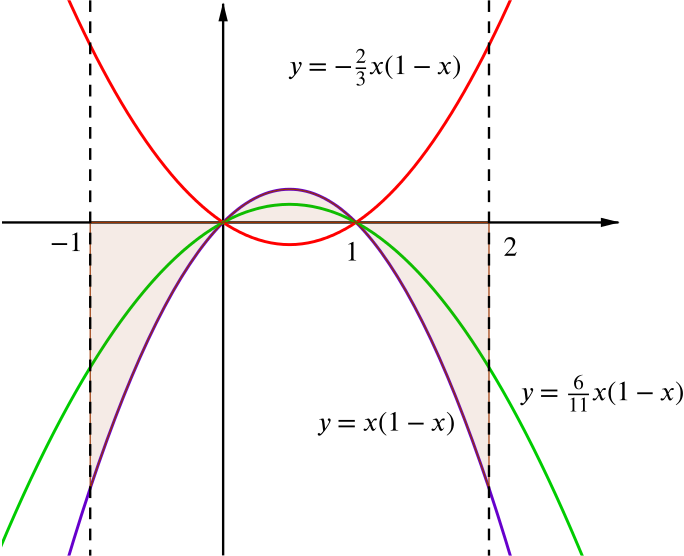
We notice that at and which are both within our interval, so the curve crosses the -axis twice. Drawing a sketch will help us to think about the area condition – we will need to work out the integral in several parts.
The area will be given by
Note how we subtract the integrals for the parts of the curve that lie below the -axis because these integrals have negative values.
The symmetry of the curve means that we actually only have to calculate two integrals.
So we need to satisfy the area condition.
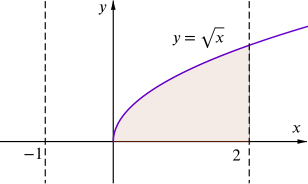
We hit a problem with this function as we can't integrate it directly across the interval. For the function is essentially , whereas for it is . So we can do the integral in two pieces or more simply look at the two triangles. The graph of this function is entirely above the axis so the same scale factor, , satisfies both conditions.
This function is undefined for so we can’t integrate it over the whole interval or find a scale factor for the integral condition.
However, we can find the area under the curve by integrating from to . It is
so would scale the area as required.
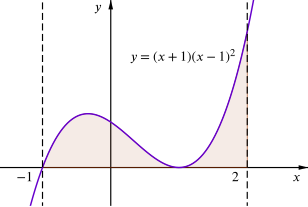
To integrate this we will need to expand the brackets, giving .
so we find for the integral condition.
For the area condition we need to consider where the integral has a negative value.
How many times does the curve cross the -axis in the interval from to ?
As the graph is entirely above the axis, the same scale factor will work for the area condition as for the integral condition.
We see that we only need to split this into two parts. and thus for an area of the scaled function must be .
This time when we expand and integrate we find the interesting result that . This will always be whatever scaling we use.
Can you explain why this has happened?
Once we draw a sketch and think about the areas above and below the axis, we can find the area and hence meet the area condition using .
Note that we do not need to evaluate two integrals to find the area. Using the symmetry of the graph we can instead evaluate .
You may not know how to integrate this yet. If you do, we still have an issue as the function is undefined at where there is a vertical asymptote. There is an infinite area between the curve and the -axis. A definite integral is only properly defined if the function is continuous between the two limits, otherwise it is called an
.
It looks intuitively as though the integral from to would exactly cancel the integral from to , but that involves subtracting infinities which is not really safe. It can be allowed under some circumstances and we'll explore that in the next section.
This function is undefined at where there is a vertical asymptote. There is an infinite area between the curve and the -axis. A definite integral is only properly defined if the function is continuous between the two limits, otherwise it is called an improper integral.
So although it looks as though we can find this is in fact absurd. We should always check that a function is continuous over the interval before evaluating a definite integral.
Any function which is undefined over part of the interval will be a problem for the integral condition.
Any function with a singularity (vertical asymptote) in the interval will be a problem, except in a few special cases.
When a function has rotational symmetry about the mid point of the interval, i.e. , then the area above and below the axis will be equal. The integral will evaluate to which cannot be scaled to however hard we try! So the integral condition cannot be satisfied, but often the area condition can.
There are other cases with zero integral which are not symmetrical in this way. For instance, starting with a simple function like we can find and choose a value of which gives . Can you extend that to find other functions?
Are there any functions without singularities for which an area of cannot be achieved?

A disagreement
In the main problem, we were trying to find a function, , such that
Abi says, so would satisfy the condition.
Ben says, so would satisfy the condition.
Charlie says, so would satisfy the condition.
Are any of them right?
A resolution
In the main problem, we were trying to find a function, , such that
Abi says, so would satisfy the condition.
If you haven’t already sketched graphs of the suggested functions it would be a good idea to do so now.
The three functions all have vertical asymptotes at . An integral of any of these over must therefore be treated with extreme caution. They are known as improper integrals.
A sketch graph suggests that Abi’s proposal is wrong. The graph is entirely above the -axis and appears to contain an infinite area between the graph and the axis.
If we split the region into two we find we cannot evaluate either piece,
There is no way round this. Abi is wrong.
Charlie says, so would satisfy the condition.
Charlie’s function has a vertical asymptote so we should see what happens if we try to integrate it in pieces. and and
Surprisingly, we can integrate up to the asymptote without a problem. The piece from to exactly cancels the piece from to and so integrating from to gives the same result as integrating from to . Although the function is undefined at , the curve encloses a finite area. This is a bit like summing an infinite series and getting a finite result.
Charlie is correct.
Ben says, so would satisfy the condition.
Ben’s function has a similar shape to Charlie’s. But this time we cannot evaluate the integral because it involves dividing by zero. So the integral does not have a proper value.
The geometry of the graph suggests that the pieces either side of should cancel out as they did for Charlie. But this is problematic because it involves subtracting one infinity from another which is not a safe thing to do.
The mathematics is really beyond this level, but it is possible to construct an argument based on symmetrical limiting cases which allows us to effectively cancel the two areas. This result is known as the Cauchy Principal Value of the ill-defined integral. You may learn about this if you go on to study mathematics at university.
In this case, the value does work out at as Ben stated, so we can say that Ben is correct.
So why does Charlie’s function work properly whereas Ben’s only works improperly?
The distinction is to do with how quickly the function converges with the vertical asymptote. A function has a finite area close to the -axis if .