What's the distance from a point to a line in the plane?
Question
Show that the perpendicular distance of the point from the straight line is the numerical value of [“Numerical value” means ignoring whether it is positive or negative, that is, the absolute value of this expression.]
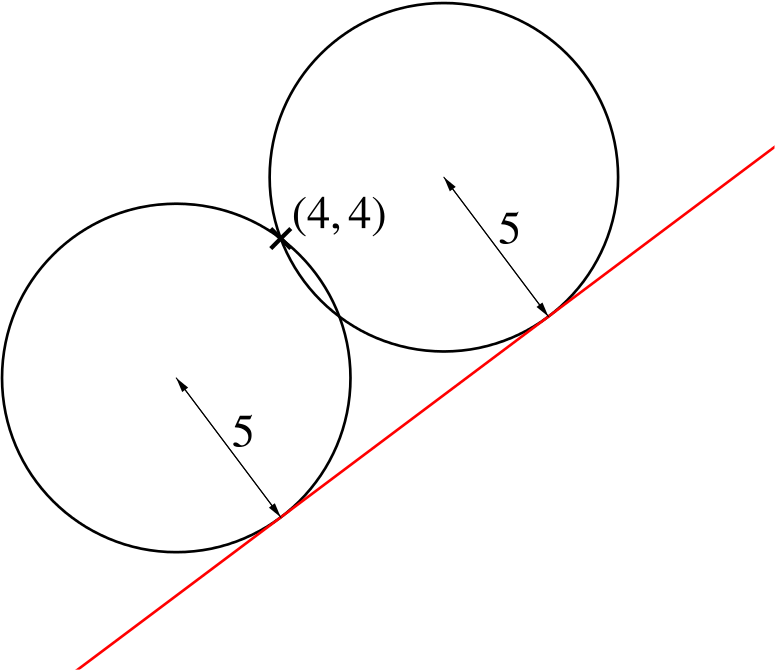
Calculate the coordinates of the centres of the two circles of radius which pass through the point and touch the straight line .
Suggestion
Can we draw a diagram that helps here? If we draw the line , what is its gradient? Which angle is in the diagram?
How does this part relate to the first part? Draw a new diagram to get a feel for this.
Can we derive expressions involving the coordinates of the centres of the circles?
Remember that the first part only gives us the “numerical value” of the expression. If you want to find out whether it’s positive or negative, you will have to do some extra work.
Solution
Two approaches to this question are given here; the first approach comes to mind more quickly, perhaps, but the second approach works for any value of .
Approach 1
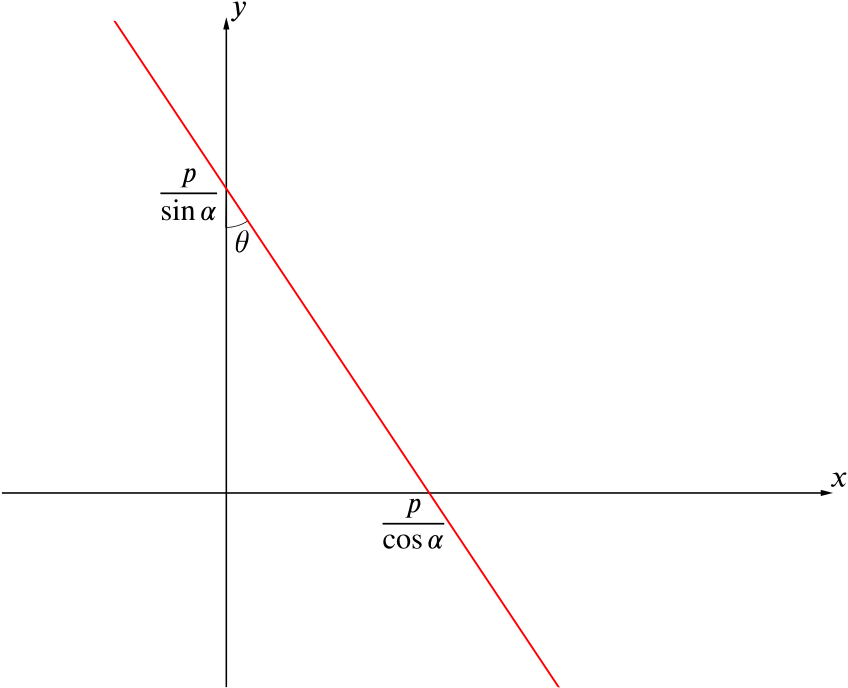
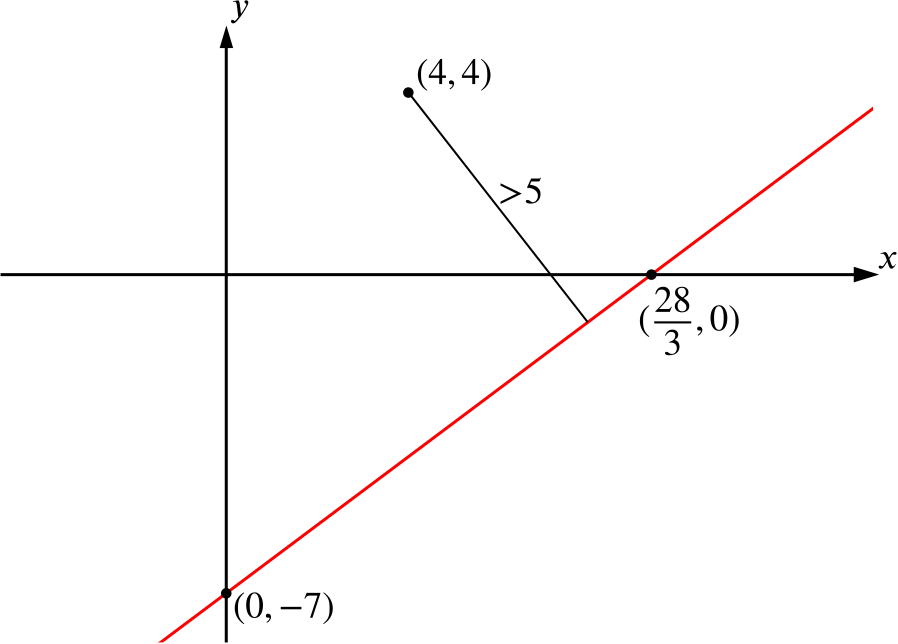
We begin by sketching the line , and finding the points of intersection with the and axes.
By substituting into the equation of the line, we get that the line intersects the -axis at . Similarly, the line intersects the -axis at .
We may have wondered up until now about the significance of our constant and if it represents any of the angles in our diagram. Consider the angle , as shown in the diagram above. We know that
This now tells us that .
Does this argument still work in the case where is obtuse or reflex? Will our angle still be equal to in this case?
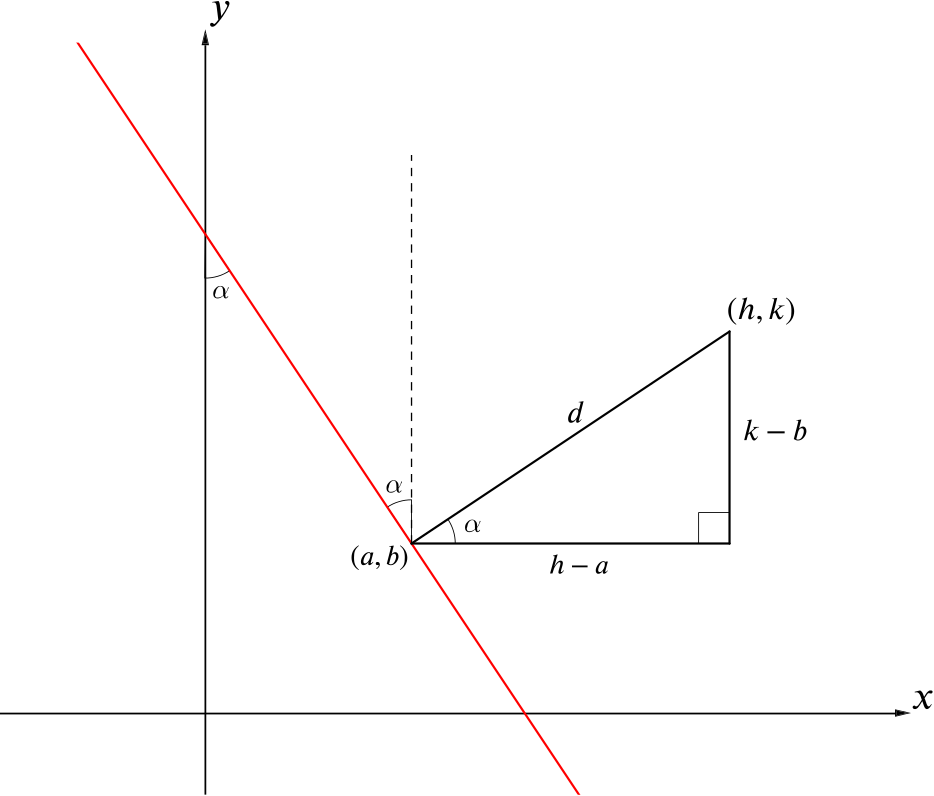
We’ll label the perpendicular distance from the point to the line , and the point of intersection (we’ll assume that is on the opposite side of the line to the origin).
By alternate angles, we know that the angle between the line and the vertical at is , and hence the angle between the perpendicular line and the horizontal must also be .
By considering the right-angled triangle in the diagram above, we see that
which we can rearrange to give
As is a point on the line, we know that and so
which rearranges to
as required.
If was on the same side of the line as the origin, in what ways would our calculations change?
Approach 2
We’ll begin by considering our original diagram; we’ve found the significance of , can we find the significance of as well?
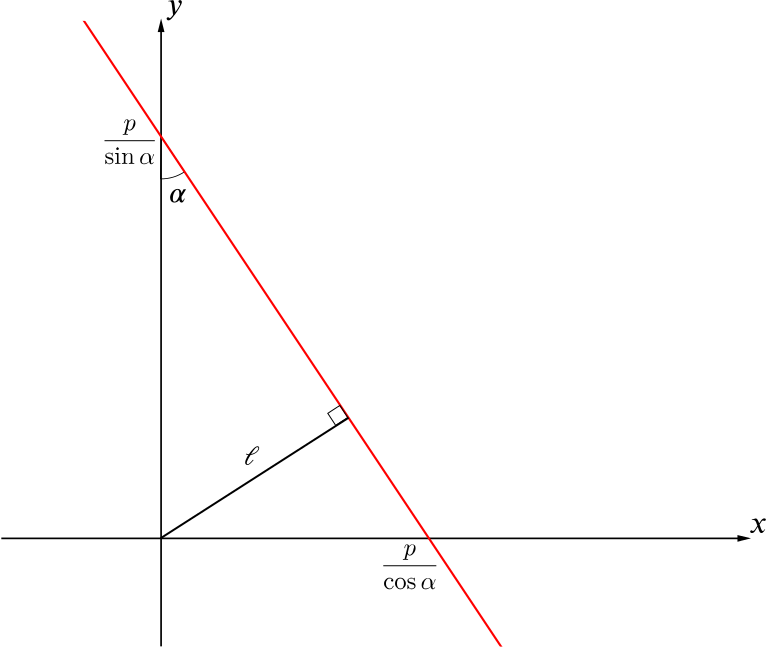
Can we find the perpendicular distance of the line from the origin? The intercepts are proportional to , so it’s reasonable to think that this distance will be too.
So adding in this line, we can see a right-angled triangle with angle and hypotenuse .
Letting be the length of the perpendicular line, we see that
and rearranging gives us
Therefore represents the perpendicular distance of the line from the origin.
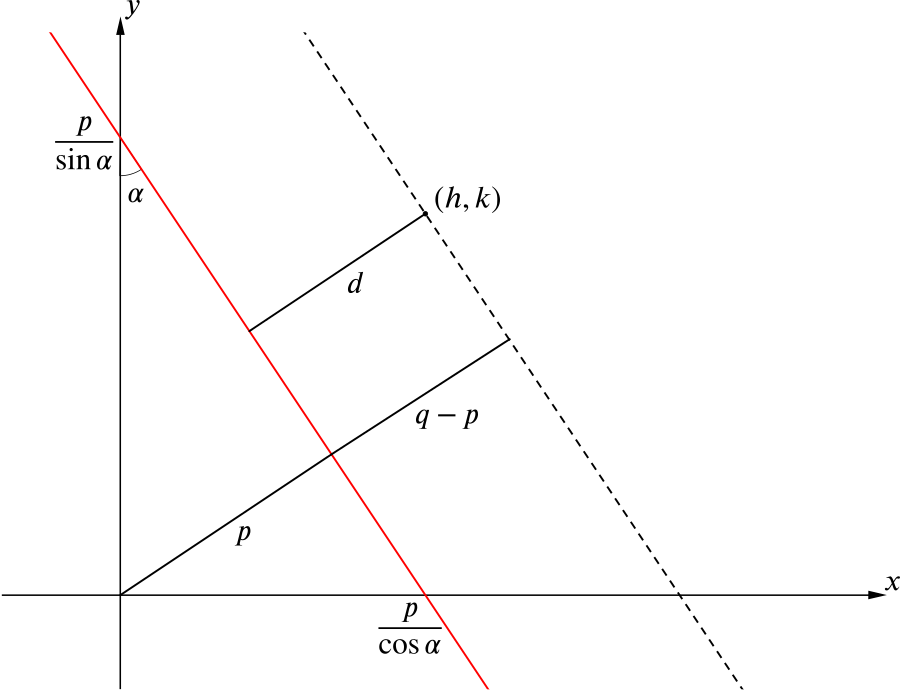
With our new result in mind, we now consider the line passing through and parallel to our original line.
By our result above, the equation of this line is , where is the perpendicular distance from the line to the origin.
We can see that the perpendicular distance from the original line to the point is equal to the difference between the two perpendicular distances from the origin.
We can write this as to account for the case where , i.e. the case where is on the other side of the line.
As is a point on the line, this can be rewritten as
Would our conclusion still be the same if was negative?
It may be worth taking a step back and thinking about the two approaches we have just seen.
Which one do you prefer? Does one or the other provide more insight to the result?
We need to find the points that are a distance of away from , and which have perpendicular distance from the line .
We can use the formula for distance that we have just found.
The line we’ve been given is not quite in the form we require, since and cannot be the values of or .
But we can scale the whole equation by a real positive number . We multiply through to get which gives Dividing these gives , which means is a reflex angle (this wasn’t explicitly dealt with above, but our argument can accommodate this without too much trouble).
Since we see that , so . We can write the line as so , , and .
The perpendicular distance from to the line is
Let denote the coordinates we are trying to find. Note that we need to find two possible options for .
The perpendicular distance between and the given line is
From our sketch we can see that is on the same side of the line as the origin, and so the points we seek must be the same side of the line as the origin also.
How far are our centres from the line? We have (we must have -5 here, since we are on this side of the line) which is equivalent to
Since the distance between and is , we also know that , and substituting for we obtain which can be rearranged to give the quadratic which is satisfied for , and .
So we have the two points and as the centres of our two circles.