Can we calculate the total time taken for this car journey?
Question
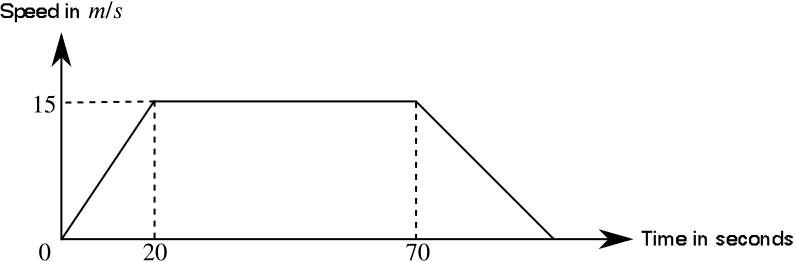
The diagram shows a speed-time graph of a car.
- Calculate the acceleration of the car during the first seconds.
- Calculate the distance the car travels from rest before it begins to decelerate.
- Given that the car decelerates at , calculate the total time taken for the journey.
Suggestion
The diagram shows a speed-time graph of a car.
Which part of the above graph represents the acceleration of the car?
How is the distance the car travels represented?
Can we find the equations of the straight line parts of the graph?
How can you use this to compute the total time taken for the journey?
Solution
The acceleration at any point is given by the gradient of the line, so the acceleration is constant on each section.
The gradient for the first section is , and so the acceleration of the car during the first seconds is .
The distance the car travels is given by the area below the graph up to .
We’ll split this area into two pieces, the left hand side triangle (the distance the car travels during the first 20 seconds), and the rectangle for .
The base of the triangle is and the height is , and so the area of the triangle is given by .
The rectangle has sides of lengths and and so has an area of
Therefore, the total distance the car travels before it begins to decelerate is .
We’ll describe the deceleration of the car as a linear function, or the equation of a straight line, and then compute the -intercept.
The general form for a linear function is , where is the slope of the function and is the -intercept.
We already know that the gradient of the graph is , so the function is of the form
The graph passes through the point , so the function has to satisfy , which yields .
The function describing the graph for is therefore given by
The -intercept is the solution to , which gives . Therefore, the total time taken for the journey is .