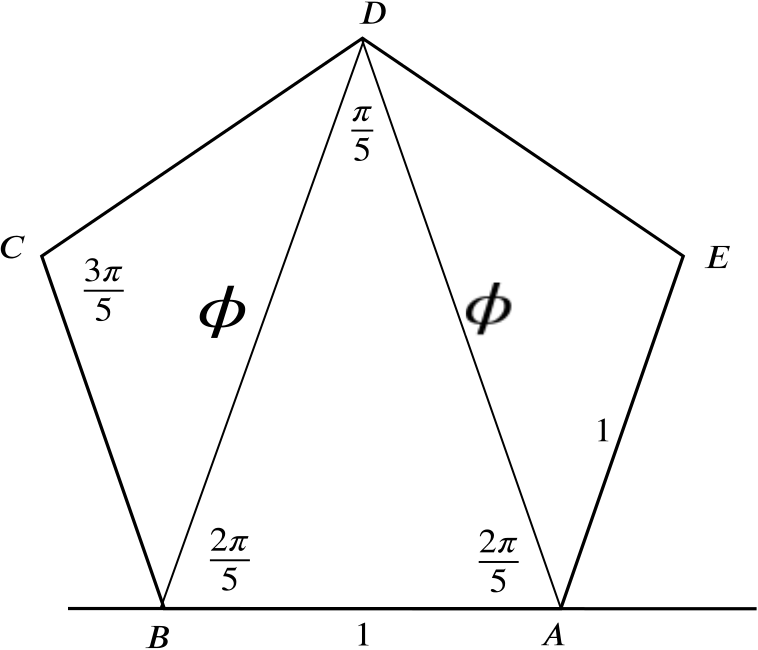
ABCDE is a regular pentagon. By projecting the broken line AED on the line AB, or otherwise, show that cos5π−cos52π=21.
Hence, or otherwise, show that cos5π=45+1.
Show further that cos53π=−45−1.
Suggestion
ABCDE is a regular pentagon. By projecting the broken line AED on the line AB, or otherwise, show that cos5π−cos52π=21.
Let’s assume that the side lengths of the pentagon are 1.
Can we draw a large, clear diagram of the pentagon ABCDE, with AB horizontally at the bottom?
What are the angles inside a regular pentagon, in radians?
If we now drop perpendiculars from D and E to the horizontal, can we start to find lengths and angles?
Using the first part, are there any trigonometrical identities we could use? To get this just in terms of cos5π?
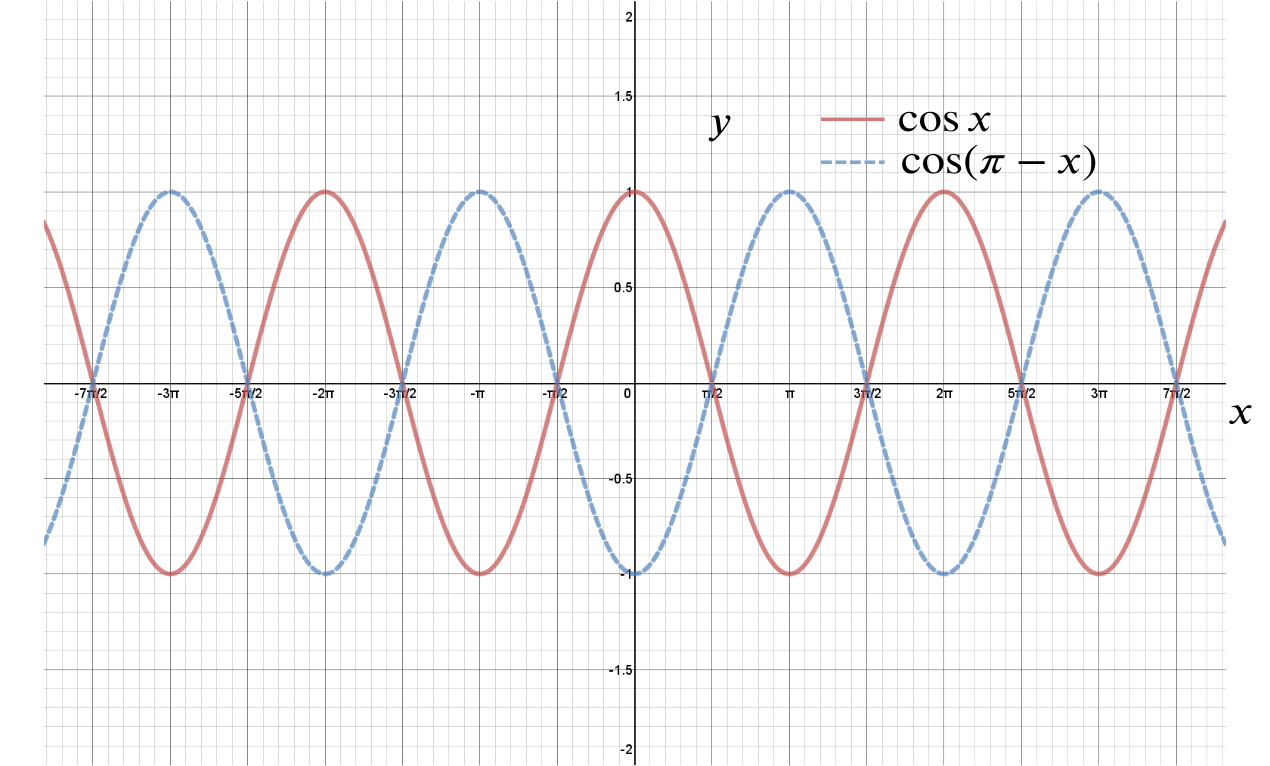
What’s the sum of 53π and 52π? How does this connect cos53π and cos52π?
Solution
ABCDE is a regular pentagon. By projecting the broken line AED on the line AB, or otherwise, show that cos5π−cos52π=21.
Method 1
The sum of angles inside a n-sided polygon is (n−2)π, so each angle inside our regular pentagon is 53π. For simplicity we choose each side to be of length 1.
Let
D′
and
E′
be the points
D
and
E
projected onto the line
AB
as shown. Since
ABCDE
is a regular pentagon,
D′A=21.
From the right-angled triangle
AEE′
we see that
AE′=cos52π,
and from the triangle
DPE
we find that
D′E′=PE=cos5π.
Since
D′E′=D′A+AE′,
we get the result
cos5π−cos52π=21.(∗)
Method 2
The question says ‘or otherwise’, so we’re free to pick another method if we wish.
The regular pentagon is intimately connected with ϕ, the Golden Ratio =1.61803..., which is the positive solution to x2−x−1=0.
Using the Cosine Rule in ABD one way, cos52π=2ϕ1. Using the Cosine Rule in ABD another way, cos5π=2ϕ22ϕ2−1.
We then use the quadratic formula to solve for γ: we have γ=cos5π=2×42±4−4×4×(−1)=41±5. We know that 5π<2π so cos5π>0 and thus we choose the positive root: cos5π=41+5.
We use the fact that cos(π−θ)=−cosθ, which we can see from the diagram.