Can we solve this equation with a sum of square roots?
Question
- Sketch the curve . Use your sketch to show that only one real value of satisfies and give this value.
- Determine graphically the number of real values of that satisfy Solve this equation.
Suggestion
For what values of is defined?
Try evaluating the function for some integer values of . What does this suggest about the function?
Are there any stationary points? If so, where and of what type?
Solution
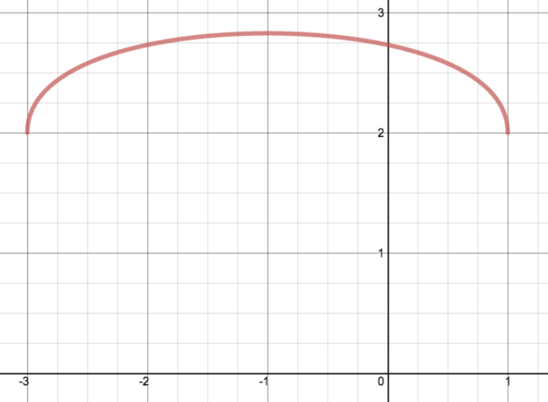
First, we identify some key properties of the graph so we can sketch it.
- The right-hand side is defined only for , so the endpoints are at and .
- If we evaluate the function (let’s call it ) at a few points, we find that
This suggests that the function is symmetrical about the line . In fact, we can show this, since So our curve is the graph of shifted to the left, and it’s easy to see that the graph of is symmetrical about the -axis.
- Although this is not essential to sketch the curve, we can differentiate to find the stationary points. We have so to find the stationary points we find when this is zero. We have and we can check that really does give derivative .
Clearly this is a maximum because the other points evaluated have values smaller than .
- We can also see that the gradient at the endpoints must be infinite, because when the expression for the derivative is evaluated at either of them, one of the fractions will be of the form .
This gives us enough information to sketch the curve.
Now to solve the equation given, we also plot the graph of and find where they intersect.
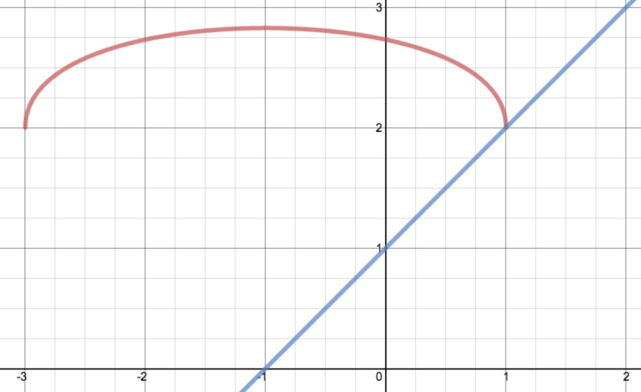
So we clearly see that is the only (real) solution.
Here we use a similar method, and sketch the graphs of the curves and .
The first is essentially the same curve as in (i), but defined on the interval , with its maximum at and symmetry about the -axis.
The second curve is similar to the graph of , with a translation, reflection and enlargement applied to it:
- Translation of one unit to the left:
- Reflection in the -axis:
- Enlargement by a scale factor of 2:
We can also see that the graph passes through and .
From this, we sketch the two graphs on the same axes.
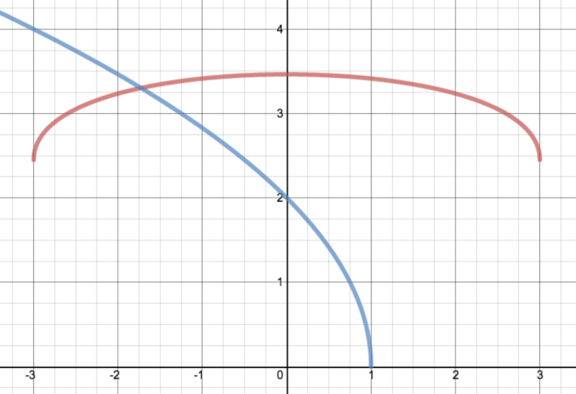
These curves intersect only once, when .
We use algebra to solve the equation:
We can solve this quadratic equation, to find that
Then one of these roots is positive and one is negative. However, only the negative root is a valid solution, as the sketch shows. So the solution of this equation is