If , when does have a maximum?
Question
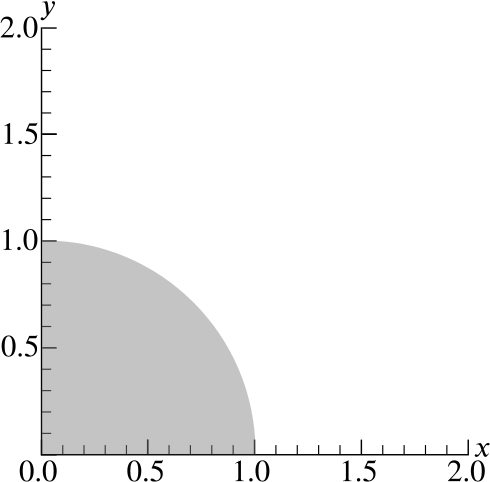
Let denote the quarter-disc of points such that , and as drawn in Figures A and B below.
Figure A
Figure B
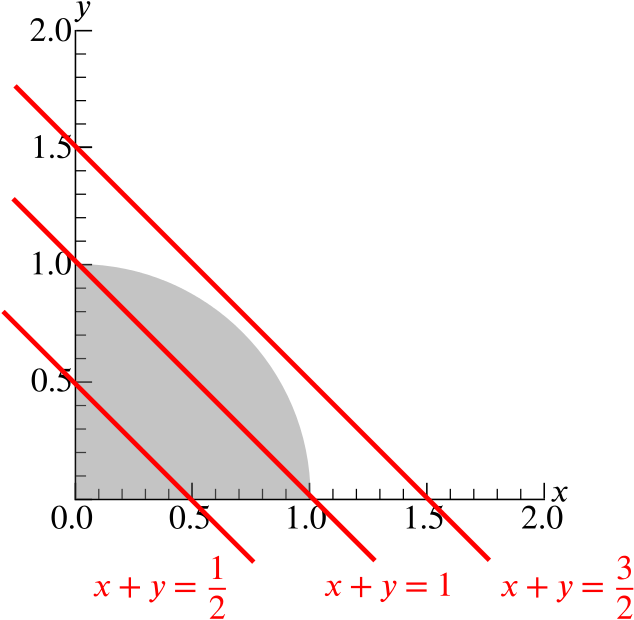
- On the axes in Figure A, sketch the graphs of What is the largest value of achieved at points in ? Justify your answer.
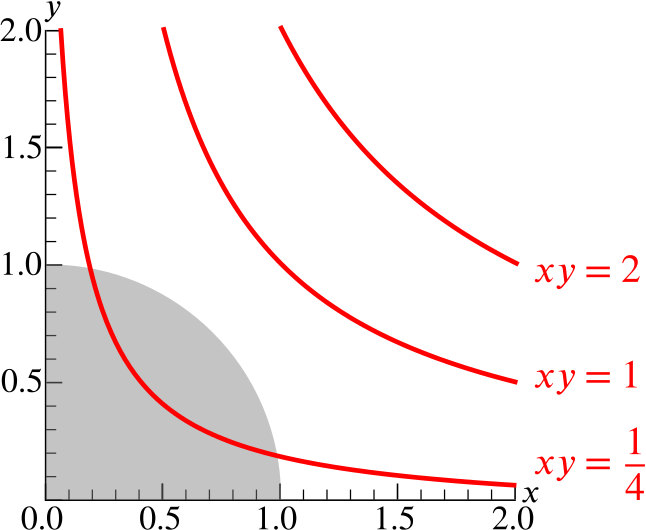
- On the axes in Figure B, sketch the graphs of What is the largest value of achieved at points in ? What is the largest value of achieved at points in ?
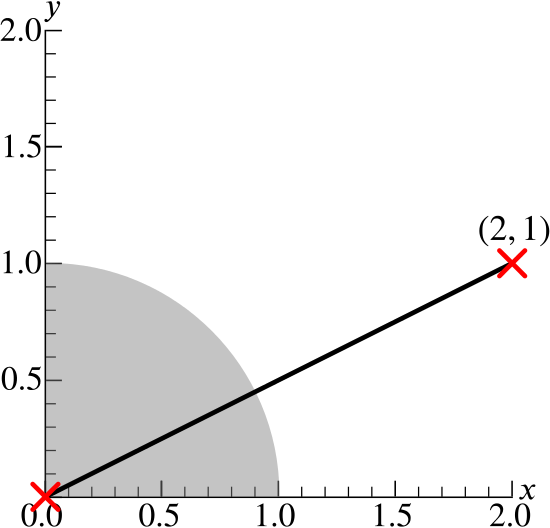
- Describe the curve where . What is the smallest value of achieved at points in ?
Suggestion
What do we observe in Figure A after drawing the three graphs? How are they related?
Is this part of the question similar to the previous part in any way?
How could we use the diagram to solve the problem?
‘If the largest values of two functions, say and , are and , and can take the value , then the largest value of is .’
Is this logic okay?
What similar statement can we make about the largest value of ?
How else can we write ? What curve does this look like?
Solution
Figure A
As we can observe, the line will see its largest value for when the graph is tangent to , that is, when the line is the furthest possible from the origin that still intersects the region.
Hence we want the value of such that the pair of simultaneous equations have a unique solution.
We have , or , which must have a discriminant of zero when viewed as a quadratic in .
Thus , and so , and . Hence, the largest value of on is .
Figure B
Similarly as above, will achieve its maximum value on when , when will be .
Since the maximum value of in is , the largest value of on is .
In order to get the largest value of we need the largest value of , which is , and the smallest value of , which is .
So the largest value of on is , achieved, for instance, at and .
The curve’s equation can be rewritten on completing the square as which becomes so it describes a circle of centre and radius . So is smaller if is closer to .
In order to find the smallest value of achieved at points in , we should find the closest point to in .
Since is the quadrant of the disc in the positive quadrant of the plane, and is in that same quadrant, the closest point can be obtained by drawing the straight line connecting the points and , and finding where this intersects with the circumference of .
Therefore the result will be the solution of the simultaneous equations By substituting into the second equation, we get so . So the smallest value of is where we have substituted for and into , noting as a check that .