Can we find the lengths and angles in this pyramid?
Review questionbeyond the specification map
Beyond the specification map. Pyramid altitudes and angles: 3D right-angle trig — IGCSE/0606 bearing. (Refines lane 4's routed-1.5 preview, which never claimed a final verdict.) It is kept in the library for extra maths practice, not as specification-point coverage.
Can we find the lengths and angles in this pyramid?
Question
An equilateral triangle ABC has side length 6 units. The three altitudes of the triangle meet at N. Show that AN=23 units.
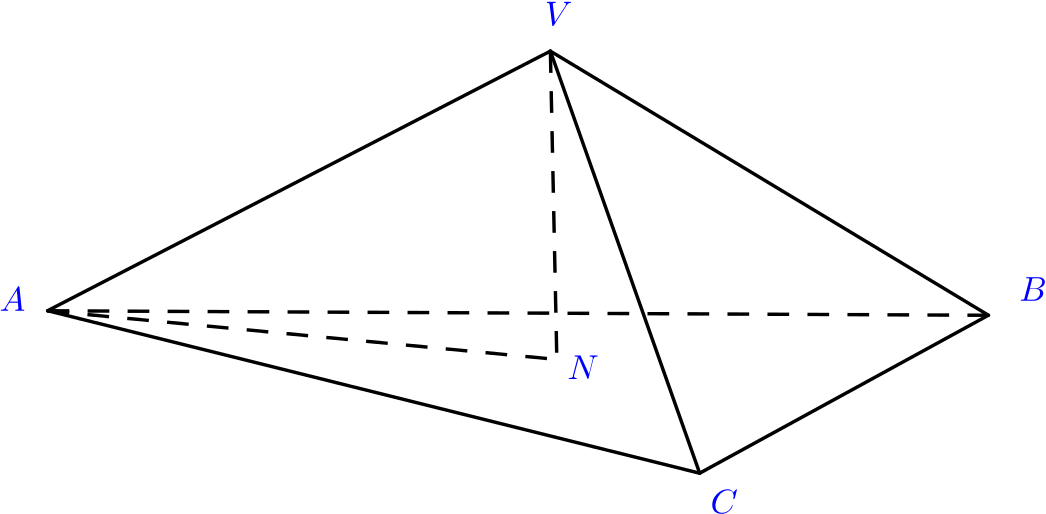
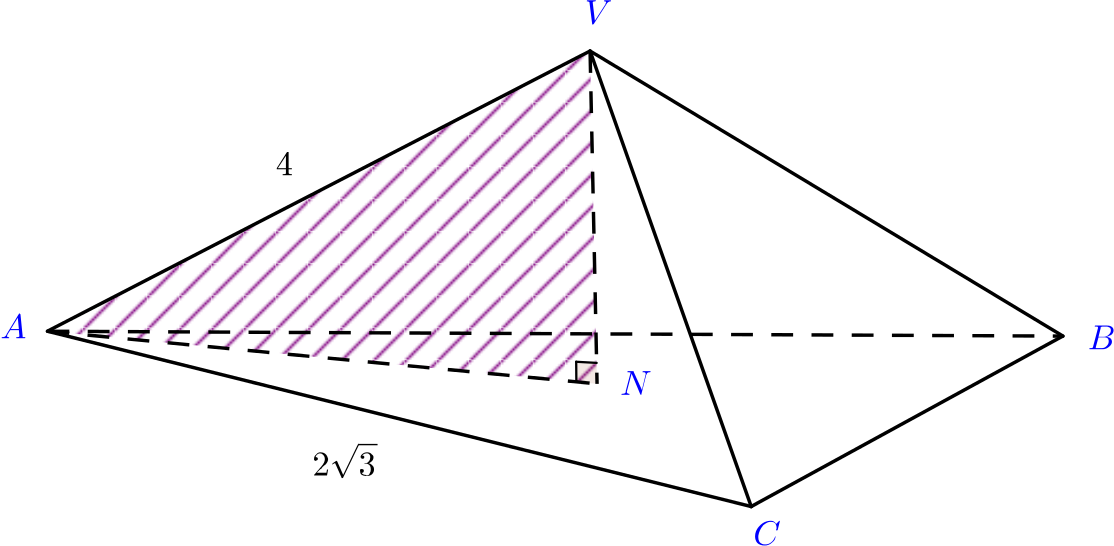
This triangle is the base of a pyramid whose apex V lies on the line through N perpendicular to the plane ABC. Given that VN=2 units, prove that VAN=30∘.
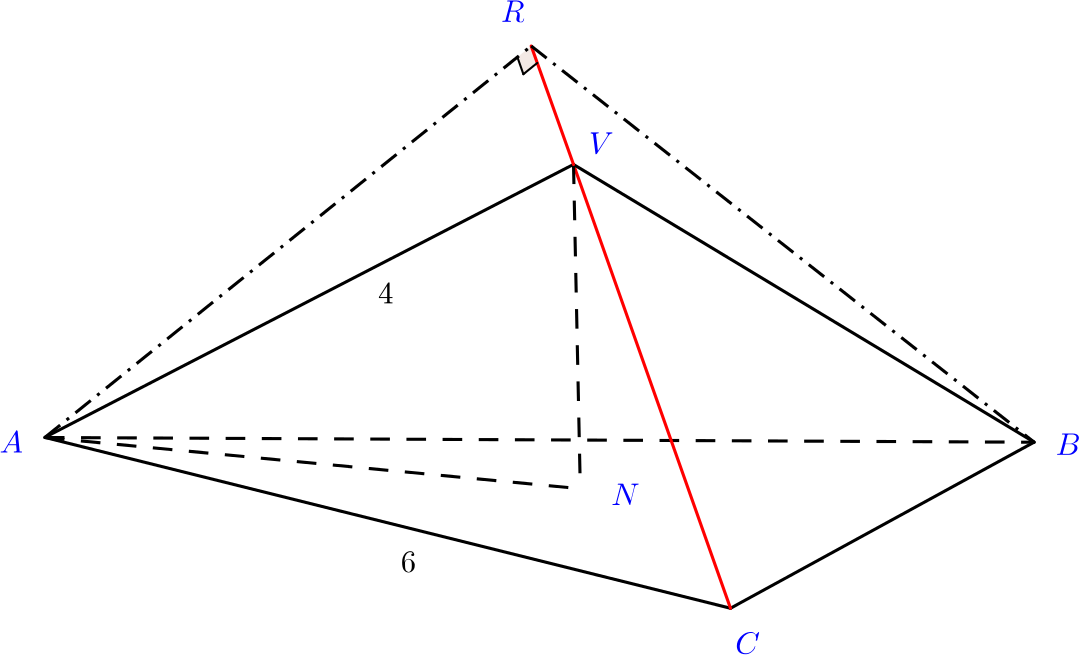
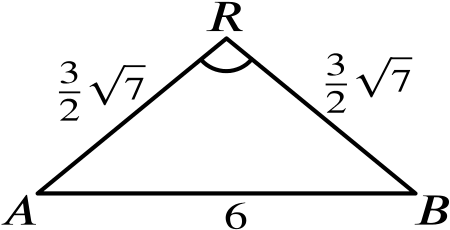
The perpendicular from A to the edge VC meets CV produced at R. Prove that AR=237 units, and find the exact value of cosARB.
Suggestion
Could we draw a picture of ABC with the altitudes and N marked? Can you spot any similar triangles? Or right-angled triangles?
Could we draw another picture? In three dimensions this time?
The phrase “CV produced” means, “the line segment CV extended”.
Could we draw a picture of AVC, marking in R? Which lengths in this triangle do we already know?
Solution
To find the length AN, let’s call the midpoint of AC,M, and the midpoint of BC,P.
Then the triangles ANM and ACP are similar, since they are both right-angled, and they also share another angle.
Using Pythagoras, we find that AP=62−32=36−9=27=33. We know that
3AN=AMAN=APAC=336,
since the triangles are similar, and so AN=36=633=23 units.
Alternatively, we could have recognised that ANM is a standard 30-60-90 triangle with edges in the ratio 1:2:3.
We know AN, and VN is given in the question giving tanVAN=232=31 which we should recognize as tan30∘ giving VAN=30∘.
Alternatively we find AV=4, by Pythagoras.
We now have that sinVAN=42=21, Therefore VAN=30∘.
The perpendicular from A to the edge VC meets CV produced at R. Prove that AR=237 units, and find the exact value of cosARB.
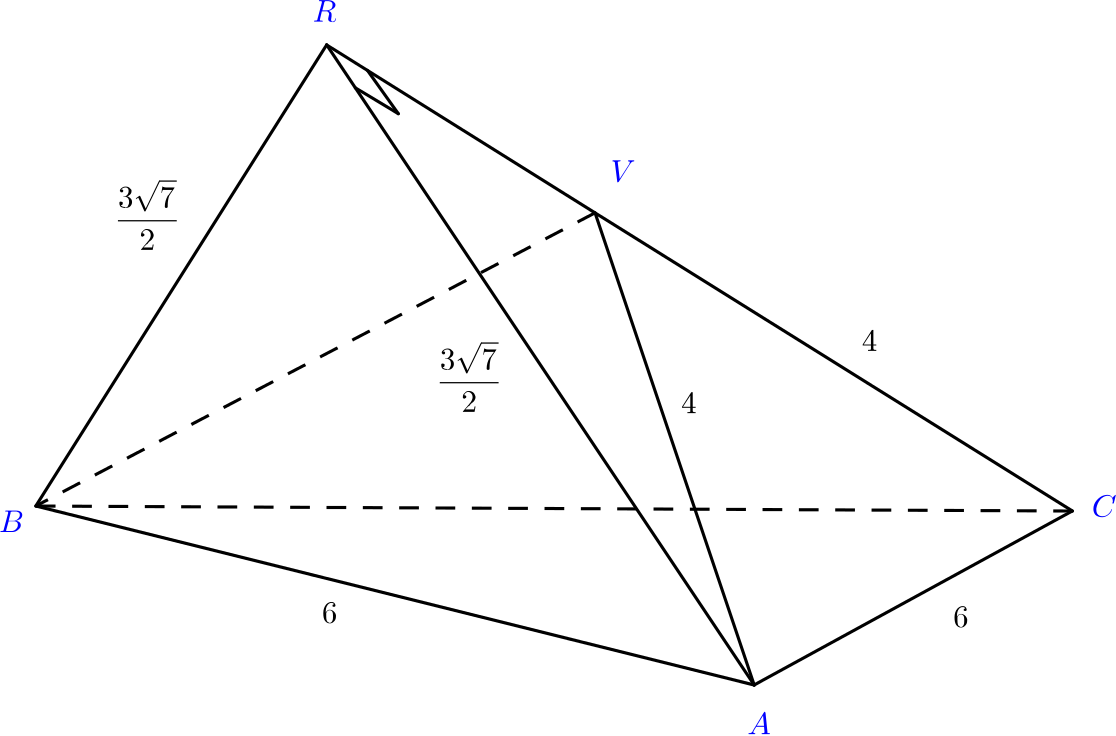
The triangle AVC
By symmetry, we know that AV=VC. We’ll use the cosine rule to find ACV.
Applying the cosine rule to
ACV
, we have that
4248cosACVcosACV=62+42−2×4×6×cosACV,=36,=43.
Now by right-angled trigonometry, we have that sinACV=6AR, and so AR=6sinACV=61−cos2ACV=6167=467=237.
Alternatively, we could say RV=x, and AR=y, and then use Pythagoras twice to create simultaneous equations that enable us to find y.
We need now to compute cosARB.
By symmetry, we have that BR=AR. So we can apply the cosine rule to ARB.