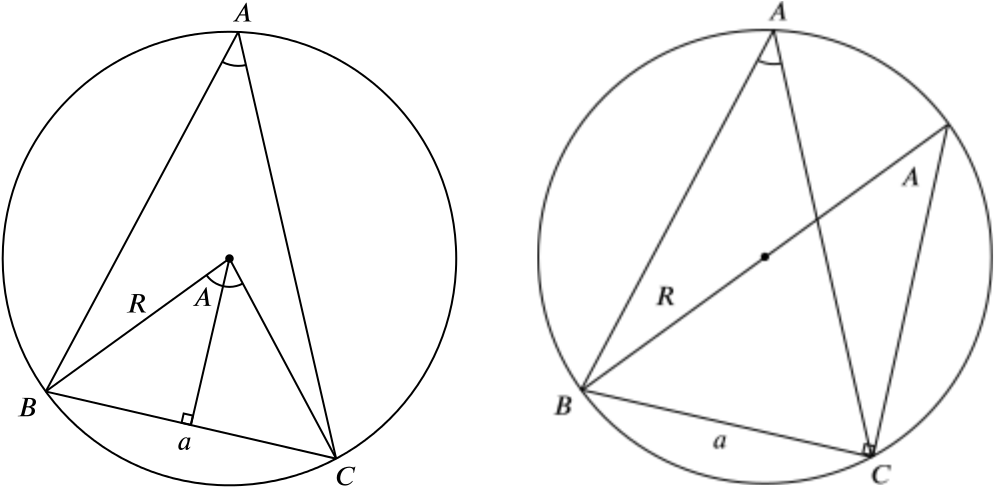
If R is the circumradius of triangle ABC, can we show a/sinA=2R?
Question
With the usual notation prove that
sinAa=2R
where R is the radius of the circumcircle of the triangle ABC.
[You need consider only the case when the angle A is acute.]
Hence or otherwise deduce that
- acosA+bcosB=ccos(A−B),
- acosA+bcosB+ccosC=4RsinAsinBsinC.
Solution
In the diagram on the left we have used the facts that
-
the perpendicular from the centre bisects the chord BC, and
-
the angle at the centre is twice the angle at the circumference.
Now we can see that RsinA=2a. Alternatively, in the diagram on the right we have used the facts that
-
the angles subtended at the circumference are equal, and
-
the angle in a semi-circle is a right-angle.
This shows us that sinA=2Ra.
Either of these gives us sinAa=2R as required.
We will use the identities sin2x=2sinxcosx, sin(π−x)=sinx, and sinx+siny=2sin2x+ycos2x−y.
Now
acosA+bcosB=sinAasinAcosA+sinBbsinBcosB=2RsinAcosA+2RsinBcosB=R(sin2A+sin2B)=R(2sin(A+B)cos(A−B))=2Rsin(π−A−B)cos(A−B))=2RsinCcos(A−B)=sinCcsinCcos(A−B)=ccos(A−B),
as required.
We’ll use the additional identities cosx+cosy=2cos2x+ycos2x−y, and cos(2π−x)=sinx.
We have
acosA+bcosB+ccosC=sinAasinAcosA+sinBbsinBcosB+sinCcsinCcosC=2R(sinAcosA+sinBcosB+sinCcosC)=R(sin2A+sin2B+2sinCcosC)=R(2sin(A+B)cos(A−B)+2sinCcosC)=R(2sinCcos(A−B)+2sinCcosC)=2RsinC(cos(A−B)+cosC)=4RsinC(cos2A+C−Bcos2A−B−C)=4RsinCcos(2π−B)cos(2π−A)=4RsinAsinBsinC.