What is the locus of these points fixed to a rod?
Question
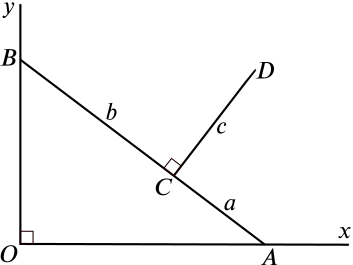
The ends and of a rod of fixed length move on the positive and axes respectively. is a point on , and is perpendicular to , as shown in the figure. The lengths of , and are , and respectively.
- Find parametric equations for the locus of .
- Find parametric equations for the locus of .
- If show that the locus of consists of part of a straight line and find the coordinates of the extremities of this locus.
- Sketch the loci of and for the case , , .
Solution
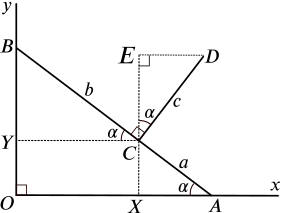
In the question the rod is moving attached to the axes, so one aspect which changes is the angle that it makes with the horizontal (angle ). We can then annotate our original diagram to help in writing our parametric equations.
Let be the acute angle the rod makes with the -axis. We can mark in other angles on our diagram as shown.
It is possible to use a different variable as the parameter, for instance the -coordinate of . The final result would be the same.
Now using triangle
and
we can write the parametric equations for
.
To get the equations for
we need to add sides from triangle
.
We are told to consider when . Using the parametric equations for with this information we can find a relationship between and . Multiplying by and by we can create equations with a matching term so that subtraction eliminates them. Since we know that this reduces to which is a straight line through the origin with gradient .
If you used other ways of eliminating from these equations you may have got or or . Can you show that these are all equivalent?
The extremities of the locus will be when
is either
(the rod is lying flat) or
(the rod is vertical) these are the points
and
respectively.
The parametric equations for the locus of tell us this is (one quarter of) an ellipse with semi-minor axis and semi-major axis . (If we don’t recognise this we can rearrange for and and use the Pythagorean identity to eliminate .)
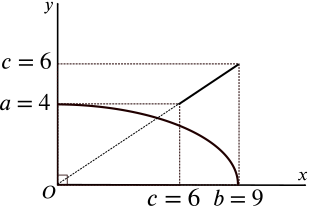
We can now sketch these two loci: