It's a matter of perspective
Excerpt: This resource asks students to find the equation of a parabola given three points. It can be used as a follow-on from 'Name that graph again', and it introduces a wider range of transformations than those previously encountered.
Problem
We would like to find an equation for this parabola in the form .
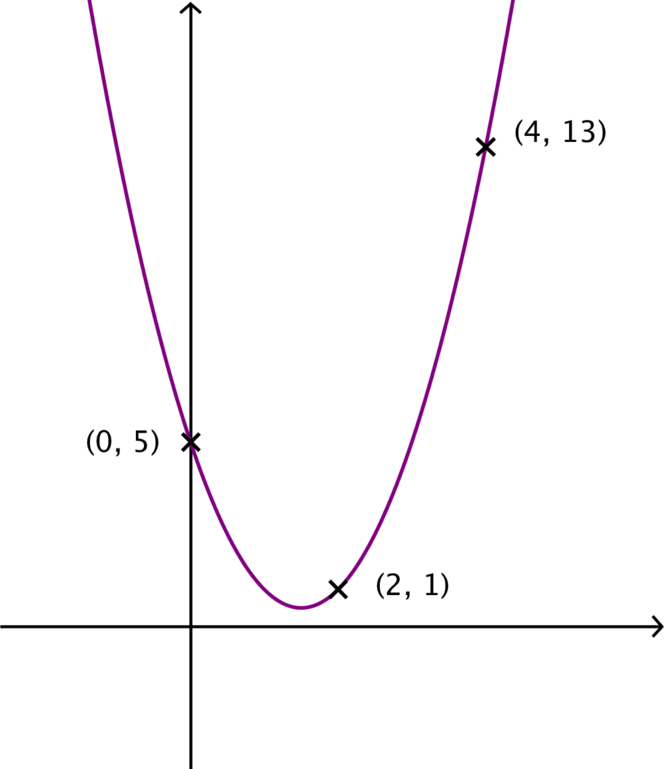
What ways come to mind straight away?
A certain point of view
Click on the Animate button in the applet below or move the slider.
[interactive embed (geogebra-iframe): //www.geogebratube.org/material/iframe/id/kgWsjQfY/width/600/height/400/border/888888/rc/false/ai/false/sdz/false/smb/false/stb/false/stbh/false/ld/false/sri/true/asb/false/at/html5] — not part of the text import; see the source page.
Download GeoGebra file
What is happening in the animation as the value of increases from to ?
As increases, the points and are moved in such a way that their -coordinates stay the same but their -coordinates smoothly change to . They are transformed to and .
The red dashed line is drawn passing through the two points described above. This line becomes horizontal (and lies on the -axis) when .
The original parabola is transformed so that it always passes through these two points. It appears to remain as a parabola.
The point marked on the parabola remains fixed throughout.
An answer
Which characteristics of the parabola are being preserved and which are being changed?
The curve does remain as a parabola as increases, so we could say that its “parabolic” shape stays the same. Its orientation remains upward facing.
However, it is transformed so that when it passes through the points and rather than the points and . The original parabola does not intersect the -axis but the transformed one does.
An answer
How can we describe the transformation that is happening to the parabola?
Each point on the parabola is being transformed in the same way as each point on the straight line.
The equation of the original straight line can be written as . As increases, we are gradually subtracting from its values until when the equation of the line has become . At this stage, we have therefore subtracted from the value of each point on the line.
This type of transformation is called a shear; in this case, it is a shear parallel to the -axis. A shear is a particular example of an affine transformation.
Similarly, if we write the equation of the original parabola as
and subtract
when
, we can say that the transformed parabola has equation
An answer
What can we say about the transformed parabola?
where is some constant.
We can see that the transformed parabola intersects the
-axis at
and
, so its equation can be written as
An answer
Can we use the transformed parabola to find the equation of the original parabola, ?
We saw above that the transformed parabola has equation , and also that it can be written as . Therefore and we can rearrange this to get
and the equation of the original parabola is
We can find the value of
by using the third given point on the original parabola
:
and solving this gives
. Thus
An answer
A point is marked on the diagram. What happens to the point as varies and what condition must the point satisfy?
A final thought