Elliptical crossings
Excerpt: Students are asked to describe the behaviour of the midpoint of the line segment formed by the intersection of a straight line with a particular ellipse.
Problem
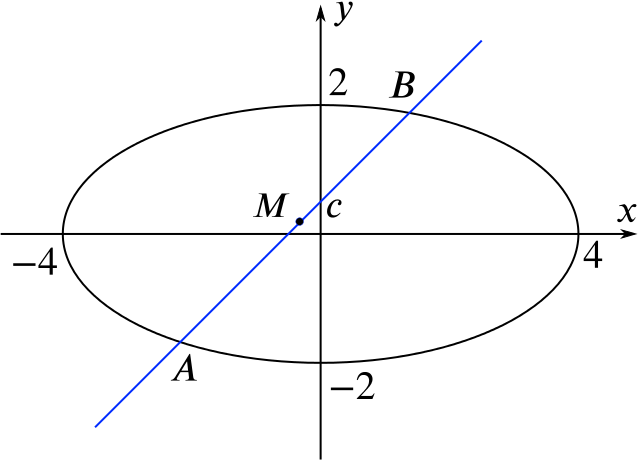
This diagram shows the ellipse with equation together with the straight line .
The line and ellipse intersect at the points and , and the midpoint of is .
Find the coordinates of for some different values of .
What do you notice?
Suggestion
What would be a simple value of to choose first?
If you have found an or value, which equation is simplest to use to find the other one?
Remember that the coordinates of are the average (mean) of the coordinates of and .
What would happen if you used straight lines of a different gradient instead?
Things you might have noticed
Let’s say we begin by considering the case where , so we have the two equations and .
Before we continue, let’s just stop and think. Why did we choose ?
-
What does the case where look like in the diagram?
-
What other values of could we have chosen?
-
Are there any values of that you would not choose? Why?
To find the coordinates of
and
, we substitute
into the quadratic to get
If we expand the brackets and rearrange, we get the quadratic
We can use the formula to find the solutions of this quadratic: they are We could simplify this, but instead we notice that these two solutions are the -coordinates of and . As the -coordinate of is the mean of these, we only need to add them together and halve the answer. When we add the two solutions together, the square roots cancel and we are left with . So the -coordinate of is half of this, which is .
Since lies on the straight line , it follows that the -coordinate of is . Hence has coordinates .
We could have been even more sneaky in saving work for ourselves!
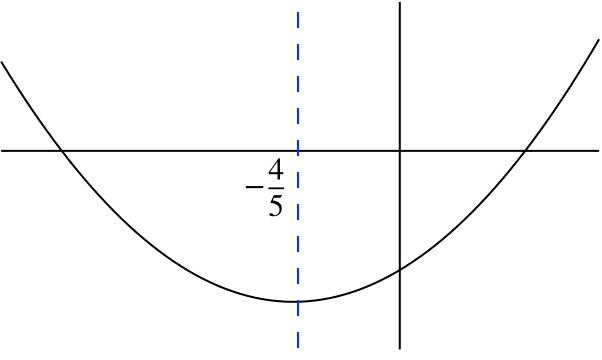
If we begin to complete the square for the quadratic in equation , we have for some number . The graph therefore has a line of symmetry and so the two solutions are symmetrically placed about this -value, as shown in this sketch. It follows that their mean is .
And we could do this algebraically, too. If we write where the solutions (or roots) of the quadratic are and , then we see that , so the sum of the roots is , and their mean is .
In the example above, we used and found that had coordinates . When you use other values of , you may find that the coordinates are also quite simple. There does seem to be an interesting pattern to the coordinates: what happens if you plot them?
What is the locus of ?
The locus of
Download GeoGebra file
-
What is the locus of in these cases?
-
Can you find a relation between the gradient of the straight lines and the locus of ?
A partial solution
A straight line through the centre of an ellipse is called a diameter of the ellipse.
The diameter and the locus of are called conjugate diameters. There are some fascinating theorems about conjugate diameters of an ellipse, which you might wish to research further.
This problem considered an ellipse. You might find it interesting to compare this with your answer to Parabella. You could also try answering the same question for a hyperbola such as , which is the other type of conic section. Does that also give a similar answer? If so, why, and if not, why not?
A certain point of view
This diagram shows the ellipse with equation together with the straight line .
The line and ellipse intersect at the points and , and the midpoint of is .
Find the coordinates of for some different values of .
What do you notice?
What is the locus of as varies?
What would happen if you used straight lines of a different gradient instead?
The ellipse looks like a stretched circle: it is the circle stretched by a factor of in the -direction.
What happens to the problem when we undo the stretch, by stretching by a factor of in the -direction?
Suggestion
-
What happens to the straight line when we stretch it by a factor of in the -direction?
-
What happens to the points , and when we do this stretch? Is still the midpoint of after the stretch?
-
Can you use this information to work out the locus of in the stretched version as changes (without using any equation for the locus that you have already worked out)?
-
Can you use your answers to work out the equation of the locus of in the original problem?
-
What would your answers be if the original straight lines had equations instead? Or, more generally, for a fixed value of ?