Quadratic Inequalities (Cambridge International A-Level Mathematics)
Exam board Cambridge International · A-LevelUpdated 2026-07-02
Quadratic inequalities
What is a quadratic inequality?
- Similar to quadratic equations
- Sketching a quadratic graph is essential
- Can involve the discriminant or applications in mechanics and statistics
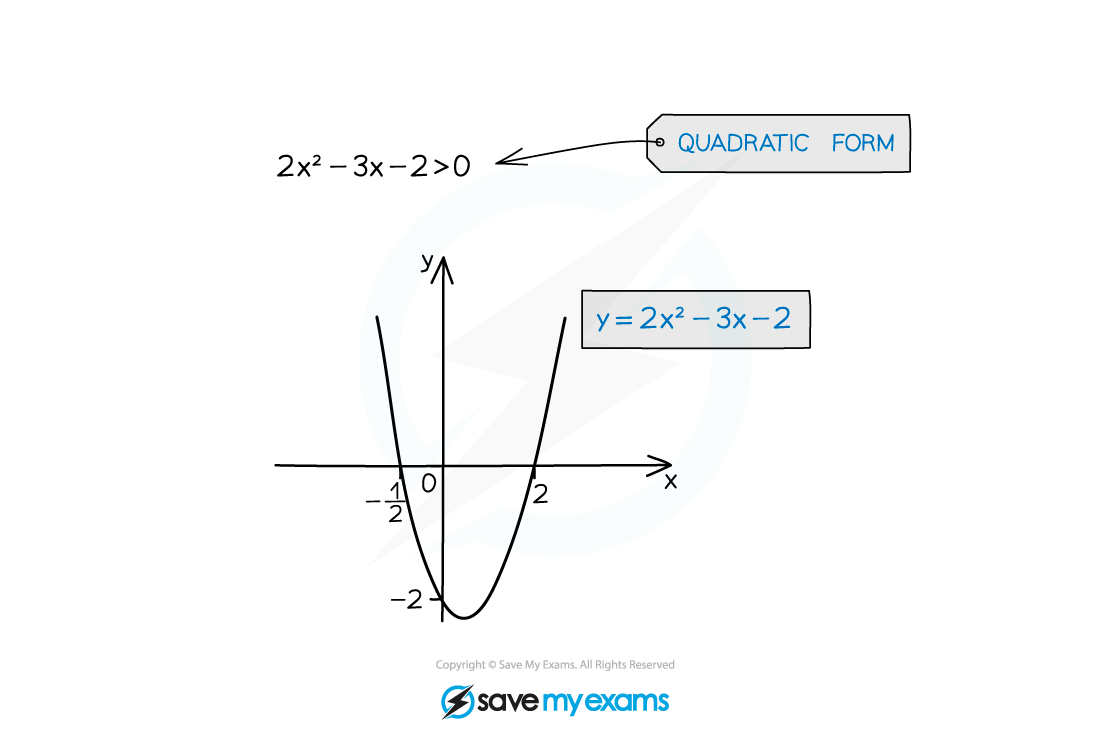
How do I solve quadratic inequalities?
-
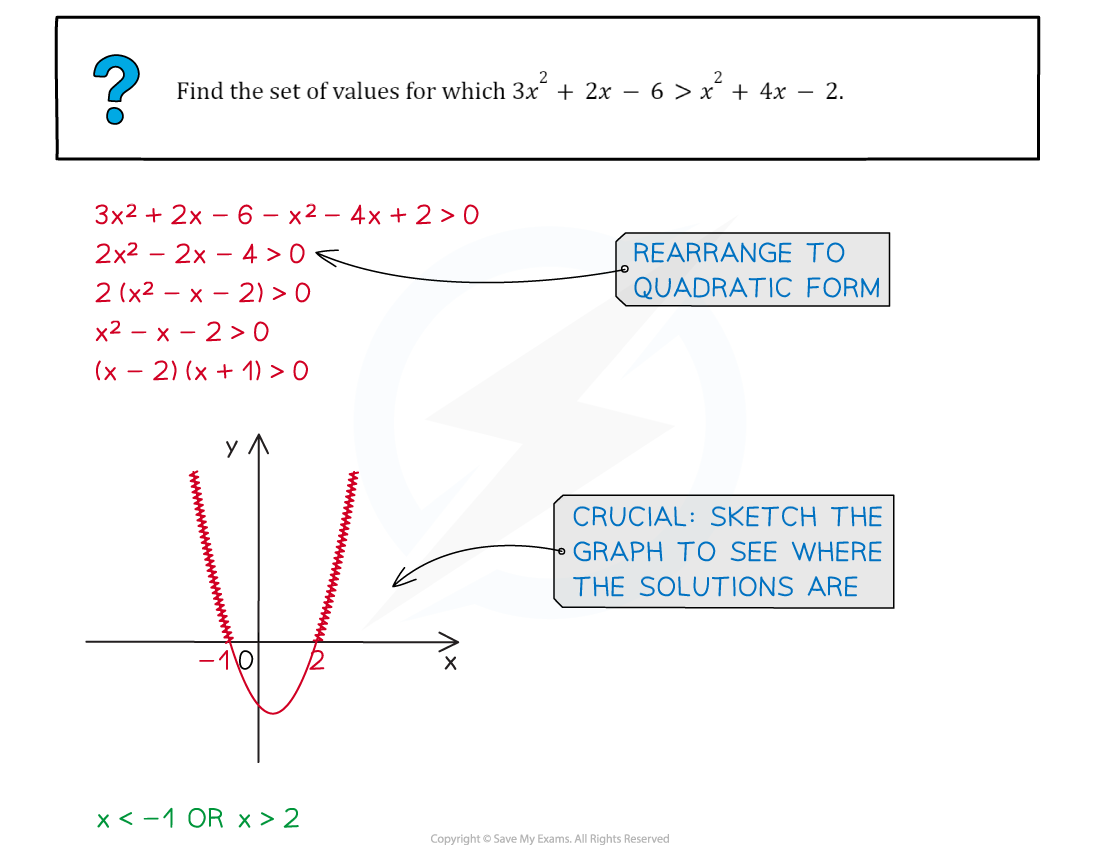
STEP 1: Rearrange the inequality into quadratic form with a positive squared term
- ax2+ bx + c > 0 (>, <, ≤ or ≥)
-
STEP 2: Find the roots of the quadratic equation
- Solve ax2 + bx + c = 0 to get x1* and x2 where x1 < x2
-
STEP 3: Sketch a graph of the quadratic and label the roots
- As the squared term is positive it will be "U" shaped
-
STEP 4: Identify the region that satisfies the inequality
-
For ax2+ bx + c > 0 you want the region above the x-axis
- The solution is x< x1 or **x > x2 **
-
For ax2** + bx + c < 0** you want the region below the x-axis
- The solution is x > x1 and **x < x2
- This is more commonly written as x1** < x < x2
-
-
Be careful:
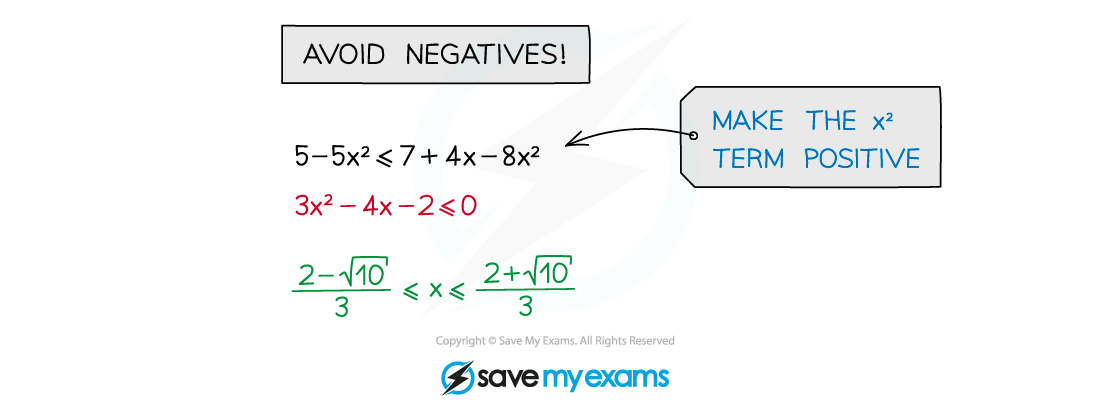
- avoid multiplying or dividing by a negative number if unavoidable, “flip” the inequality sign so < → >, ≥ → ≤, etc
- avoid multiplying or dividing by a variable (x) that could be negative (multiplying or dividing by x2 guarantees positivity (unless x could be 0) but this can create extra, invalid solutions)
- do rearrange to make the x2 term positive
Worked Example
Exam Hint
A calculator can be super-efficient but some marks are for method.
Use your judgement:
- is it a “show that” or “prove” question?
- how many marks?
- how long is the question?
Was this revision note helpful?
Build on this topic