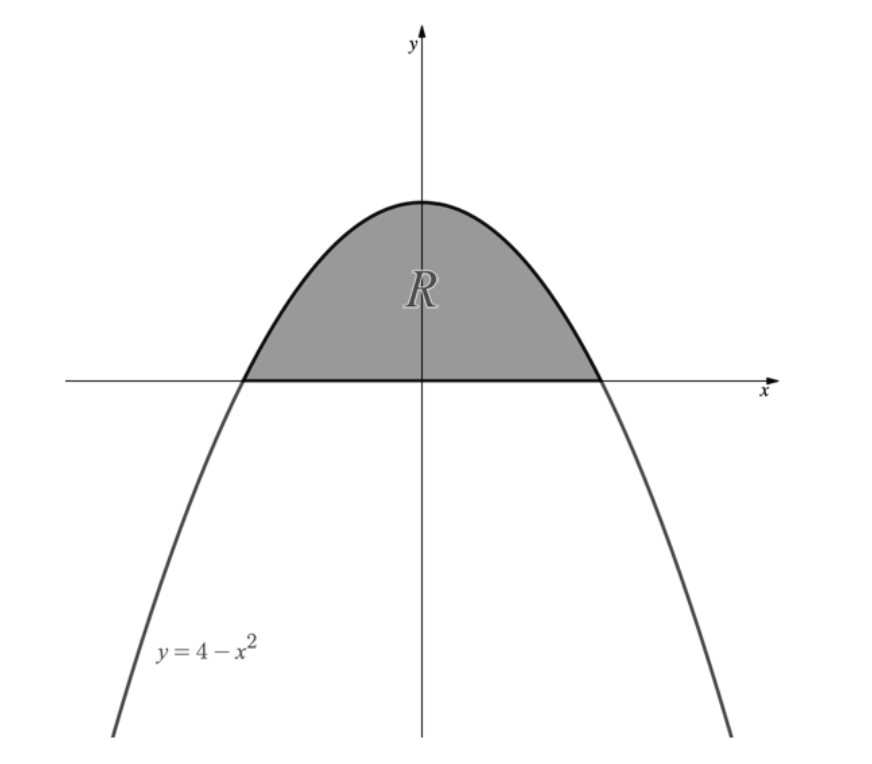
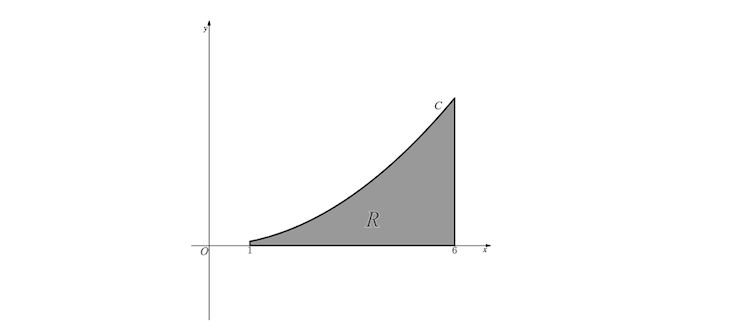
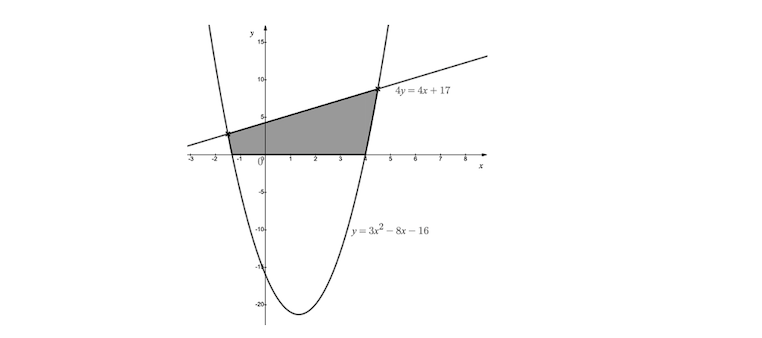
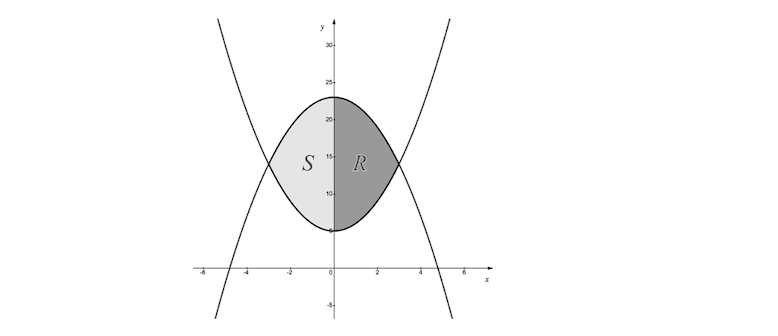
The area bounded by the curve with equation , the -axis and the vertical lines with equations and is to be found.
Write down an integral that would find this area.
Evaluate your integral from part (a) and hence find the area described above.
28 questions · 182 marks · ≈ 3 hours
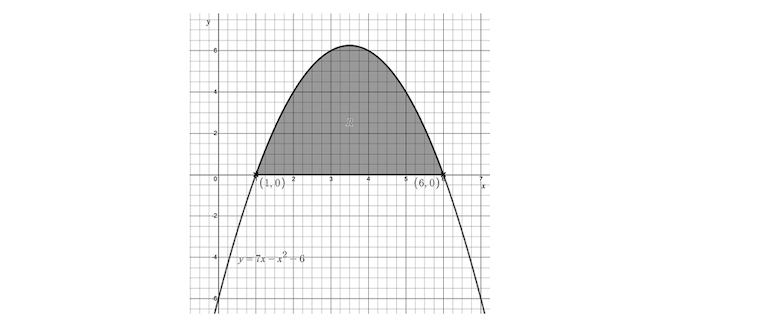
The area bounded by the curve with equation , the -axis and the vertical lines with equations and is to be found.
Write down an integral that would find this area.
Evaluate your integral from part (a) and hence find the area described above.
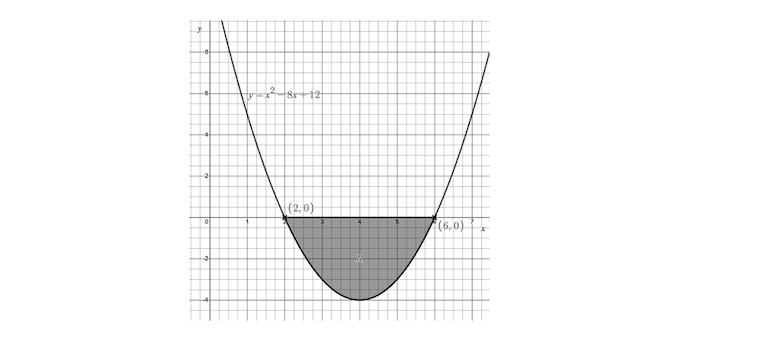
The diagram below shows the graph of .

Find the shaded area, giving your answer as a fraction in its simplest terms.
The diagram below shows the graph of .

Find the shaded area marked , giving your answer as a fraction in its simplest form.
Simplify x - \left(x^{2} - 8x + 18\right).
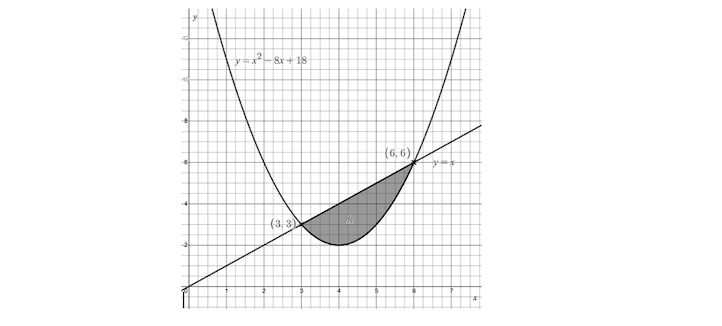
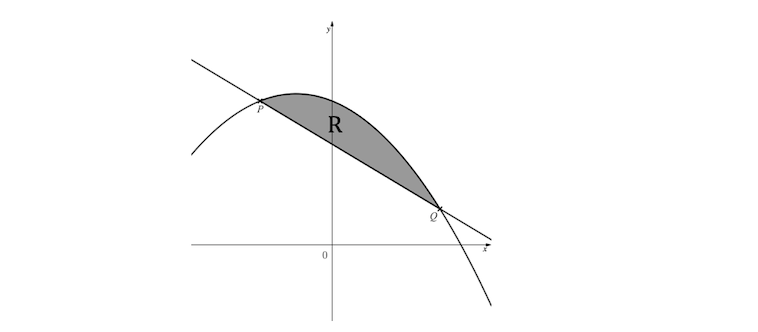
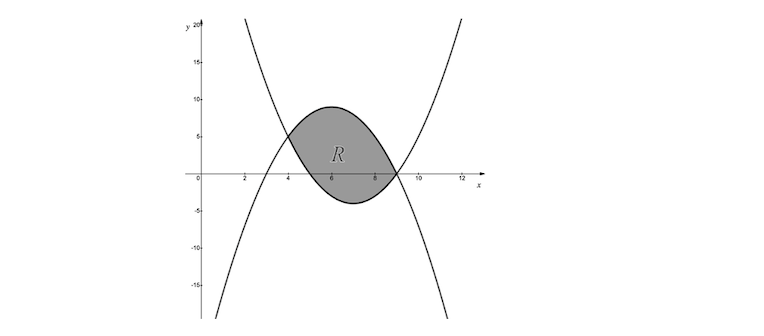
The diagram below shows the graphs of and .

Find the shaded area marked , giving your answer as a fraction in its simplest terms.
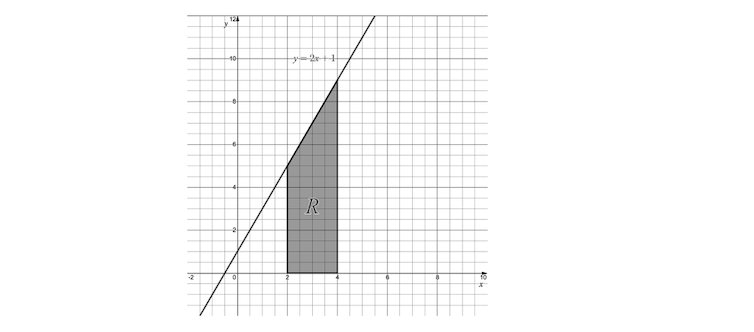
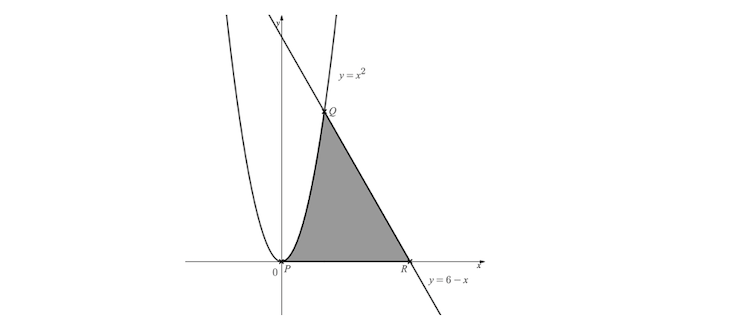
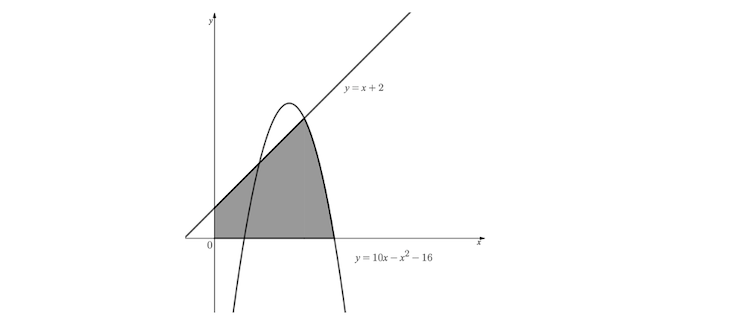
The diagram below shows the region , bounded by the straight lines with equations , , and the -axis.

(i) For , show that .
(ii) Find the volume of the solid formed when the region is rotated 360° around the -axis.
The diagram shows the curve with equation . The shaded region is bounded by the curve, the -axis and the lines and .

Find the volume of the solid formed when the shaded region is rotated through 360° about the -axis.
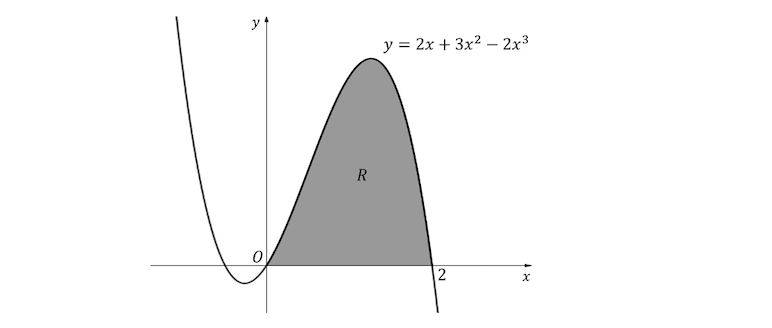
The diagram below shows part of the graph of .
Find the area of the shaded region labelled .

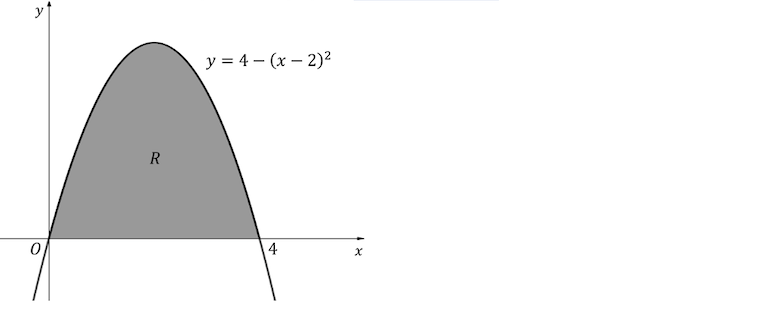
The diagram below shows part of the graph of y = 4 - \left(x - 2\right)^{2}.

Write down the values of where .
Show that
4 - \left(x - 2\right)^{2} = 4x - x^{2}
Evaluate
\int_{0}^{4} \left(4x - x^{2}\right) \,\text{d}x
Write down the area of the region labelled .
Find the -coordinates of the points of intersection of the line with equation and the curve with equation .
Evaluate
\int_{1}^{3} \left(x^{2} - 4x + 5\right) \,\text{d}x
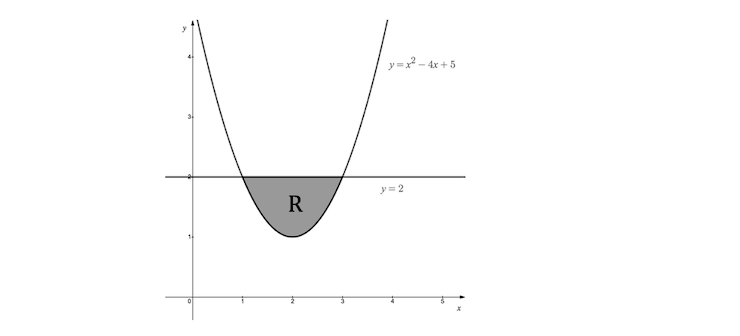
The diagram below shows the graphs of and .

Find the exact area of the shaded region .
The diagram below shows the graphs of the line and the curve .

Find the -coordinates of the points labelled , and .
Find the area of the shaded region.
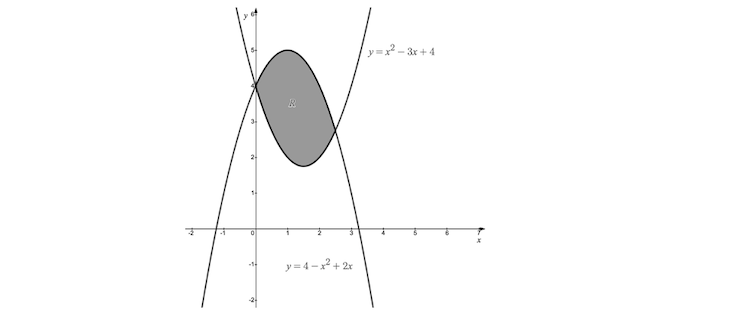
The diagram below shows a sketch of the curves with equations
and

Find the -coordinates of the points of intersection of the two graphs.
Show that the area of the shaded region labelled is given by
\int_{0}^{\frac{5}{2}} \left(5x - 2x^{2}\right) \,\text{d}x
Use calculus to find the area of the shaded region labelled .
The diagram below shows the graph of the curve with equation .

(i) Find the -coordinates of the points where the graph of crosses the -axis.
(ii) The shaded region is rotated through 360° about the -axis. Find the volume of the solid formed.
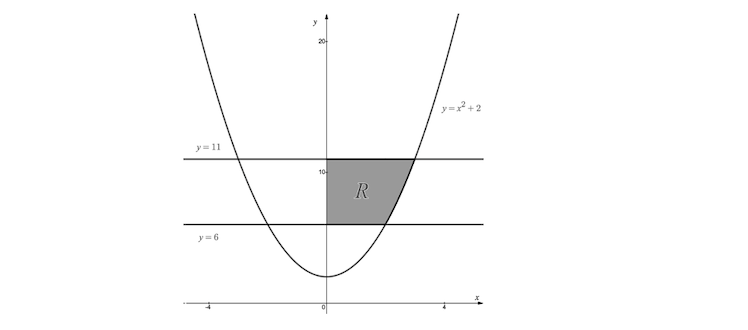
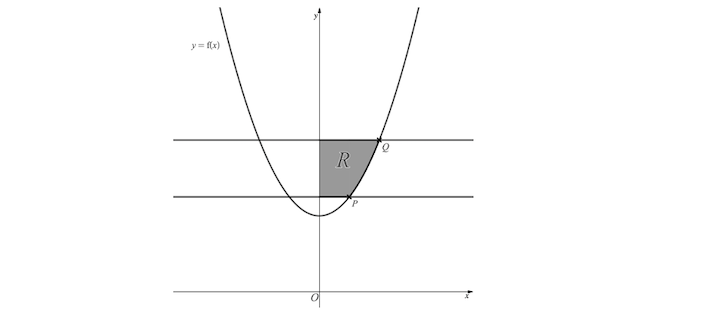
The diagram below shows the graphs of two horizontal lines and the function .
, where and are constants.

Point has coordinates \left(1, 5\right).
Point has coordinates \left(2, 8\right).
(i) Find the values of and .
(ii) Write down the equations of the two horizontal lines.
The shaded region is rotated through 360° about the -axis. Find the volume of the solid formed.
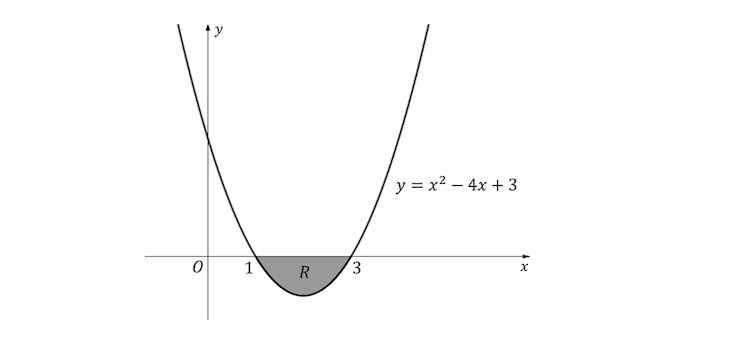
The diagram below shows part of the graph of .

Find the area of the shaded region labelled .
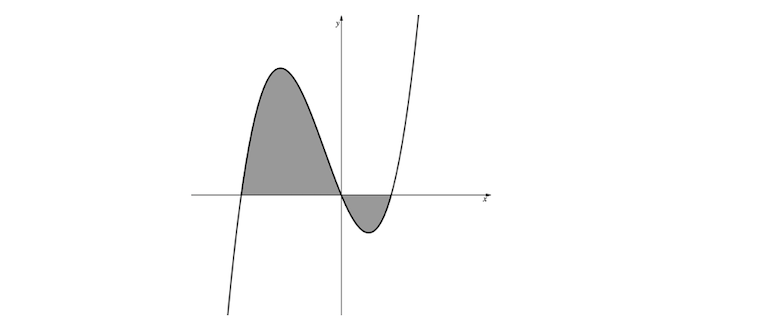
The diagram below shows part of the graph of y = x\left(x - 1\right)\left(x + 2\right).
Find the total area of the two shaded regions.

The line with equation cuts the curve with equation at the points and , as shown.

Find the - and -coordinates of the points and .
Find the exact area of the region labelled , giving your answer in the form , where and are integers to be found.
The diagram below shows the graphs of and .

Find the exact area of the shaded region.
The diagram below shows a sketch of the curves with equations
and

Find the -coordinates of the points of intersection of the two graphs.
Use calculus to find the total shaded area enclosed by the two graphs.
A mathematical model for a bowl is obtained by rotating through 360° about the -axis the part of the curve which is between and , and then adding a flat bottom. is a constant such that .
Find the capacity of the bowl in terms of .
In the case where the boundaries and are used in place of and , the capacity of the bowl is increased by cubic units.
Find the value of .
What assumption has been made in finding the capacity of the bowl?
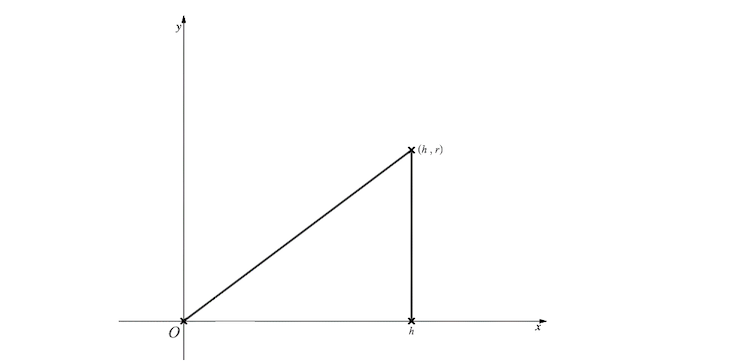
The diagram below shows a right-angled triangle with vertices at the origin, the point \left(h, 0\right) and the point \left(h, r\right), where and .

Find an equation of the line on which the hypotenuse of the right-angled triangle lies, giving your answer in the form .
The triangle is rotated through 360° about the -axis to form a cone.
Hence use calculus to show that the general formula for the volume of a cone is
where is the base radius of the cone and is its perpendicular height.
The diagram below shows part of the curve defined by the equation , where is a positive constant. The shaded region is bounded by the curve, the -axis, and the lines and .

Given that the volume of the solid formed when the region is rotated through 360° about the -axis is cubic units, find the value of .
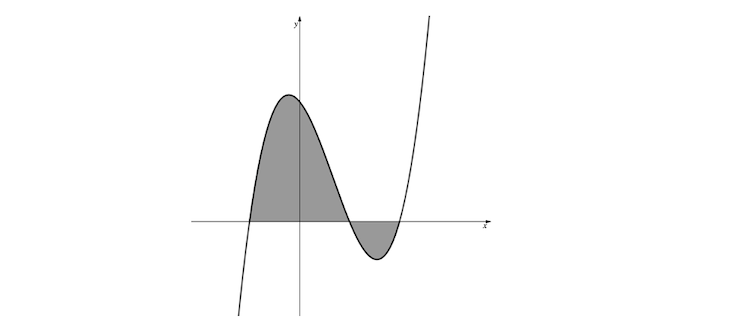
The diagram below shows part of the graph of .
Find the total area of the two shaded regions.

The diagram below shows the graphs of and .

Find the area of the shaded region, .
Starting with the equation of a semicircle of radius , (where ), use calculus to show that the general formula for the volume of a sphere of radius is
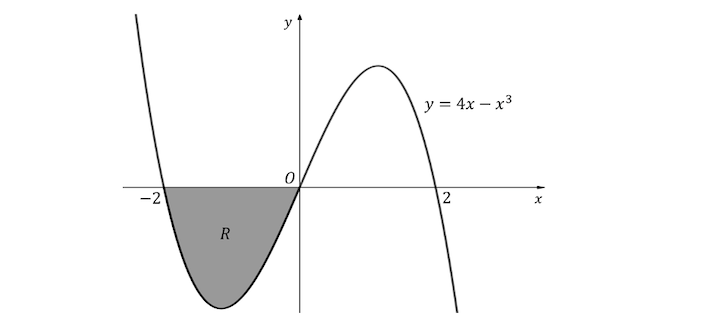
The diagram below shows part of the graph of .

Find the area of the shaded region labelled .
Without doing any additional calculation, explain why \int_{-2}^{2} \left(4x - x^{3}\right) \,\text{d}x must be equal to zero.
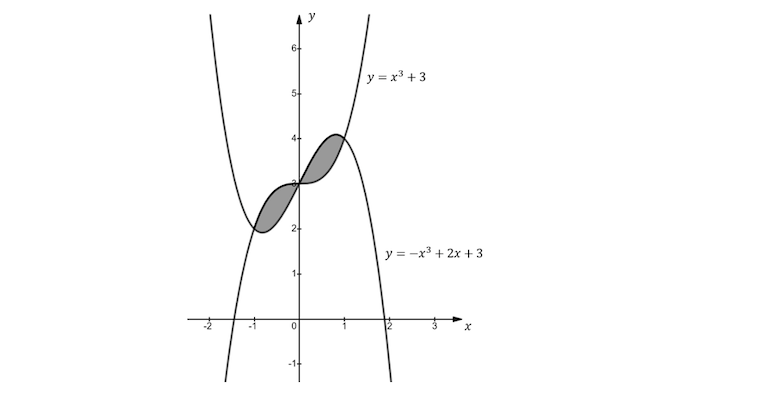
The diagram below shows the graphs of and .
Find the exact area of the shaded region.

Sketch the region bounded by the lines
, , and , where .
The region described in part (a) is rotated through 360° about the -axis.
Find the volume of the solid formed, giving your answer in terms of .
The solid formed in part (b) will have a 'hole' in its centre.
(i) Find the volume of this 'hole', giving your answer in terms of .
(ii) Hence show that there are no values of in the given interval that make the volume of the solid equal to the volume of the 'hole'.
The diagram below shows a sketch of the curves with equations and .

The region is bounded by the -axis and the two curves. This region is rotated through 360° about the -axis. Find the volume of the solid formed.
The regions marked and are now to be considered as a single region bounded by the two curves.
A student calculates the volume swept out when this combined region is rotated through a full 360° about the -axis, without taking the symmetry of the two curves into account. Call this value .
How does compare to the answer you found in part (a)?
Be sure to fully explain your answer.