Causes of Changes & AD/AS Analysis (Cambridge International A-Level Economics)
Causes of changes in a floating exchange rate
- Changes in a floating exchange rate are caused by shifts in the demand for or supply of a currency on the FOREX market
Factors that increase demand for a currency (causing appreciation)
-
Rising interest rates
- Higher interest rates attract foreign investors seeking better returns on savings and investments, increasing demand for the currency
-
Increased demand for exports
- Foreign buyers must purchase the domestic currency to pay for exports, increasing demand
-
Speculation
- If investors expect a currency to rise in value, they buy it now in anticipation of future gain, increasing demand
-
Relative inflation
- If a country has lower inflation than its trading partners, its goods become more price competitive, increasing export demand and therefore currency demand
Factors that increase supply of a currency (causing depreciation)
-
Falling interest rates
- Lower returns on domestic assets cause investors to move funds abroad, selling the domestic currency and increasing its supply on FOREX
-
Increased demand for imports
- Domestic buyers must sell the domestic currency to obtain foreign currency to pay for imports, increasing supply
-
Speculation
- If investors expect a currency to fall, they sell it before the fall, increasing supply
-
Higher relative inflation
- Domestic goods become less competitive, export demand falls, and less foreign currency flows in to buy the domestic currency
| Factor | Effect on exchange rate | Mechanism |
|---|---|---|
| Rise in interest rates | Appreciation | - Hot money flows in; demand for currency rises |
| Fall in interest rates | Depreciation | - Hot money flows out; supply of currency rises |
| Increase in exports | Appreciation | - Foreign buyers demand domestic currency |
| Increase in imports | Depreciation | - Domestic buyers supply domestic currency |
| Speculation (expected rise) | Appreciation | - Speculators buy currency in advance |
| Speculation (expected fall) | Depreciation | - Speculators sell currency in advance |
| Lower relative inflation | Appreciation | - Exports more competitive; export demand rises |
| Higher relative inflation | Depreciation | - Exports less competitive; export demand falls |
AD/AS analysis of the impact of exchange rate changes
- Exchange rate changes affect the domestic economy through their impact on the price of exports and imports, which feeds through into AD, the price level, real output and employment
Impact of a depreciation
- A depreciation makes exports cheaper for foreign buyers and imports more expensive for domestic buyers
- Net exports (X-M) rise as export demand increases and import demand falls - AD shifts right
- Import prices rise, increasing the cost of imported raw materials and finished goods - contributing to cost-push inflation
- The rightward shift in AD also generates demand-pull inflation if the economy is near full capacity
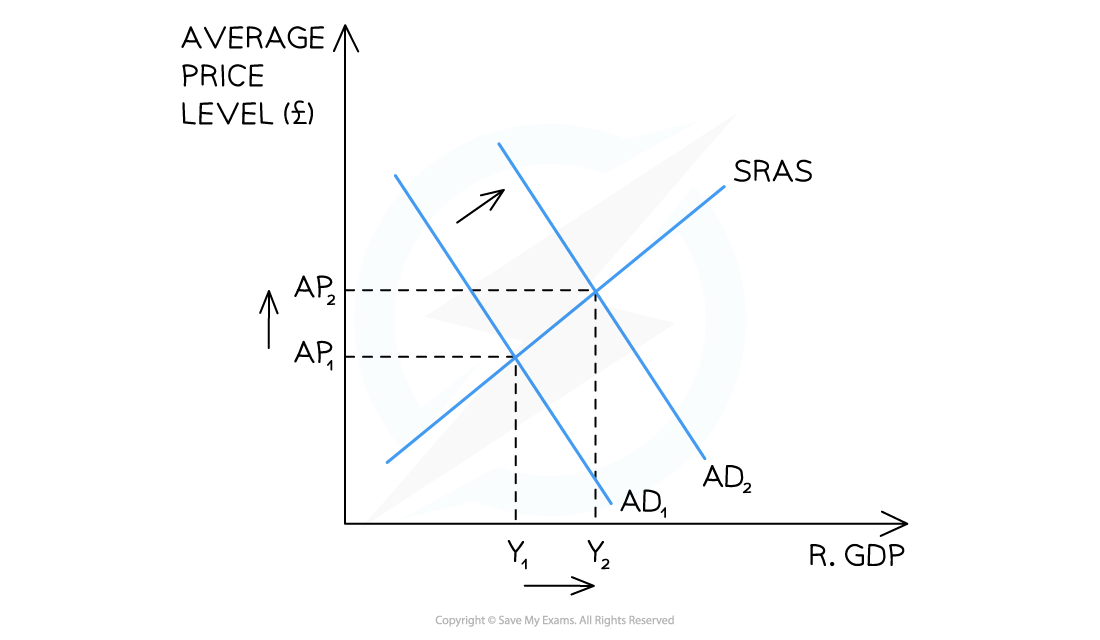
Currency depreciation may cause AD to increase
Diagram analysis
- The initial short-run equilibrium is at AP1Y1 with AD1 intersecting SRAS
- A depreciation makes exports cheaper and imports more expensive - net exports rise
- The rise in net exports (X-M) increases AD, shifting the curve rightward from AD1 → AD2
- The average price level rises from AP1 → AP2 - reflecting both demand-pull and cost-push inflationary pressure
- Real GDP rises from Y1 → Y2
- Employment rises as firms increase output to meet higher export demand
Impact of an appreciation
- An appreciation makes exports more expensive for foreign buyers and imports cheaper for domestic buyers
- Net exports (X-M) fall as export demand decreases and import demand rises - AD shifts left
- Import prices fall, reducing cost-push inflationary pressure and lowering the average price level
- Real output and employment fall as domestic firms face reduced demand for exports
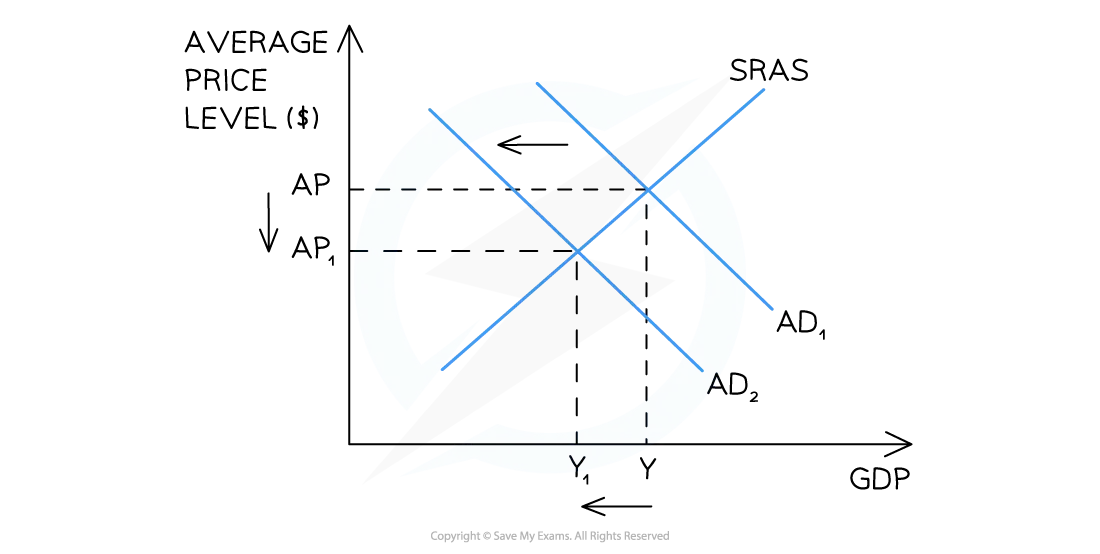
Currency appreciation can cause AD to fall
Diagram analysis
- The initial short-run equilibrium is at AP and Y with AD1 intersecting SRAS
- An appreciation makes exports more expensive and imports cheaper - net exports fall
- The fall in net exports (X-M) reduces AD, shifting the curve leftward from AD1 → AD2
- The average price level falls from AP → AP1
- Real GDP falls from Y → Y1
- Employment falls as firms reduce output in response to lower export demand
Exam Hint When analysing the impact of an exchange rate change, always work through three stages:
- identify whether the exchange rate has appreciated or depreciated;
- state the effect on export and import prices;
- then trace the impact through AD onto the price level, real output and employment.
A common error is to state only that AD shifts without explaining the transmission mechanism - always link the exchange rate change explicitly to net exports (X-M).
Note that depreciation generates inflationary pressure through two channels simultaneously - demand-pull from the rightward AD shift and cost-push from higher import prices - making the inflationary effect of depreciation typically stronger than the deflationary effect of appreciation.
Was this revision note helpful?
Build on this topic