Property Rights & Pollution Permits (Cambridge International A-Level Economics)
Property rights and pollution permits
-
Property rights are legally enforced entitlement that defines who owns a resource and how it may be used, transferred or exchanged
-
Many market failures arise because property rights over resources are absent or poorly defined
- When no one owns a resource - such as clean air, ocean fish stocks, or a rainforest - no one has an incentive to manage it sustainably
- This leads to over-exploitation: the private cost of using the resource is below the social cost, generating a negative externality
-
Governments can correct this by assigning property rights over previously unowned resources, giving the rights-holder a direct incentive to manage the resource efficiently
- This internalises the externality - the cost of degrading the resource falls on the owner rather than on society
-
Pollution permits are the most important application of this principle in economics
- They create tradeable property rights over the right to emit pollution
-
Pollution permits are a government-issued licence that gives the holder the legal right to emit a specified quantity of pollution
- Permits are tradeable, allowing firms to buy and sell them so that emissions reductions are made where they are least costly
Property rights
-
When property rights are assigned over a common access resource:
- The owner has an incentive to prevent over-exploitation — degrading the resource reduces its future value to the owner
- The negative externality is internalised — private costs rise to reflect social costs
- Output is reduced towards the socially optimal level where MSB = MSC
International examples of property rights
-
Fishing rights: New Zealand and Iceland pioneered Individual Transferable Quotas (ITQs) - tradeable property rights over a share of the total allowable fish catch
- Rights-holders have a direct incentive to protect stock as it determines the future value of their quota
-
Forest rights: Community forest management programmes in Nepal and Mexico have assigned property rights over forest resources to local communities
- This has dramatically reducing illegal logging and deforestation rates compared to state-managed forests
Evaluating property rights
| Advantages | Disadvantages |
|---|---|
| - Internalises externalities - gives resource owners a direct market incentive to manage sustainably without ongoing government intervention in prices or quantities | - Equity concerns - deciding who receives property rights is politically difficult; granting rights to existing users may reward past harmful behaviour and exclude others |
| - Cost-efficient - harnesses market incentives rather than requiring costly ongoing regulation and enforcement | - Cannot be applied to global commons - it is not possible to assign enforceable ownership of the atmosphere or oceans across national borders |
| - Tradeable rights allow efficient allocation - resources flow to their highest-value use through voluntary exchange, as with water rights in Chile and Australia | - Enforcement costs - establishing and policing property rights requires strong legal institutions that may not exist in lower-income economies |
| - Reduces need for command and control - less reliance on regulation and its associated risks of regulatory capture and government failure | - Divisibility problems - some resources such as clean air are not easily divided among users, making formal property rights difficult to define and monitor |
Pollution permits
-
A pollution permit *(also called a cap-and-trade scheme) creates a tradeable property right over the right to emit a specified quantity of pollution
- The government sets a total emissions cap - the maximum quantity of pollution permitted across all firms in the scheme
- This cap is divided into individual permits, each allowing the holder to emit one unit of pollution
-
Permits are allocated to firms, who may then
- Use them to cover their own emissions
- Sell surplus permits if they reduce emissions below their allocation
- Buy additional permits if they wish to emit more than their allocation allows
-
The price of permits is determined by supply and demand in the permit market
- The government fixes the quantity (the cap) and the market determines the price
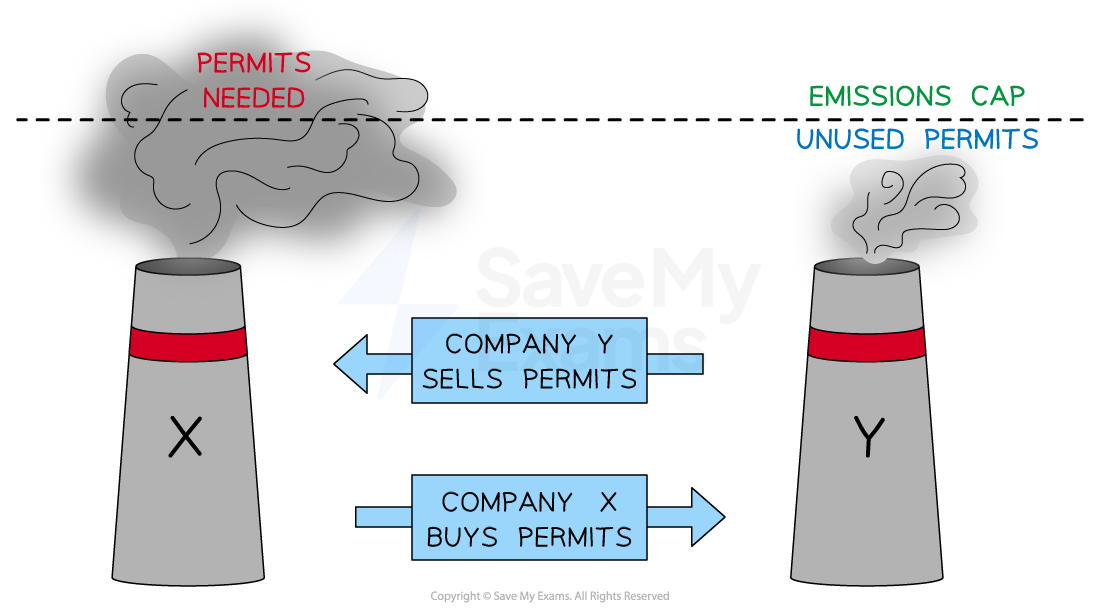
Pollution permits internalise the externality
Diagram analysis
-
The emissions cap sets the total quantity of pollution permitted
- This is fixed by the government and represents the socially optimal level of total emissions
-
Company Y reduces its emissions below its allocation
- It invests in cleaner technology and sells its surplus permits, generating revenue
-
Company X finds it cheaper to buy permits than to reduce its own emissions
- It purchases Company Y's surplus permits
-
The permit price is determined by supply and demand:
- If abatement is cheap for most firms, permit demand is low and the price falls
- If abatement is costly, permit demand is high and the price rises, incentivising investment in cleaner technology
-
If the permit price exceeds the cost of adopting green technology, firms will switch to cleaner production — the market automatically incentivises innovation
International examples of pollution permits
- EU Emissions Trading System (ETS): the world's largest carbon market, covering energy, industry and aviation across EU member states — the cap has been tightened progressively to drive emissions reductions
- South Korea's Emissions Trading Scheme: established in 2015, covering around 70% of national greenhouse gas emissions across industry, energy and buildings
Evaluating pollution permits
| Advantages | Disadvantages |
|---|---|
| - Achieves emissions target with certainty - the cap directly limits total pollution regardless of the permit price, unlike a carbon tax whose effect on quantity depends on PED | - Setting the correct cap is difficult - if the cap is set too high, permits are cheap, emissions reduction is minimal and the market failure persists |
| - Cost-efficient - emissions reductions are made by firms with the lowest abatement costs, achieving the overall target at least total cost across the economy | - Permit price volatility - prices fluctuate with economic conditions; during recessions, lower output reduces permit demand and prices collapse, weakening the incentive to invest in green technology |
| - Incentivises innovation - firms that develop cheaper abatement technology can sell surplus permits, generating revenue and a continuous market incentive to innovate beyond the required standard | - Initial allocation raises equity concerns - if permits are given free to existing polluters ("grandfathering"), this rewards past harmful behaviour and creates a windfall for high-emitting incumbents |
| - Generates government revenue - if permits are auctioned rather than allocated free, the government raises significant revenue that can be used to fund green investment or reduce other taxes | - Carbon leakage - if only some countries operate permit schemes, firms may relocate production to countries without carbon costs, shifting emissions rather than reducing them globally |
| - Market-based - harnesses price signals rather than requiring detailed knowledge of each firm's abatement costs, avoiding the information problems that affect regulation | - Requires strong institutions - effective monitoring, reporting and verification of emissions is essential; in lower-income economies this capacity may not exist |
Permits vs regulation vs taxation: key comparison
| Pollution Permits | Carbon Tax | Regulation | |
|---|---|---|---|
| Mechanism | - Tradeable property rights | - Price instrument | - Legal standard |
| Certainty of quantity outcome | - High — cap fixes total emissions | - Low — depends on PED | - High — legal limit |
| Cost efficiency | - High — lowest-cost abatement first | - High — firms abate if cheaper than tax | - Low — uniform standard regardless of cost |
| Government revenue | - Yes — if permits auctioned | - Yes | - Only from fines |
| Incentive to innovate beyond standard | - Yes — continuous price incentive | - Yes — continuous price incentive | - No — only up to required standard |
| Information required | - Cap level | - Correct tax rate = MEC at Qopt | - Correct regulatory standard |
Exam Hint Frame permits as a property rights solution — the government creates a market for the right to pollute, correcting the market failure of absent property rights.
Key distinction
- Permits fix quantity with certainty but allow price to fluctuate
- A carbon tax fixes price but allows quantity to vary with PED
Two strongest evaluation points
- Cap too generous → permit price collapses → minimal emissions reduction (early EU ETS)
- Carbon leakage → firms relocate to avoid carbon costs, shifting rather than reducing global emissions
Connect property rights to the externality framework: absent rights mean MSC > MPC → assigning rights raises private costs towards social costs → output moves towards Qopt.
Was this revision note helpful?
Build on this topic