Causes & Consequences of Globalisation (Cambridge International A-Level Economics)
Meaning of globalisation
-
Globalisation is the process by which national economies become increasingly integrated with one another through cross-border flows of goods, services, capital and people.
-
Trade links expand, with goods and services produced in one country and consumed in another
-
Capital flows across borders in the form of FDI, portfolio investment and international lending
-
People move between countries as migrants, tourists and temporary workers
-
Production processes are increasingly subdivided across multiple countries
- A single product may be designed in one country, have components made in several more, and be assembled in another
-
-
Globalisation also involves the transfer of technology and the strengthening of cultural and political ties between countries
Causes of globalisation
- Globalisation has accelerated rapidly since the late 20th century due to a combination of technological, economic and political factors.
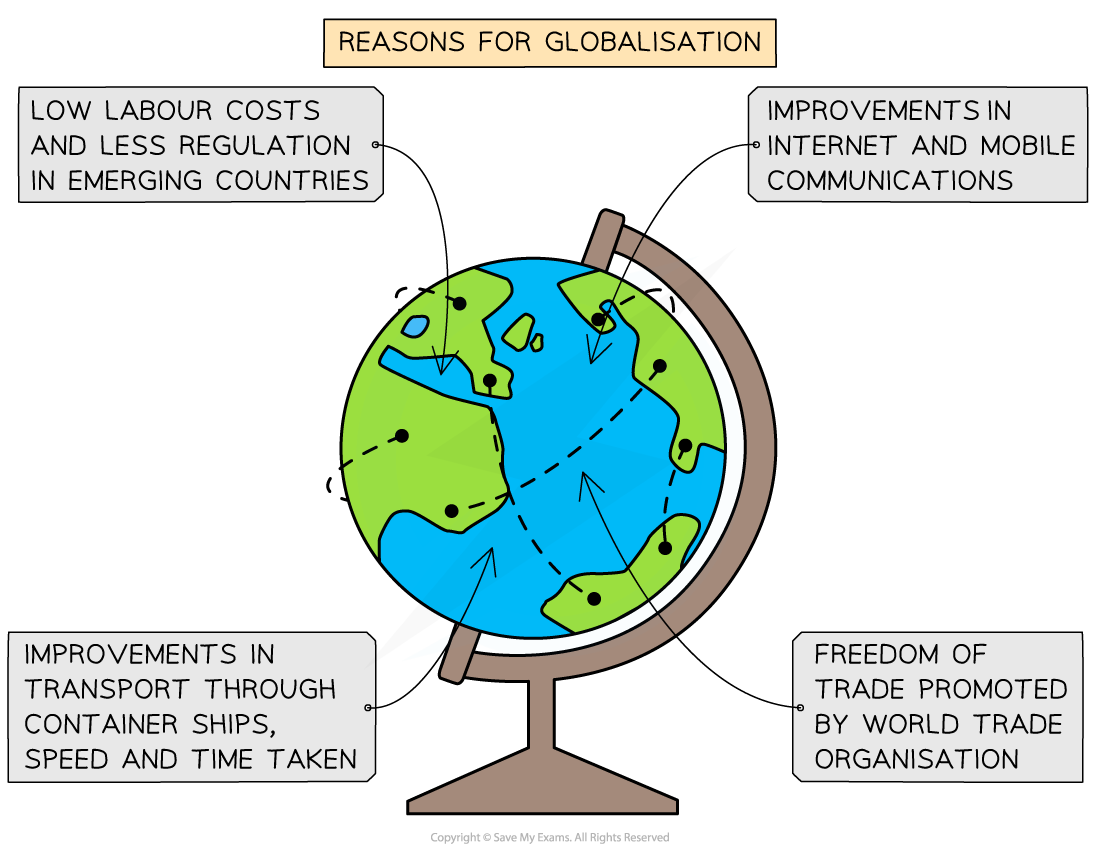
Some causes of globalisation
| Cause | Explanation |
|---|---|
| Falling transport costs | - Containerisation, larger cargo ships and cheaper air freight have sharply reduced the cost of moving goods internationally |
| Advances in communications | - The internet, mobile technology and low-cost international telecommunications enable real-time coordination of global business |
| Trade liberalisation | - Tariff reductions through the WTO, regional trade agreements and bilateral deals have lowered barriers to international trade |
| Capital market liberalisation | - Removal of controls on cross-border capital flows has enabled investment to move freely between countries |
| Growth of multinational companies | - MNCs have expanded operations across borders, building global supply chains and production networks |
| Economic reforms in major economies | - Market-oriented reforms in China (from 1978), India (from 1991), Vietnam and the former Soviet bloc have integrated large populations into the global economy |
Consequences of globalisation
- The consequences of globalisation are contested. Outcomes vary by country, by time period and by the economic sector considered
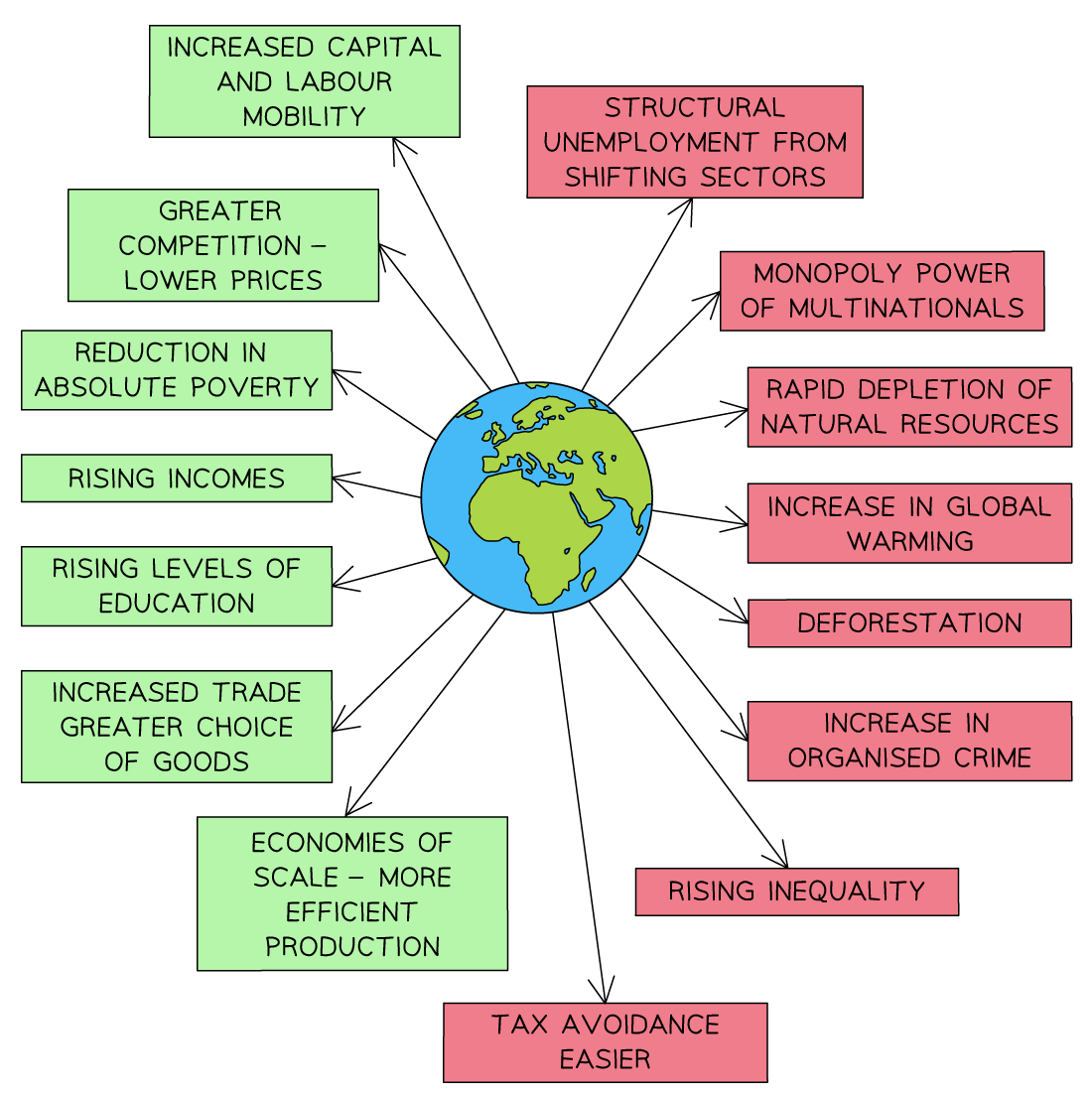
The positive and negative impacts of globalisation
Positive consequences
| Consequence | Explanation |
|---|---|
| Higher global output | - Specialisation according to comparative advantage raises total world production |
| Lower prices and wider choice for consumers | - Access to goods produced at lowest global cost benefits consumers worldwide |
| Economic growth in developing economies | - Export-led growth has lifted hundreds of millions out of poverty, particularly in East and Southeast Asia |
| Technology and skills transfer | - Globalisation accelerates the spread of technology and management practices to developing economies |
| Employment opportunities | - FDI and export industries create jobs in developing economies |
| Competitive pressure on firms | - Exposure to global competition forces firms to improve productivity and quality |
Negative consequences
| Consequence | Explanation |
|---|---|
| Widening inequality | - Benefits of globalisation have been uneven — both between countries and within countries - High-skilled workers and capital owners have often gained more than low-skilled workers |
| Loss of jobs in developed economies | - Manufacturing employment in high-wage countries has declined as production has shifted abroad |
| Exploitation concerns | - Labour conditions in some global supply chains have raised significant ethical concerns |
| Economic dependency | - Small or specialised economies may become highly dependent on global demand, leaving them vulnerable to external shocks |
| Destruction of indigenous industries | - Local firms may be outcompeted and forced to close, reducing domestic production capacity |
| Environmental damage | - Global trade increases emissions; MNC operations in weakly regulated economies can cause pollution |
| Vulnerability to global shocks | - The 2008 financial crisis and the 2020 COVID-19 pandemic demonstrated how problems in one part of the global economy spread rapidly to others |
Case Study China's Integration into the Global Economy
The context
Before 1978, China was largely closed to the global economy. Mao-era central planning had isolated the country from international trade and investment.
The reform and opening up programme launched by Deng Xiaoping in 1978 began China's transformation into the world's largest manufacturing economy — and the single most significant case of globalisation in modern economic history.
Actions taken
- Creation of Special Economic Zones (starting with Shenzhen in 1980) offering foreign investors tax incentives and flexible regulation
- Progressive trade liberalisation, culminating in WTO accession in 2001
- Massive investment in ports, transport and energy infrastructure to support export-led growth
- Integration into global supply chains, particularly in electronics, textiles and machinery
Outcomes
- China became the world's largest exporter by the 2010s
- Over 800 million people lifted out of extreme poverty between 1978 and 2020 — the largest poverty reduction in human history
- GDP per capita rose from under US$200 in 1978 to over US$12,000 by 2022
- Rapid development also brought severe air and water pollution, rising inequality between coastal and inland regions, and growing trade tensions with major partners including the US and EU
The Chinese case illustrates both the scale of benefits globalisation can deliver and the tensions it creates —rapid development alongside environmental costs, inequality and trade disputes.
Exam Hint The strongest analytical point on globalisation is that consequences are unevenly distributed — both between countries and within countries. Strong responses identify specific winners and losers rather than treating globalisation as uniformly good or bad.
CIE mark schemes for globalisation essays reward the definition as flows of goods, services, capital and people between countries, with production processes increasingly subdivided across multiple countries. This precise wording is worth learning.
For evaluation, the two strongest critical points are uneven distribution of benefits (some countries and groups gain far more than others) and vulnerability to global shocks (interconnected economies transmit crises rapidly, as shown in 2008 and 2020).
Use country-specific examples: China and Vietnam for successful integration; commodity-dependent African economies and Latin American economies facing volatile capital flows for the risks. Avoid vague references to "developing countries".
For synoptic depth, link globalisation to MNCs, FDI and international trade theory. Globalisation is the overarching process; these are its main mechanisms.
Was this revision note helpful?
Build on this topic