Inclusive Economic Growth (Cambridge International A-Level Economics)
What is inclusive economic growth?
- Inclusive economic growth is growth that creates opportunities for all groups and shares the benefits fairly across society
- It goes beyond raising real GDP and focuses on who benefits
- Key features: broad-based gains, equality of opportunity, rising participation in formal employment
Impact of economic growth on equity and equality
-
Growth does not automatically improve equity or equality
- The outcome depends on the type of growth
| Positive impacts | Negative impacts |
|---|---|
| - More jobs reduce absolute poverty | - Gains often concentrate with owners of capital and skilled labour |
| - Higher tax revenues fund redistribution | - Skill-biased technology widens wage gaps |
| - Rising incomes enable investment in children's education | - Regional inequality (urban vs rural) can widen |
| - Structural shift from agriculture raises low-end wages | - Informal workers often excluded from gains |
-
The Kuznets curve hypothesises inequality first rises then falls as economies develop
- The empirical evidence to support this is mixed
Policies to promote inclusive growth
| Policy | Mechanism | Key limitation |
|---|---|---|
| Investment in education and healthcare | - Raises human capital across all groups | - Long time lags before results appear |
| Progressive taxation and transfers | - Redistributes income directly | - Risk of disincentive effects on work and investment |
| National minimum wage | - Raises incomes at the bottom | - May reduce employment if set too high |
| Financial inclusion (banking, microfinance, mobile money) | - Enables poor households and small firms to access credit | - Limited impact without complementary skills and infrastructure |
| Regional and rural development | - Infrastructure investment reduces geographic inequality | - Expensive; long payback period |
Case Study Bangladesh's garment sector
From the 1980s, Bangladesh's ready-made garment (RMG) sector grew to employ around 4 million workers by 2023, roughly 60% women. The sector generates over 80% of export earnings.
Inclusive outcomes
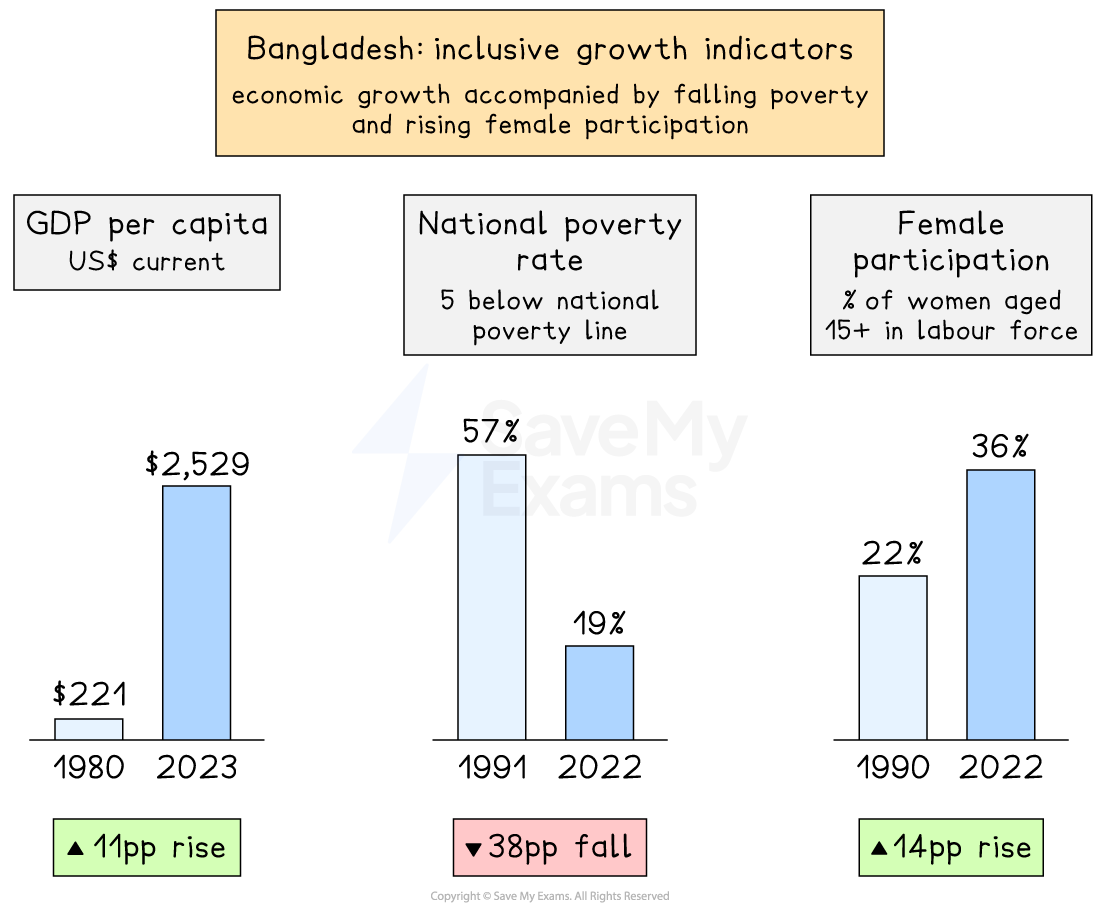
- Female labour force participation rose from 22% in 1990 to 36% by 2022 — one of the sharpest rises in South Asia
- GDP per capita rose from US$220 (1980) to over US$2,500 (2023)
- Poverty headcount fell from 44% (1991) to under 19% (2022)
- Rising female earnings linked to falling fertility and higher girls' school enrolment
Limitations
Wages remain among the lowest globally; factory safety issues (Rana Plaza, 2013); gains concentrated in urban Dhaka and Chittagong
Key lesson
Labour-intensive, export-led growth can be strongly inclusive when it draws excluded groups into formal employment — but requires complementary safety regulation and regional balance to be genuinely shared.
Exam Hint Always distinguish inclusive growth from ordinary growth in your first paragraph — ordinary growth raises real GDP; inclusive growth raises real GDP and shares the gains fairly.
For 12-mark evaluation questions, raise the efficiency–equity trade-off: strong redistribution can discourage work and investment, though recent IMF and OECD research suggests high inequality itself harms growth, so the trade-off is contested.
Was this revision note helpful?
Build on this topic