Wage Determination in Perfect Markets (Cambridge International A-Level Economics)
Equilibrium wage rate and employment
Conditions for a perfectly competitive labour market
-
A perfectly competitive labour market requires:
- many buyers and sellers: many firms hiring and many workers supplying labour, so no individual participant can influence the wage rate
- homogeneous labour: all workers in the occupation are assumed to have identical skills and productivity
- perfect information: all workers and firms have full knowledge of wage rates and job opportunities
- freedom of entry and exit: workers can move freely between occupations and firms
-
In reality these conditions are never fully met
- labour markets are inherently imperfect due to skill differences, asymmetric information and geographical immobility
- the perfectly competitive model is therefore a theoretical benchmark rather than a description of reality
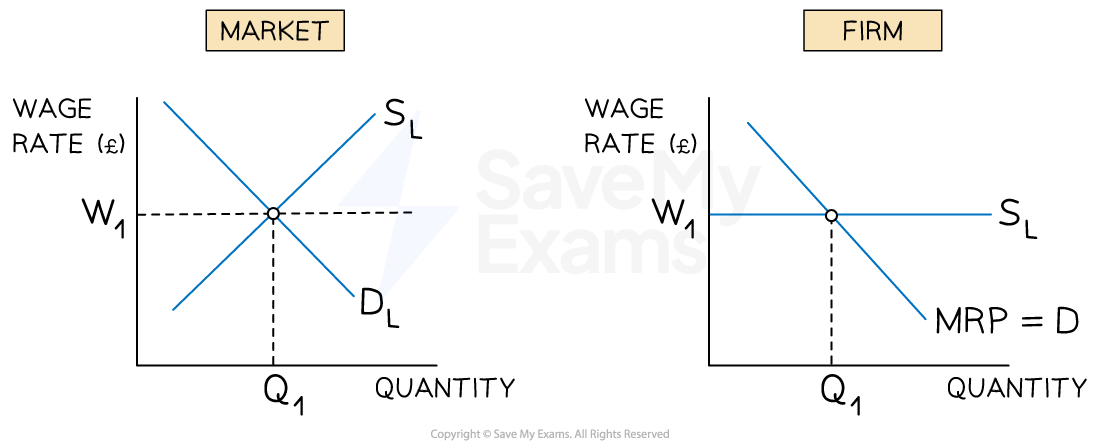
In the labour market for perfectly competitive firms, the wage rate is set by the industry wage rate
Diagram analysis
Wage determination at market level
-
The equilibrium wage rate is determined where demand for labour (DL) = supply of labour (SL)
-
At the equilibrium wage W₁, the quantity of labour demanded equals the quantity supplied - Q₁ workers are employed
-
As in product markets, if the wage rate is above or below W₁, market forces push it back towards equilibrium
- excess labour supply drives wages down; excess demand drives wages up
Wage determination at firm level
-
In a perfectly competitive labour market, the individual firm is a wage taker
- it is too small to influence the market wage rate and must pay W₁
-
The firm faces a perfectly elastic supply of labour at W₁:
- If it offers a lower wage, it cannot recruit any workers - all will work elsewhere at W₁
- If it offers a higher wage, it attracts more workers than it needs and pays above the market rate unnecessarily
-
Because every additional worker costs the same wage rate W₁, the supply curve is also the firm's average cost of labour (ACL) and marginal cost of labour (MCL):
- ACL = W₁ for every worker hired
- MCL = W₁ for every additional worker hired
- Therefore SL= ACL= MCL= W₁
-
The firm's demand curve for labour is its marginal revenue product of labour (MRPL) curve - see marginal revenue product theory
-
The firm maximises profit by hiring labour up to the point where MRPL= MCL - i.e. where MRPL = W₁
-
Equilibrium for the individual firm occurs at wage W₁ and employment level Q₁
Exam Hint Connect wage determination to equilibrium and disequilibrium: excess demand pushes wages up; excess supply pushes wages down - the same mechanism as a product market.
For higher-mark responses, note that the perfectly competitive model predicts allocative efficiency - workers are paid their marginal revenue product, directing labour to its highest-value use. This is the benchmark against which imperfect labour market outcomes are judged.
Evaluating the perfectly competitive labour market model
| Strength | Limitation |
|---|---|
| - Provides a clear theoretical benchmark for wage determination | - Assumes homogeneous labour - In reality workers have different skills, experience and productivity |
| - Predicts that wages adjust to clear the market - A useful starting point for analysis | - Assumes perfect information - In reality workers and firms face significant information asymmetries |
| - Explains why wage rates tend to equalise across firms in the same occupation | - Ignores trade union power, minimum wages and monopsony - All of which prevent the competitive outcome |
| - The model of DL = SL is directly applicable to large unskilled labour markets | - Labour is geographically immobile - Workers cannot always move freely to where wages are highest |
Was this revision note helpful?
Build on this topic