Understanding Poverty (Cambridge International A-Level Economics)
Absolute and relative poverty
-
Absolute poverty is a condition in which an individual lacks the minimum resources necessary for basic survival
-
They have insufficient income to meet basic needs such as food, shelter, clean water and healthcare
-
It is defined against a fixed standard that does not change as average living standards rise
- The World Bank defines the international absolute poverty line as living on less than $3.00 per person per day (2025, purchasing power parity)
-
-
Relative poverty is a condition in which an individual's income falls significantly below the average standard of living in their society
-
This is typically defined as below 50% or 60% of median household income
-
It is determined by comparing against a moving standard that rises as average incomes rise — meaning relative poverty can persist or worsen even as absolute poverty falls
- Relative poverty is therefore a measure of inequality as much as deprivation
- Relative poverty exists in all economies, including high-income ones
-
Key distinction
| Feature | Absolute poverty | Relative poverty |
|---|---|---|
| Standard | Fixed minimum threshold | Relative to average living standards |
| Changes as incomes rise? | No — threshold is fixed | Yes — threshold rises with median income |
| Measure of | Deprivation | Inequality |
| Most relevant to | Low-income economies | All economies, including high-income |
| Example threshold | World Bank $2.15/day | Below 60% of median income |
Case Study Absolute vs relative poverty in India
The context
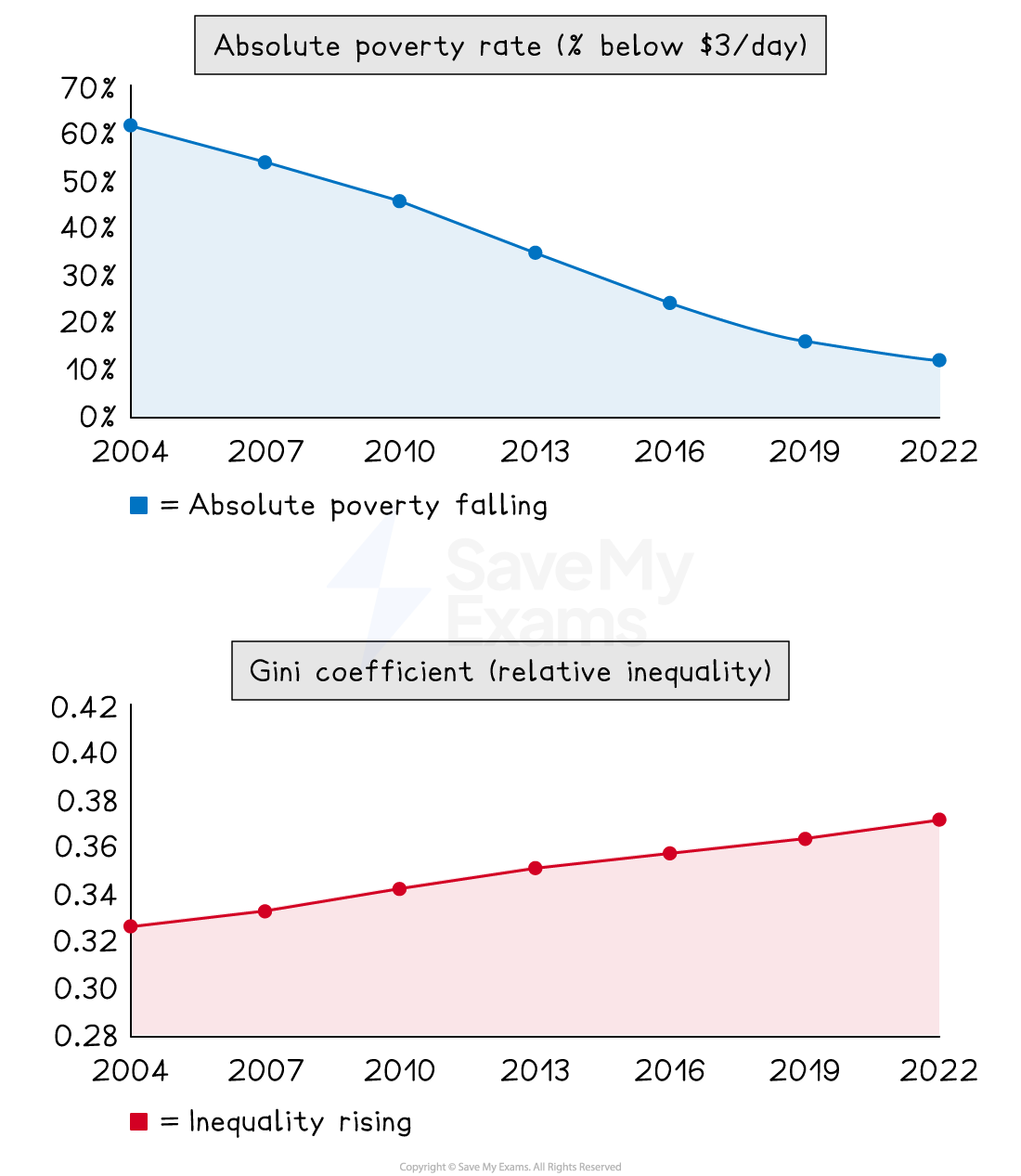
India's rapid economic growth since the liberalisation reforms of the 1990s provides a striking illustration of the distinction between absolute and relative poverty - dramatic progress on one measure alongside deterioration on the other.
Actions taken
- Market liberalisation drove technology-led growth, particularly in services and manufacturing
- MGNREGA guaranteed rural employment, directly targeting absolute poverty
- Direct benefit transfers channelled food, fuel and fertiliser subsidies to low-income households
Outcomes
- The share of Indians living in absolute poverty fell from over 40% in 2011 to under 12% by 2022 - hundreds of millions lifted out of extreme deprivation
- Under the updated $3.00 per day line (2025 PPP), progress remains significant
- However India's Gini coefficient rose during the same period, with the wealthiest 1% capturing a disproportionate share of national income
This illustrates that rapid growth can simultaneously reduce absolute poverty while worsening relative poverty
The poverty trap
Spec point —
8.2.4
-
The poverty trap occurs when individuals receiving means-tested benefits face such a high effective marginal tax rate as they move into work that the financial gain from working is negligible or negative - creating a disincentive to work
-
It arises from the interaction of two simultaneous effects as earned income rises:
-
Benefit withdrawal
- means-tested benefits are reduced or removed as income rises
-
Income tax and social contributions
- earned income becomes subject to taxation
-
-
Together these can create an effective marginal tax rate
- the combined rate at which additional earned income is lost to tax and benefit withdrawal can exceed 80% or even 100% in some systems
-
The individual then faces a rational calculation at the margin
- If the financial gain from working is negligible, and work involves additional costs such as transport and childcare, remaining on benefits may be the rational choice
- This is a direct application of the margin and decision-making key concept — work does not pay at the margin
Graphing the poverty trap
Diagram analysis
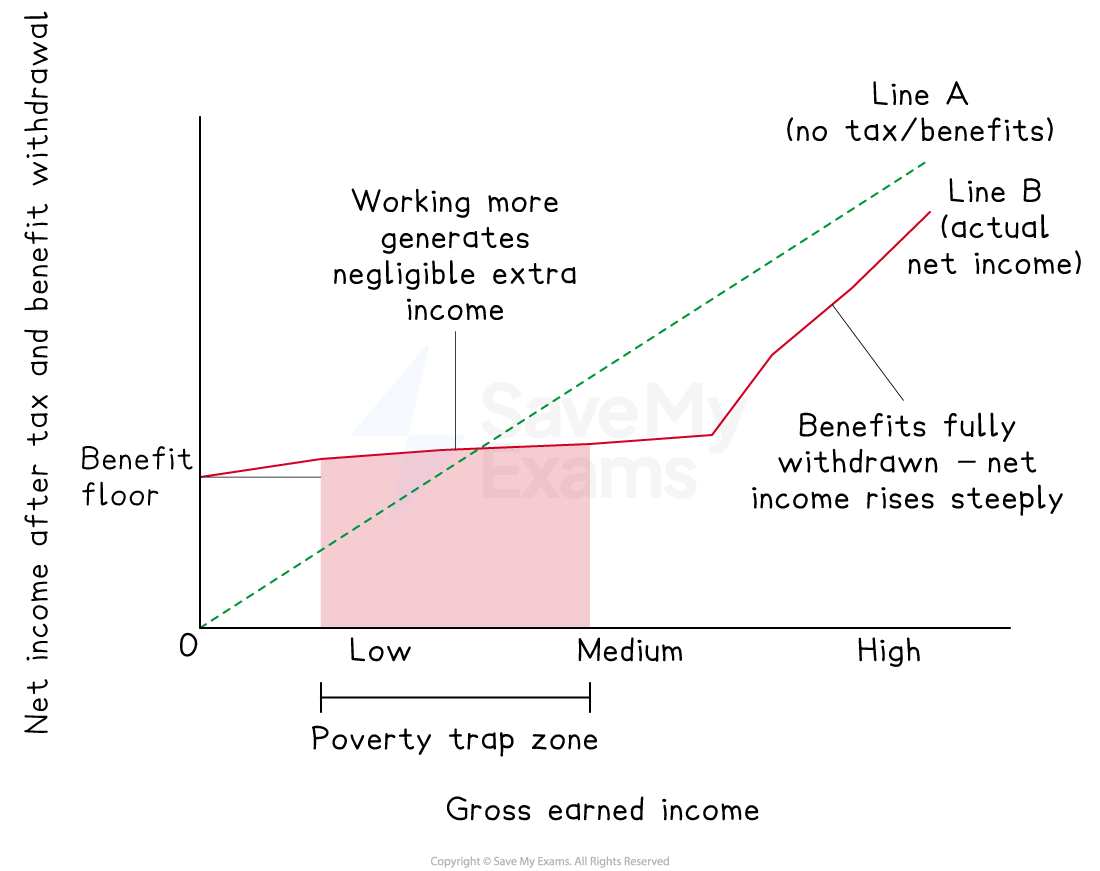
- Line A (45°) shows net income with no tax or benefit withdrawal - every unit earned is kept
- Line B starts above zero, reflecting the benefit floor received by those not working
- As earned income rises, Line B is nearly flat - benefit withdrawal and taxation offset additional earnings, creating the poverty trap zone
- Once benefits are fully withdrawn, Line B rises steeply - work finally pays at the margin
- Throughout the trap zone, Line B lies well below Line A - illustrating how little individuals actually keep from additional earnings
Evaluating the poverty trap
| Point | Explanation |
|---|---|
| Disincentive to work | - High effective marginal tax rates reduce labour supply at the margin - This is a productive inefficiency with macroeconomic costs |
| Rational behaviour | - Individuals staying on benefits are not irrational - They are responding correctly to the incentives the system creates. the problem is with the system design, not the individual |
| Equity concern | - The poverty trap disproportionately affects the lowest-income groups, entrenching inequality rather than reducing it - The opposite of the redistribution system's stated goal |
| Policy trade-off | - Reducing benefit withdrawal rates to eliminate the poverty trap requires either lower benefit levels (worsening equity) or higher government spending (fiscal cost) - there is no costless solution |
| Measurement difficulty | - The effective marginal tax rate varies significantly across individuals depending on their specific combination of benefits, family circumstances and local costs, making the poverty trap hard to quantify and target |
Exam Hint The poverty trap is fundamentally about the margin and decision-making: individuals compare the marginal financial gain from working against its costs. When the effective marginal tax rate is very high, work does not pay at the margin - this is rational behaviour, not laziness.
The strongest evaluative point is the policy trade-off: eliminating the poverty trap requires either reducing benefit levels (worsening equity) or increasing government spending (fiscal cost). There is no costless solution
Was this revision note helpful?