Market Failure (Cambridge International A-Level Economics)
Exam board Cambridge International · A-LevelUpdated 2026-03-05
What market failure is
Understanding market failure
-
Market failure occurs when the free market fails to allocate resources efficiently, meaning the quantity of goods produced does not maximise social welfare
-
In a free market, the price mechanism determines the most efficient allocation of scarce resources in response to the competing wants and needs in the marketplace
- Scarce resources are the factors of production (land, labour, capital, enterprise)
- Free markets often work very well
-
Market failure occurs when markets fail at delivering efficiency
- Often, there is a less-than-optimum allocation of resources from the point of view of society
-
There are several factors that cause markets to fail
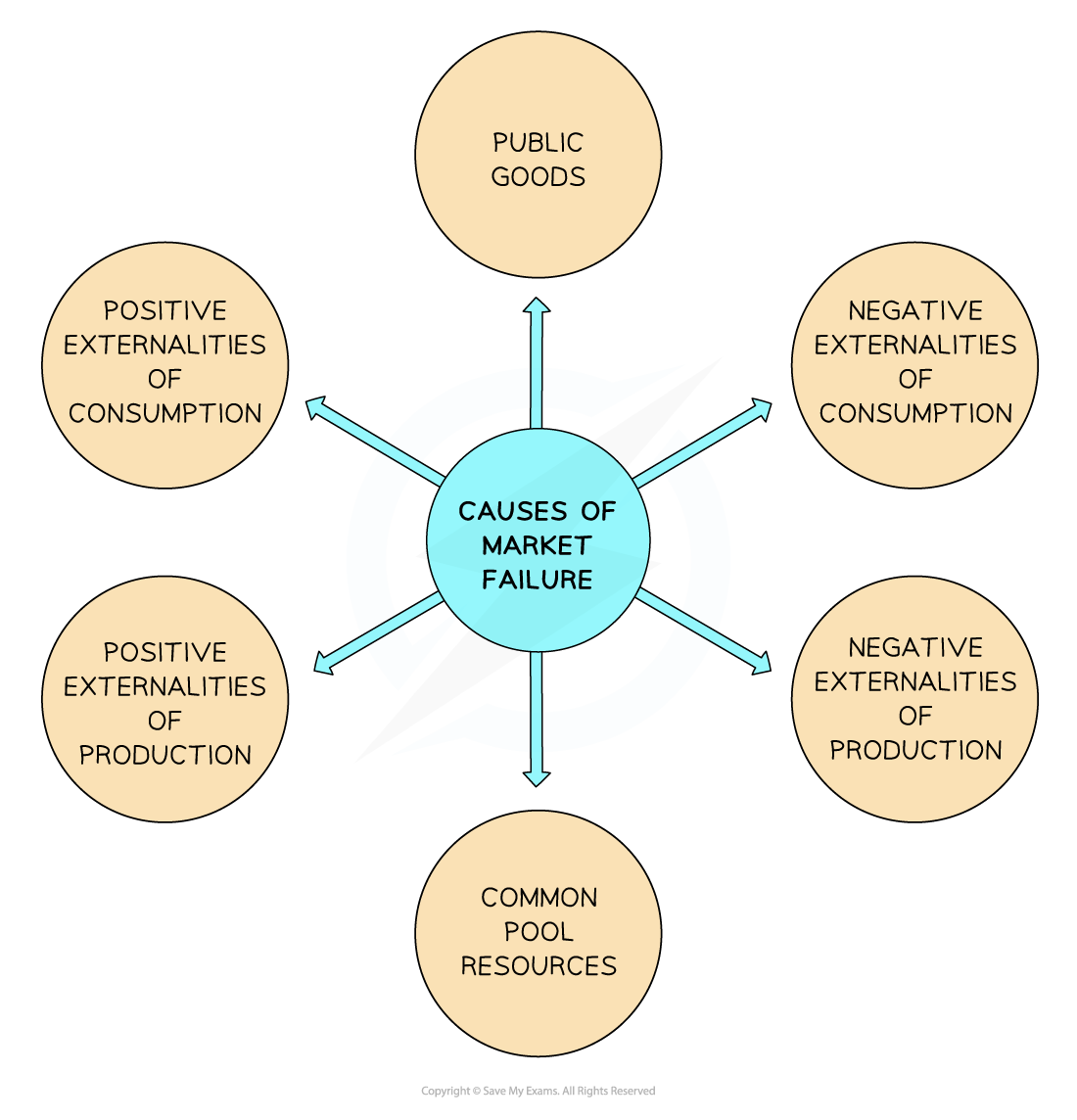
-
From society’s point of view, in each of these cases, there is a lack of efficiency in the allocation of resources
- Sometimes there is an **over-provision **of goods or services which are harmful (demerit goods) and therefore an over-allocation of the resources (factors of production) used to make these goods/services e.g. cigarettes
- Sometimes there is an** under-provision** of the goods or services which are beneficial (public goods and merit goods) and therefore an under-allocation of the resources (factors of production) used to make these goods or services e.g. education
- In the case of common pool resources, there is an overuse of a finite resource
Was this revision note helpful?
Build on this topic