Understanding Supply Side Policy (Cambridge International A-Level Economics)
What is supply-side policy?
- Supply-side policy is government policy that aims to increase the productive capacity of the economy by shifting the Long Run Aggregate Supply (LRAS) curve to the right
- Unlike fiscal and monetary policy which operate primarily through AD, supply-side policy works directly on the supply side of the economy - increasing the quantity and quality of factors of production
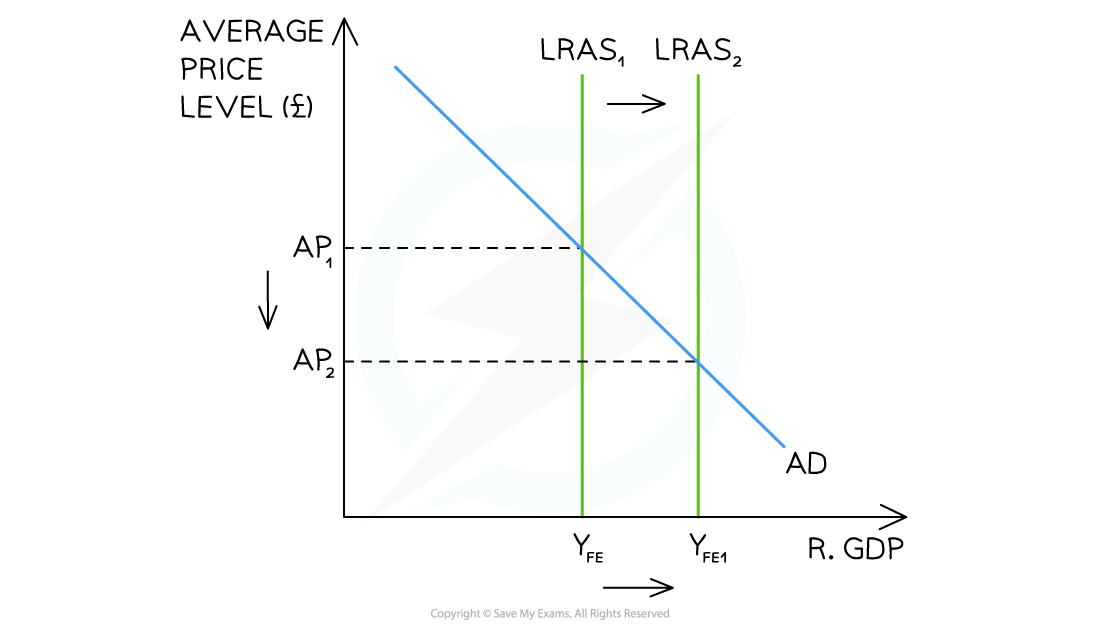
Supply side policy aims to shift LRAS
-
A rightward shift of LRAS means the economy can produce more output at every price level
- The potential output increases
The objectives of supply-side policy
1. Increasing productivity
-
Productivity is the output produced per unit of input - most commonly measured as output per worker (labour productivity)
- Higher productivity means the same number of workers can produce more output - unit costs of production fall and the economy becomes more competitive internationally
-
Productivity can be raised by improving the quality of labour (through education and training), improving technology (through R&D investment) or improving management practices
2. Increasing productive capacity
-
Productive capacity is the maximum output the economy can produce when all resources are fully employed - represented by the position of the LRAS curve
- Increasing productive capacity shifts LRAS rightward - the economy's potential output rises and the full employment level of national income increases
-
This is distinct from a movement along LRAS - supply-side policy shifts the curve itself
Tools of supply-side policy
Education and training
-
Investment in education and training raises the human capital of the workforce - the skills, knowledge and productivity of workers
- Examples include government spending on schools and universities, apprenticeship programmes and subsidised retraining for unemployed workers
-
Higher human capital raises labour productivity, reducing unit costs of production and shifting LRAS right
Infrastructure development
-
Investment in physical infrastructure - roads, railways, ports, energy networks and digital broadband - reduces the costs of doing business and improves the efficiency of the economy
- Better transport links reduce delivery times and costs
- A reliable energy supply reduces production disruptions
- Fast broadband enables more efficient communication
-
Infrastructure investment shifts LRAS right by raising the productive capacity available to all firms in the economy
Support for technological improvement
-
Government support for research and development (R&D) - through subsidies, tax incentives or direct public investment - encourages innovation and the adoption of new production technologies
- New technology raises total factor productivity - more output from the same inputs - shifting LRAS right
- Examples include government R&D tax credits, university-industry research partnerships and public investment in emerging technologies such as renewable energy and artificial intelligence
Deregulation and competition policy
-
Reducing unnecessary regulation lowers costs for firms and encourages new entrants to markets
- Greater competition incentivises firms to innovate, cut costs and improve efficiency - raising economy-wide productivity
- Examples include deregulating labour markets to improve flexibility, and removing barriers to entry in key industries
Tax incentives
- Cutting corporation tax raises post-tax profits, increasing the incentive for firms to invest in new capital - shifting LRAS right over time
- Cutting income tax or reducing benefits may increase labour supply by making work more financially rewarding relative to inactivity
Was this revision note helpful?
Build on this topic