Types of Unemployment and the Natural Rate (Cambridge International A-Level Economics)
Key terms
-
Working-age population - all people of employable age (typically 16–64)
-
Labour force (LF) - those in the working-age population who are either employed OR actively seeking work
- Excludes students, retirees, homemakers, and others not seeking work (the "economically inactive")
-
Employed - people currently working for pay (full-time, part-time, or self-employed)
-
Unemployed - people in the labour force who are not working but actively seeking work
-
Participation rate - labour force as a % of working-age population
-
Unemployment rate - unemployed as a % of labour force
Full employment
-
Full employment is the level of employment at which everyone willing and able to work at the going wage rate is employed
-
Full employment does NOT mean zero unemployment
- Some unemployment always remains due to frictional, structural and voluntary factors
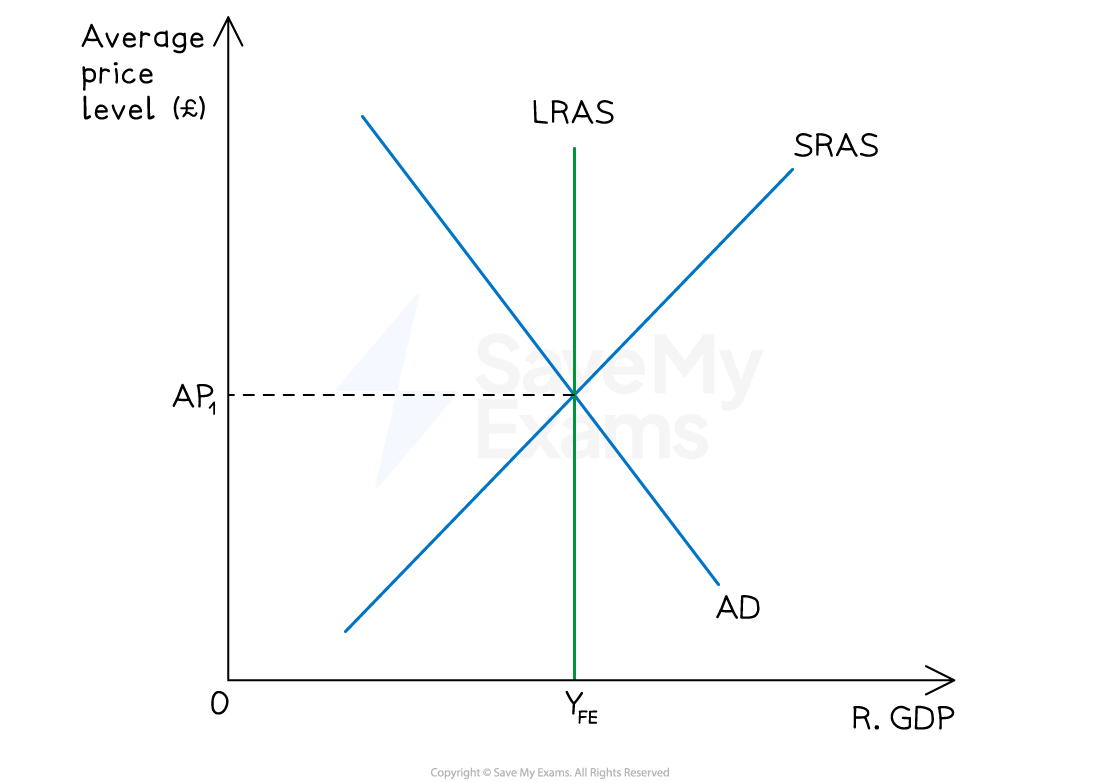
Full employment can be seen on a LRAS diagram
-
At full employment, the only unemployment is the natural rate of unemployment (NRU)
- This corresponds to real output YFE on the vertical section of LRAS
Equilibrium and disequilibrium unemployment
| Type | Cause | Examples |
|---|---|---|
| Equilibrium unemployment | - Labour market clears at the market wage - Some workers are still unemployed | - Frictional, structural, seasonal, voluntary |
| Disequilibrium unemployment | - Labour market does NOT clear - Real wage stuck above equilibrium | - Cyclical (demand-deficient), real-wage/classical |
Equilibrium unemployment
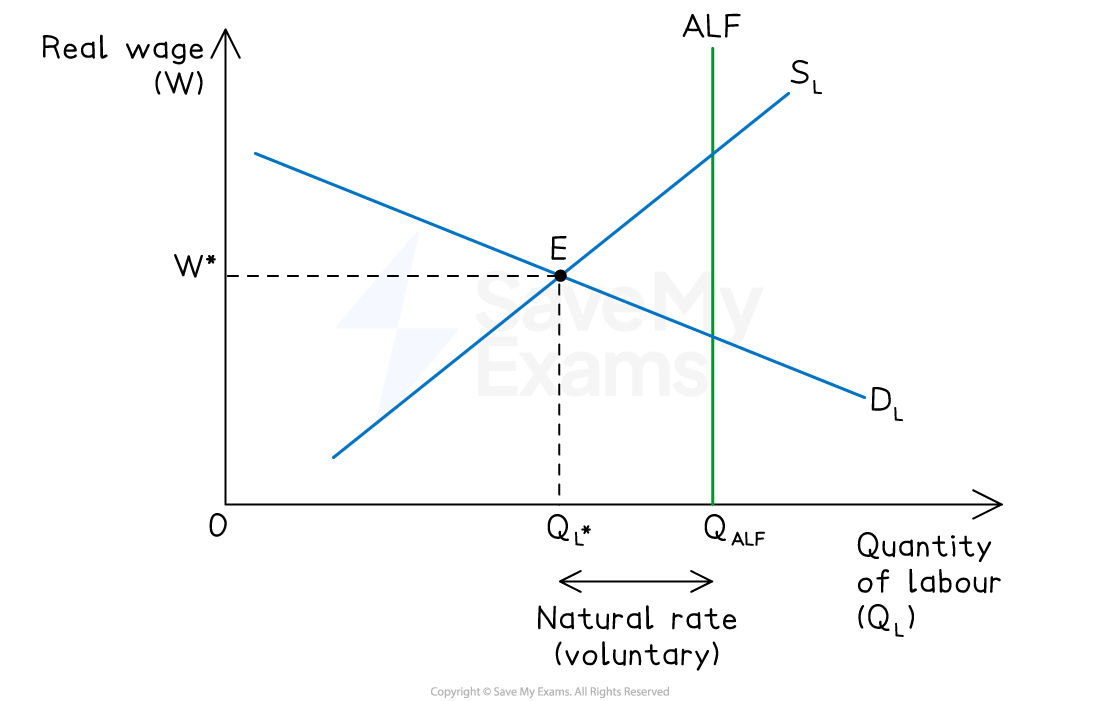
The equilibrium labour market
Diagram analysis
-
DL (downward sloping) - firms hire more workers at lower wages
-
SL (upward sloping) - more workers willing to work at higher wages
-
LF (vertical) - everyone who could potentially work (labour force)
-
Equilibrium at W, Q*L - labour market clears
-
Horizontal gap between SL and LF at W* = natural rate of unemployment
- This is voluntary as workers are in the labour force but not willing to work at W*
Hysteresis
-
Hysteresis is the tendency of unemployment to persist at higher levels after a temporary shock has passed
- Long-term unemployed lose skills (human capital erodes)
- Employers view them as less employable (signalling effect)
- Discouraged workers stop searching
-
Consequence - a cyclical shock can permanently raise the natural rate of unemployment unless addressed through active labour market policy
- Example - European unemployment rose sharply after the 1980s oil shocks and remained elevated for over a decade, even after recovery
Voluntary and involuntary unemployment
Spec point —
9.3.3
| Type | Definition | Typical cause | Part of |
|---|---|---|---|
| Voluntary | - Workers choose not to work at current wage | - Reservation wage above market wage - Searching for better job - Welfare/benefit generosity | - Equilibrium unemployment (NRU) |
| Involuntary | - Workers willing and able to work at current wage but cannot find a job | - Wage rigidity (minimum wage, trade unions) - Demand deficiency - Structural mismatch | - Disequilibrium unemployment |
Involuntary/disequilibrium unemployment
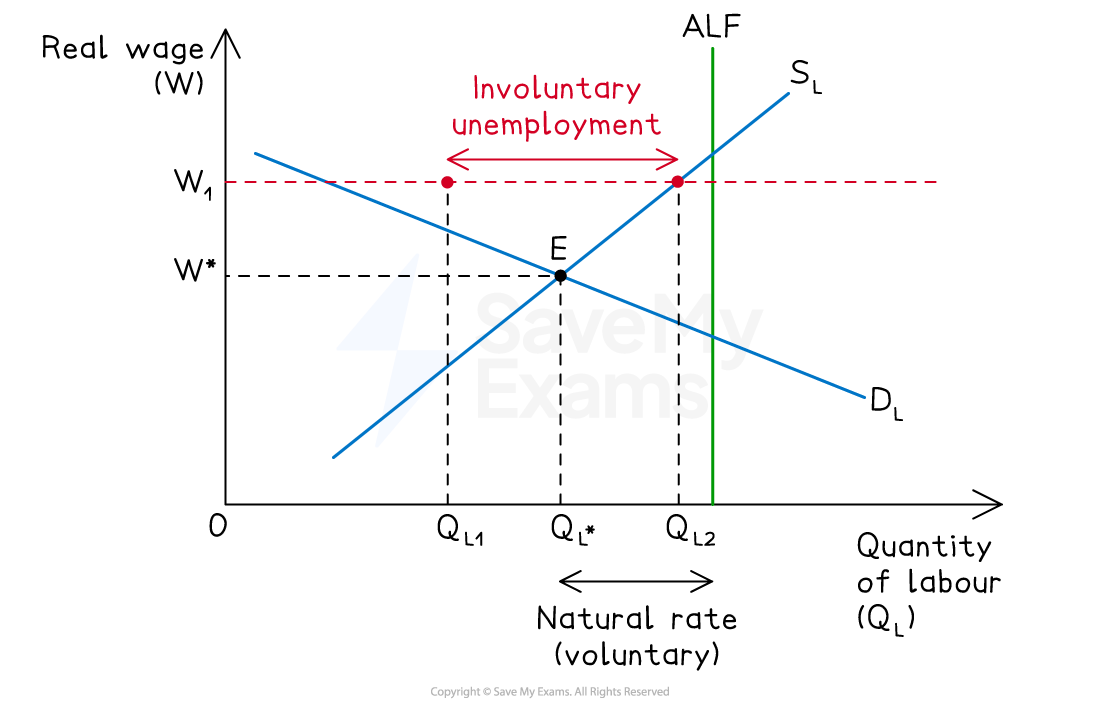
Involuntary unemployment
Diagram analysis
-
The real wage is stuck at W₁ above equilibrium W (e.g. due to minimum wage, union action, or sticky nominal wages)
-
At W₁, firms demand only Q_L1 workers, but Q_L2 workers are willing to work
-
Gap between QL1 and QL2 = involuntary unemployment
- Workers are ready and able to work at W₁ but cannot find jobs
The natural rate of unemployment (NRU)
-
The NRU is the rate of unemployment when the labour market is in equilibrium
- This corresponds to full employment output YFE
- It comprises frictional + structural + voluntary unemployment
-
The NRU cannot be reduced permanently by expansionary demand-side policy
- Doing so only creates inflation (see expectations-augmented Phillips curve)
Determinants of the NRU
| Factor | Effect on NRU |
|---|---|
| Unemployment benefit generosity | - Higher benefits raise reservation wages → higher NRU |
| Labour market regulation (unions, employment protection) | - Stronger protection → slower adjustment → higher NRU |
| Skills and training | - Better skills → lower structural mismatch → lower NRU |
| Geographic and occupational mobility | - Higher mobility → faster matching → lower NRU |
| Job-matching efficiency (job centres, technology) | - Better matching → lower NRU |
| Rate of technological change | - Faster change → more structural unemployment if retraining lags → higher NRU |
Policy implications
-
Demand-side policies (fiscal, monetary) cannot reduce unemployment below the NRU in the long run - they only cause inflation
-
Reducing the NRU requires supply-side policies:
- Education and retraining to reduce structural mismatch
- Job-search support and improved labour exchanges
- Benefit reform to reduce disincentives
- Increasing labour mobility
Exam Hint Always distinguish equilibrium and disequilibrium unemployment clearly in your opening paragraph — equilibrium unemployment is voluntary (workers choosing not to work at W*) and forms the NRU; disequilibrium unemployment is involuntary (workers wanting work but unable to find it at a sticky wage).
Draw both labour market diagrams where the question demands a comparison - a single diagram cannot show both cases.
For questions on why expansionary demand-side policy cannot permanently reduce unemployment, link directly to the expectations-augmented Phillips curve - AD stimulus reduces unemployment below the NRU in the short run but raises inflation. Once workers adjust wage expectations upward, unemployment returns to the NRU at a higher inflation rate.
Hysteresis is a high-value AO3 evaluation point - it explains why recessions can have permanent effects and why active labour market policies (training, job-search support) are justified even after the immediate shock has passed.
Was this revision note helpful?
Build on this topic