Understanding Welfare Loss (Cambridge International A-Level Economics)
Understanding the deadweight welfare loss
-
Deadweight welfare loss occurs when resources are not allocated at the socially efficient level of output where MSB = MSC
- If MSB > MSC, output is too low, meaning society would benefit from greater production or consumption
- If MSC > MSB, output is too high, meaning society would benefit from less production or consumption
- In both cases, the difference between MSB and MSC creates a welfare loss to society
Calculating the welfare loss that is caused by the positive externality of consumption
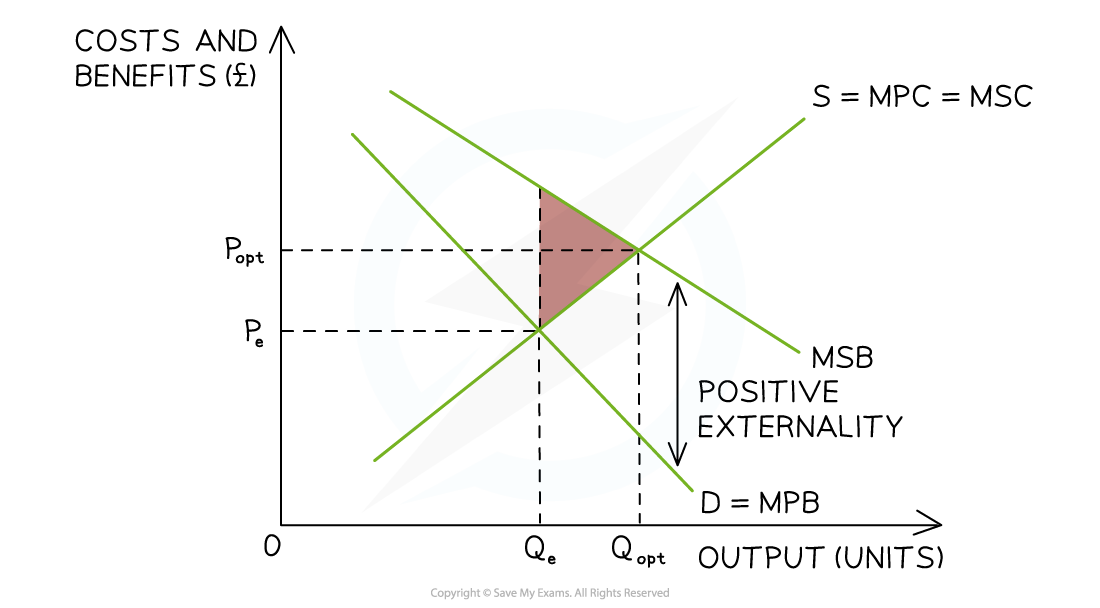
Step 1: Identify the area of welfare loss (potential welfare gain)
- This product is underconsumed – there should be higher levels of consumption
- Welfare loss to society is the triangle formed by the arrowhead which points forwards towards the socially optimal quantity
- Assume Qe = 70,000 and Qopt = 100,000
- Assume Pe = £40 and Popt = £80
Step 2: Calculate the area of the triangle
- More factors of production should be allocated to producing the optimal quantity, as societal welfare will be gained (pink triangle)
- There is an opportunity for government intervention (subsidies, partial provision, etc.) to force this market to be more socially efficient
- Any intervention that gains welfare will be beneficial
Calculating the welfare loss that is caused by the negative externality of production
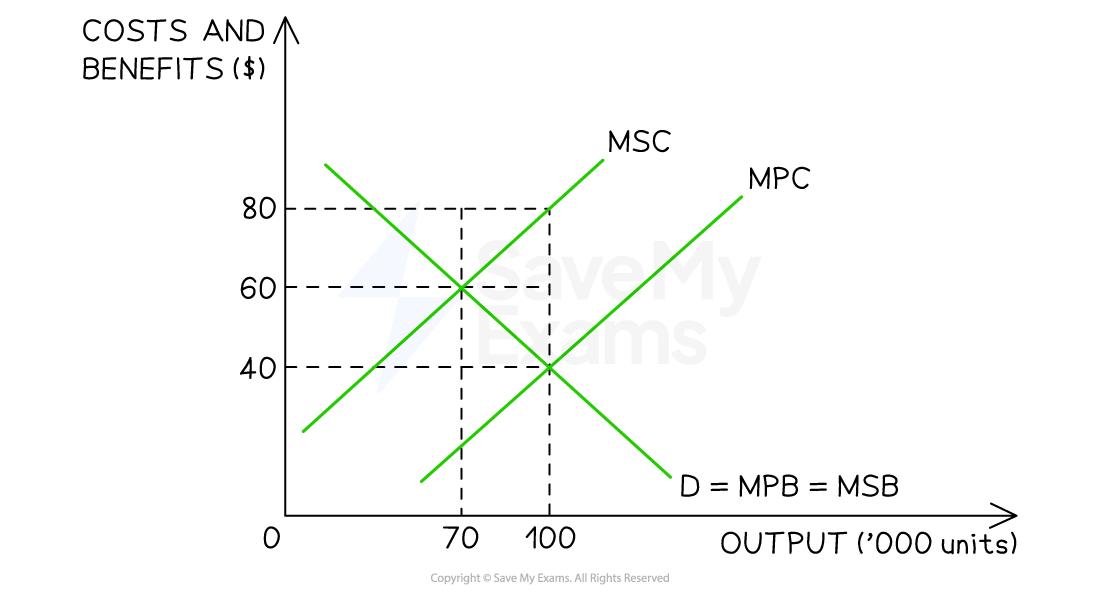
Step 1: Identify the area of welfare loss
-
The good is overproduced (Qe > Qopt), so output should fall to the socially optimal quantity
-
Deadweight welfare loss is the triangular area between the MSC and MSB curves between Qopt and Qe
- Qopt = 70,000 (social optimum where MSC = MSB)
- Qe = 100,000 (free-market equilibrium where MPC = MPB)
Step 2: Calculate the area of the triangle
$\text{Welfare} \text{loss} = \frac{( 100 , 000 - 70 , 000 ) \mathrm{x} ( \pounds 80 - \pounds 40 )}{2}
\text{Welfare} \text{loss} = \frac{30 , 000 \mathrm{x} 40}{2}
\text{Welfare} \text{loss} = \pounds 600 , 000$
- Less factors of production should be allocated to producing the optimal quantity, as societal welfare will be lost
- There is an opportunity for government intervention (indirect taxes, regulation, etc.) to force this market to be more socially efficient
- Government intervention, such as taxes or regulation, can reduce over-production and move the market closer to the socially efficient outcome
Was this revision note helpful?
Build on this topic