Shutdown Price in the Short Run & the Long Run (Cambridge International A-Level Economics)
The shut-down rule
-
Firms do not always make a profit and may endure losses for a period
- Entrepreneurs often keep firms going in the hope that market conditions will change and demand for their products will increase, leading to profitability
- This raises the question, 'when is it the best time for a firm to shut down?'
-
The shut-down rule provides the answer by considering both the long-run and short-run periods
1. The short-run shut down point
-
In the short-run, if the selling price (average revenue) is higher than the average variable cost (AVC), the firm should keep producing (AR > AVC)
- If the selling price (AR) falls to the AVC it should shut down (AR = AVC)
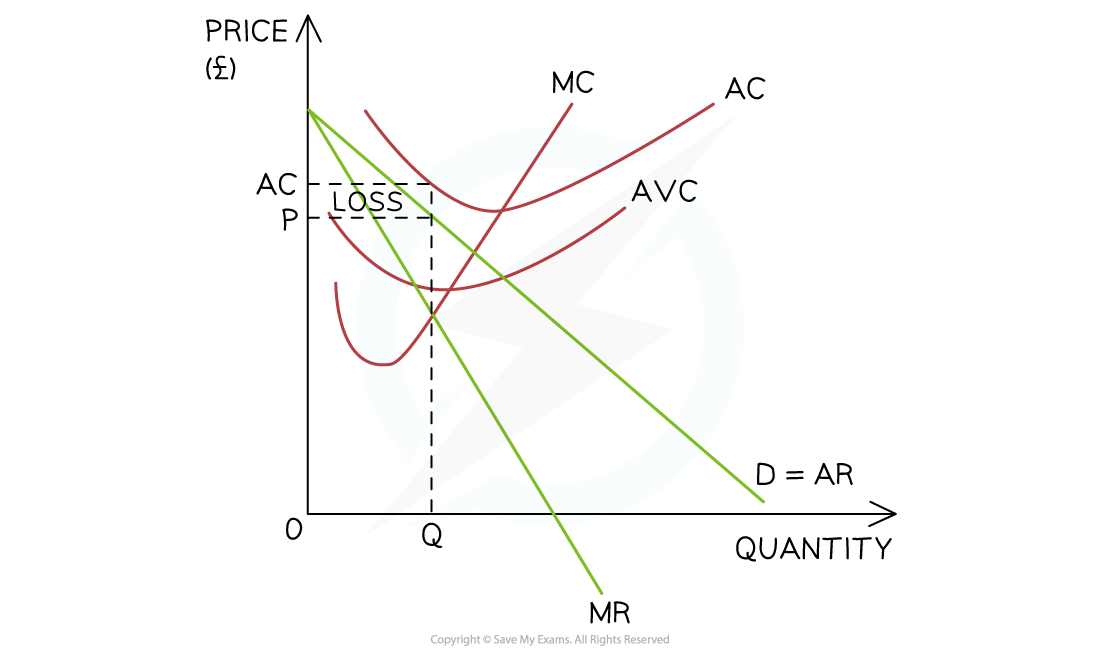
A firm should shut down in the long-run if the selling price (AR) is unable to cover the AC
Diagram analysis
-
The firm produces at the profit maximisation level of output (Q) where MC=MR
-
At this level, the P = AVC
-
This means that there is no contribution towards the firm's fixed costs
- The selling price literally only covers the cost of the raw materials used in production
- There is no point in continuing production and the firm should shut down
-
2. The long-run shut down point
-
In the long-run, if the selling price (AR) is higher than the average cost (AC) the firm should remain open (AR > AC)
- if the selling price (AR) is equal to or lower than the average cost (AC), the firm should shut down (AR = AC)
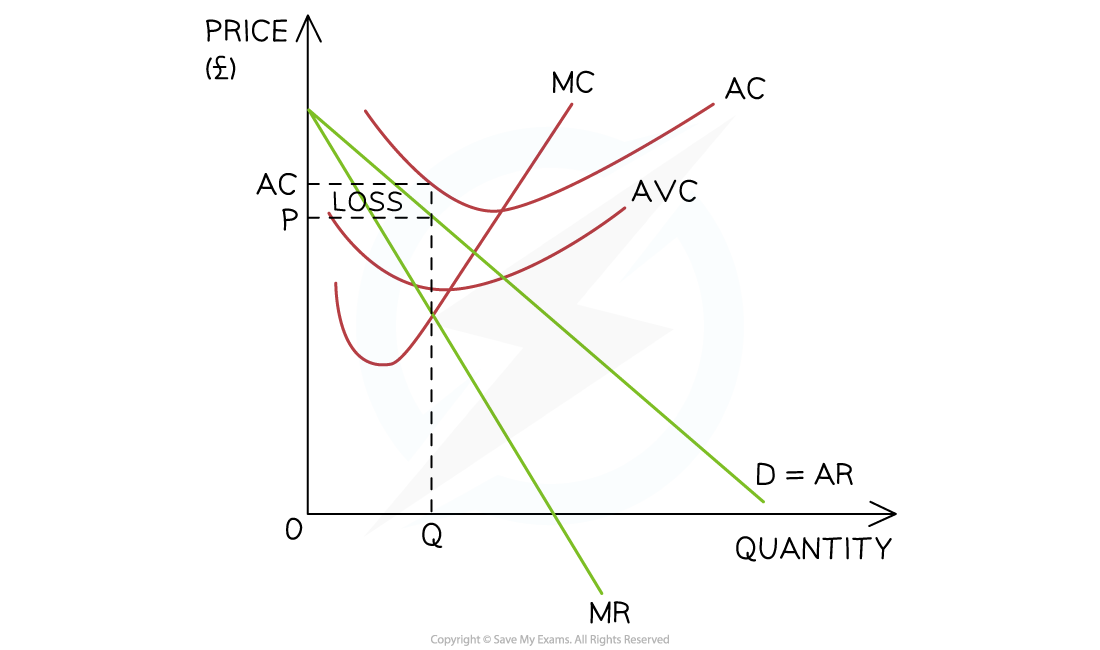
A firm should shut down in the long-run if the selling price (AR) is unable to cover the AC
Diagram analysis
-
The firm produces at the profit maximisation level of output (Q) where MC=MR
-
At this level, P < AC
- It could continue operating in the short-run as the AR > AVC, but in the long-run they are making a loss and the firm will shut down
Was this revision note helpful?
Build on this topic