Unit, Job & Batch Costing (Cambridge International A-Level Accounting)
Unit costing
Spec point — how to apply traditional costing methods to prepare costing statements using unit, job and batch costing principles in both manufacturing and service businesses as applicable
What is unit costing?
- Unit costing is where the **cost of producing a single unit **of product or service is calculated
- It is used when production is continuous and** identical products** are produced
How do I prepare a costing statement for a unit?
-
STEP 1 Calculate the direct materials cost per unit
- **Multiply the **cost per direct material unit (e.g. cost per metre) by the amount of direct materials used per unit
-
STEP 2 Calculate the** direct labour cost per unit**
-
Multiply the hourly rate by the hours spent per unit
-
These may have different hourly rates for each department
- E.g. machining department, assembly department
-
-
STEP 3 Calculate overheads per unit
-
Multiply the overhead absorption rate by machine hours or labour hours used per unit
- Machine hours for **machine-intensive **departments
- Labour hours for** labour-intensive** departments
-
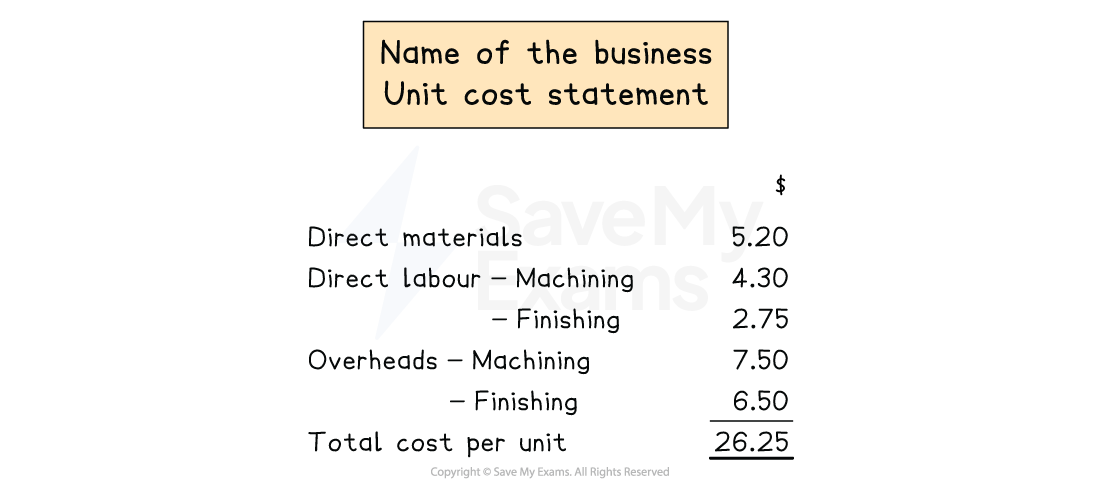
Example of a unit cost statement
Exam Hint For service businesses, there is no direct material cost or factory overheads.
Worked Example Company X manufactures tables.
The following data is available per unit for the year ended 31 December 2020.
Direct materials 5kg at $2.50 per kg Direct labour Machining department 4 hours at $10.75 per hour Finishing department 2 hours at $8.50 per hour Machine hours Machining department 2.5 hours Finishing department 1.5 hours Overhead absorption rates $5.50 per labour hour
$6.20 per machine hourCalculate the cost of producing one table.
Answer:
Use machine hours for machining department overheads
Use labour hours for finishing department overheads
Unit cost statement: $ Direct materials 5 × $2.50 12.50 Direct labour Machining department 4 × $10.75 43.00 Finishing department 2 × $8.50 17.00 Overheads Machining department 2.5 × $6.20 15.50 Finishing department 2 × $5.50 11.00 Total cost per unit 99.00 Final answer: Cost per unit is $104.50
Job costing
Spec point — how to apply traditional costing methods to prepare costing statements using unit, job and batch costing principles in both manufacturing and service businesses as applicable
What is job costing?
- Job costing is where the cost of a **special order **is calculated
- It is used when each job is** customised** or made to order
How can I prepare a costing statement using job costing?
-
A cost statement using job costing is prepared to determine the total cost and cost per job
-
STEP 1 Calculate the direct materials cost
-
STEP 2 Calculate direct labour cost
-
STEP 3 Calculate manufacturing overheads
- Add to direct costs to get total production cost
-
STEP 4 Calculate administrative and selling and distribution overheads
- Add to total production cost to get total cost of job
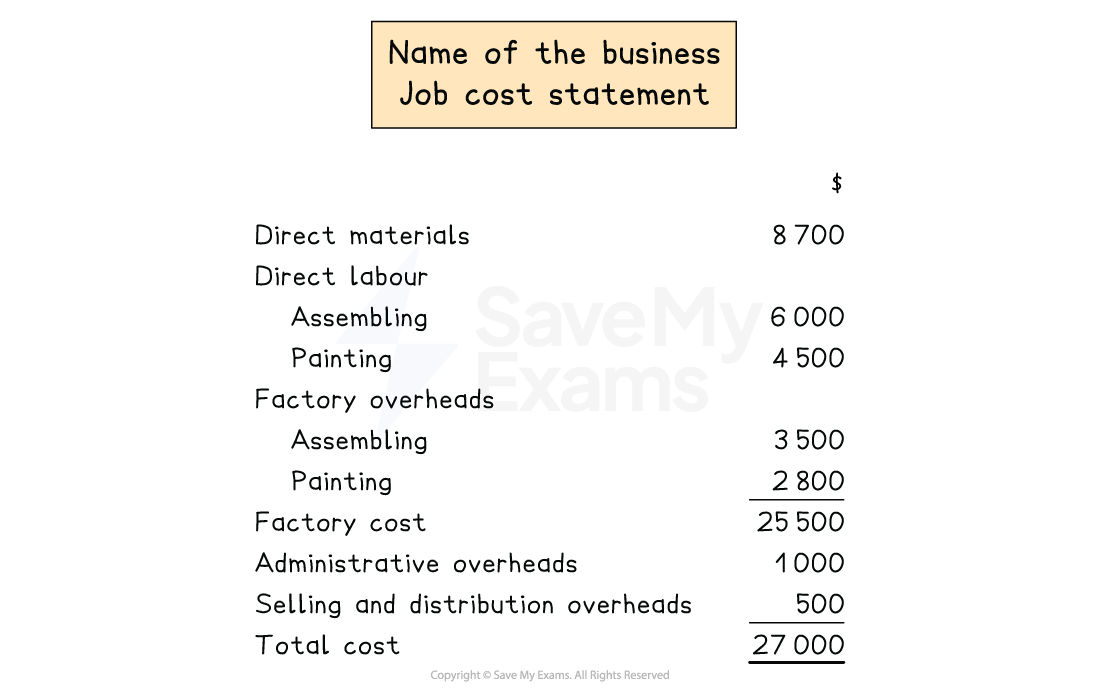
Example of a job cost statement
Exam Hint Most exam questions only include production costs. However, there has been a question where you needed to find the factory cost and then apply a percentage to it to find the selling and distribution overheads.
Worked Example Company Y produces boats. A customer places a special order for a custom boat.
The following budgeted data is available for the year ended 31 December 2024.
Direct materials $15 000 Direct labour Assembling $5 000 Painting $6 500 Overhead absorption rates $5.00 per labour hour
$4.50 per machine hoursOverheads - Assembling 500 labour hours
3 500 machine hoursOverheads - Painting 6 000 labour hours
250 machine hoursAdministrative overheads $500 Selling and distribution overheads $200 Prepare a job cost statement and calculate the total cost for the customer's order.
Answer:
Use machine hours for assembling department overheads
Use labour hours for painting department overheads
$ Direct materials 15 000 Direct labour Assembling 5 000 Painting 6 500 Overheads Assembling 3 500 × $4.50 15 750 Painting 6 000 × $5.00 30 000 Factory cost 72 250 Administrative overheads 500 Selling and distribution overheads 200 Total cost of job 72 950 Final answer: Cost of job is $72 950
Batch costing
Spec point — how to apply traditional costing methods to prepare costing statements using unit, job and batch costing principles in both manufacturing and service businesses as applicable
What is batch costing?
- Batch costing is where the cost of producing a batch of identical products is calculated
- It is used when products are produced in batches rather than individually or continuously
How can I prepare a cost statement using batch costing?
-
STEP 1 Determine the batch size
- Batch size = Total units produced in the batch
-
STEP 2 Calculate direct material cost
-
STEP 3 Calculate direct labour cost
-
STEP 4 Calculate factory overheads
-
STEP 5 Calculate total cost of batch
- Add total direct costs and factory overheads
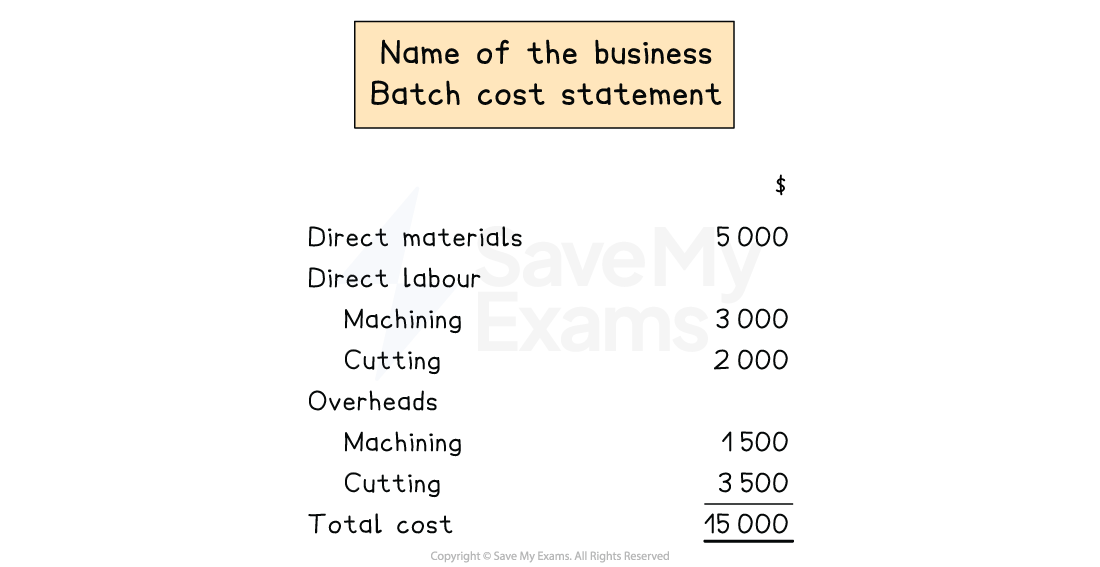
Example of a batch cost statement
Worked Example Company Z manufactures toys in batches.
The following budgeted data is available for the year ended 31 March 2023 for one batch.
Direct materials $20 000 Direct labour Assembling $15 000 Colouring $5 000 Overheads Assembling 2 000 labour hours
5 000 machine hoursColouring 3 000 labour hours
2 000 machine hoursOverhead absorption rates $3.00 per labour hour
$4.50 per machine hourCalculate the cost of the batch by preparing a batch cost statement.
Answer:
Use machine hours for assembling department overheads
Use labour hours for colouring department overheads
$ Direct materials 20 000 Direct labour Assembling 15 000 Colouring 5 000 Overheads Assembling 5 000 × $4.50 22 500 Colouring 3 000 × $3.00 9 000 Total cost 71 500 Final answer: Cost of the batch is $71 500
Was this revision note helpful?
Build on this topic