Revaluation Method of Depreciation (Cambridge International A-Level Accounting)
Revaluation depreciation
Spec point — how to measure the value of non-current assets by the cost model or the revaluation model
What is the revaluation method of depreciation?
-
The revaluation method of depreciation involves performing a valuation of assets at the end of the financial year to determine the reduction in value
-
This method is commonly used for assets of smaller value
- Such as loose tools, packing cases
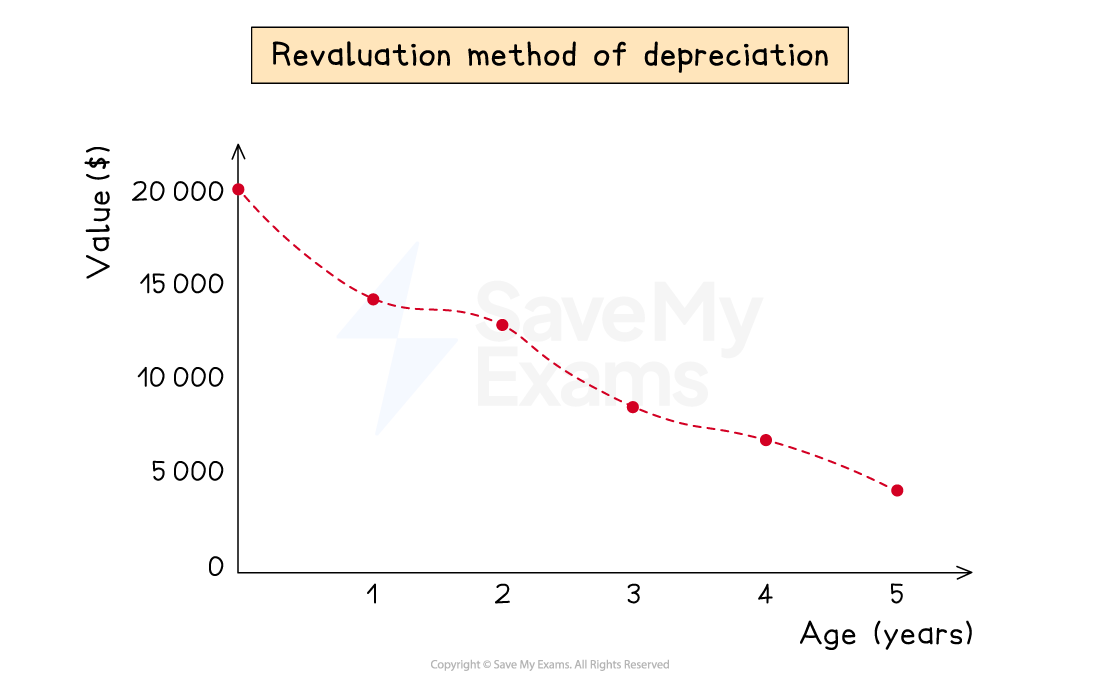
Example of an asset, which cost $20 000, being charged depreciation using the revaluation method each year
How do I calculate depreciation using the revaluation method?
-
A revaluation of the non-current asset will be given in the question
-
To calculate the depreciation charge for the year:
- start with the value at the start of the year
- add any purchases of that type of non-current asset
- subtract the revaluation amount at the end of the year
Worked Example Abi's loose tools were values at $5 000 on 1 March 2023. On 1 August 2023, Abi purchased additional loose tools costing $1 500.
On 29 February 2024, at the end of the financial year, the fixtures and fittings were valued at $4 650.
Calculate the depreciation charged for the financial year ending on 29 February 2024.
Answer:
Value at the start of the year is $5 000
Purchases during the year totalled $1 500
Value after the revaluation is $4 650
Calculate the depreciation charge
- Add the purchases to the starting value
- Subtract the revaluation
$5 000 + $1 500 - $4 650 = $1 850
Was this revision note helpful?